How to lose fat without losing muscle
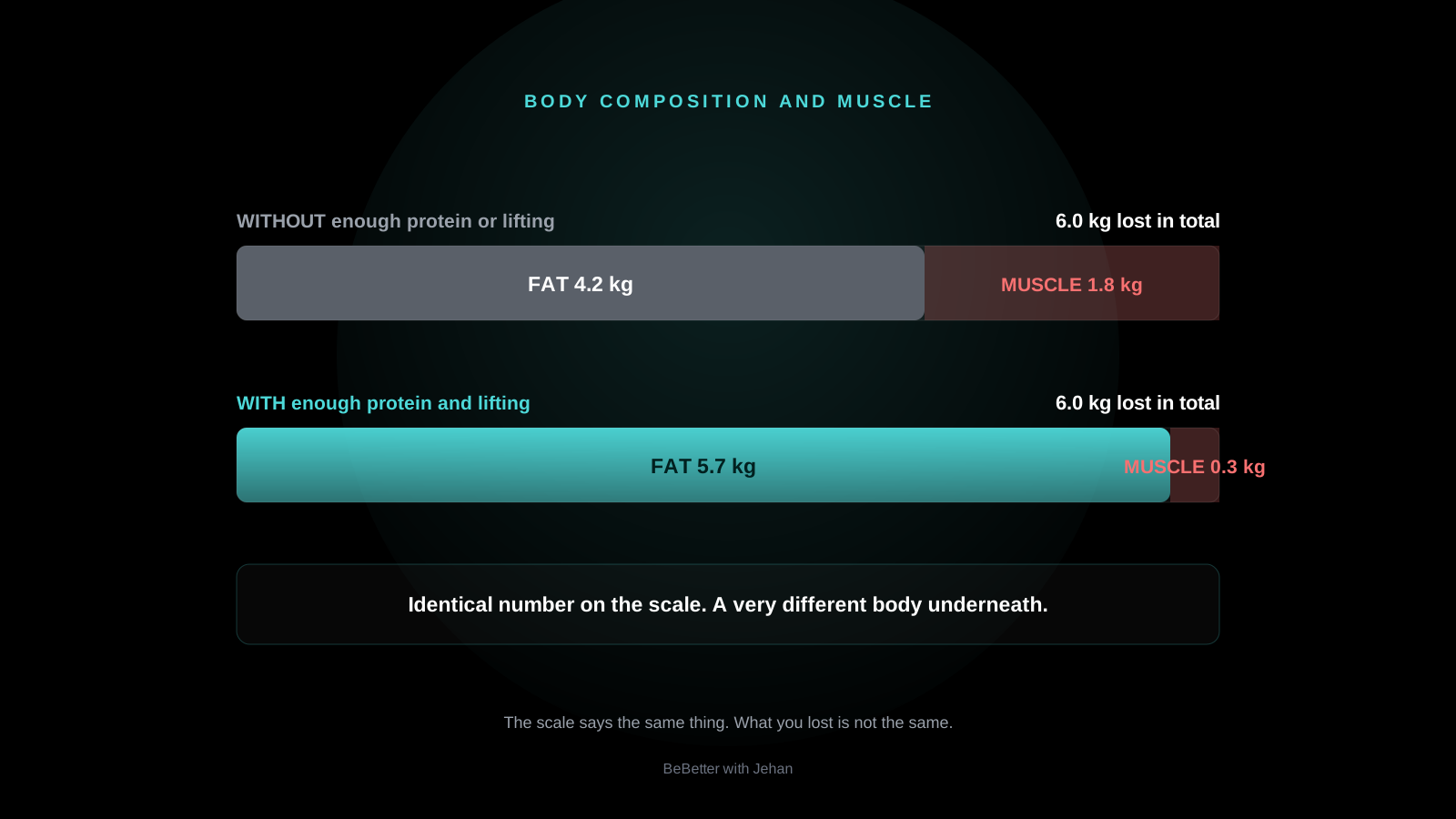
Almost everyone who tells me they lost weight and still did not like how they looked made the same three mistakes. They are all avoidable.

Three variables decide whether weight lost comes from fat or muscle: protein at 1.6 to 2.2 g per kg of bodyweight, resistance training two or more times a week, and a rate of loss around 0.5 to 1 percent of bodyweight per week.
Get all three right and most people lose almost entirely fat. Miss any one and a meaningful share of the loss comes from lean tissue, which is why some people reach their goal weight and still dislike the result.
- Set protein at 1.6 to 2.2 g per kg of bodyweight and hold it.
- Train with resistance at least twice a week and keep progressing it.
- Target 0.5 to 1 percent of bodyweight lost per week, no faster.
- Track strength alongside weight. Strength holding is your best evidence muscle is intact.
- Measure your waist weekly. It often moves when the scale does not.
Why the scale hides the problem
Bodyweight is a single number covering several tissues. Two people can lose an identical six kilograms and end up looking completely different, because the composition of that loss differed.
This is the mechanism behind the most deflating outcome in fat loss: reaching your target weight and being disappointed. Nothing went wrong with the arithmetic. You lost the weight. A large share of it simply was not fat.
Lean mass is everything that is not fat: muscle, organs, bone, and body water. When a deficit is too aggressive or protein is too low, a meaningful portion of the weight you lose comes from this compartment rather than from fat.
The practical consequence is that you should stop treating bodyweight as the outcome and start treating it as one input among several. The body recomposition guide covers the case where the scale barely moves at all while the body changes substantially.
Variable one: protein
Protein is the most important of the three, and the one most often got wrong in the wrong direction. Requirements rise in a deficit, they do not fall.
Longland and colleagues ran a randomised trial that isolates this well. Participants were placed in a substantial energy deficit with intense exercise, and the only meaningful difference between groups was protein intake. The higher protein group gained lean mass and lost more fat; the lower protein group did not (Longland et al., 2016).
| Bodyweight | 1.6 g/kg | 2.0 g/kg | Per meal across 4 meals |
|---|---|---|---|
| 60 kg | 96 g | 120 g | 24 to 30 g |
| 70 kg | 112 g | 140 g | 28 to 35 g |
| 80 kg | 128 g | 160 g | 32 to 40 g |
| 90 kg | 144 g | 180 g | 36 to 45 g |
| 100 kg | 160 g | 200 g | 40 to 50 g |
If you eat vegetarian, this is the variable that needs the most planning. The guide to hitting protein on an Indian vegetarian diet covers the practical side. The full evidence behind the number is in the main protein guide.
Variable two: resistance training
Protein supplies the raw material. Resistance training supplies the reason.
Muscle is metabolically expensive tissue. In an energy deficit, a body with no demand placed on its muscle has every reason to reduce it. Training is the signal that says this tissue is still in use.
The requirements are modest and well within reach of a busy schedule:
- At least twice a week, covering the whole body. Two sessions is genuinely enough to protect muscle, though more is better for building it.
- Sets taken reasonably close to failure, roughly one to three reps in reserve. Covered in the guide on training to failure.
- Progression over time, which is the actual mechanism. See progressive overload explained.
A common and costly error is dropping training weight during a cut because you feel weaker. Maintaining load is one of the strongest signals available that the muscle should be kept. If you must reduce something, reduce volume before you reduce load.
Coach's perspective
The pattern I see repeatedly is someone who did cardio for twelve weeks, ate very little, lost eight kilograms and is unhappy with the result. They did not fail at fat loss. They succeeded at weight loss, which is a different thing.
The uncomfortable part is that this is largely irreversible in the short term. Rebuilding lost muscle takes considerably longer than losing it did. That is why the three variables are worth getting right from week one rather than fixing later.
Variable three: rate of loss
Even with protein and training handled, an aggressive deficit shifts the balance.
Garthe and colleagues compared two rates of weight loss in elite athletes. The slower rate, around 0.7 percent of bodyweight per week, preserved and in some cases increased lean mass and strength. The faster rate did not (Garthe et al., 2011).
| Bodyweight | 0.5 percent per week | 1.0 percent per week |
|---|---|---|
| 60 kg | 0.3 kg | 0.6 kg |
| 70 kg | 0.35 kg | 0.7 kg |
| 80 kg | 0.4 kg | 0.8 kg |
| 90 kg | 0.45 kg | 0.9 kg |
| 100 kg | 0.5 kg | 1.0 kg |
Those numbers look small on a weekly basis and substantial across twelve weeks. An 80 kg person losing 0.6 kg a week is down roughly 7 kg after twelve weeks, with strength intact. That is a far better outcome than 10 kg lost with three of it from muscle.
How to set the deficit that produces this rate is covered in how to calculate a calorie deficit safely.
How to tell if it is working
| Signal | Good | Warning |
|---|---|---|
| Strength in the gym | Holding or climbing | Falling for three weeks straight |
| Waist measurement | Reducing weekly | Static while weight drops fast |
| Rate of weight loss | 0.5 to 1 percent per week | Above 1 percent consistently |
| Photos every four weeks | Shape changing | Smaller but softer looking |
| Energy and sleep | Stable | Persistently poor, often a sign the deficit is too large |
Strength is the most practical early-warning system you have. In a well-run deficit it should hold or continue climbing for most of a twelve week block. A consistent, multi-week decline in strength while eating in a deficit is the clearest signal that the deficit is too large, protein too low, or both.
Where cardio fits
Cardio is not the enemy here, and the common advice to avoid it during a cut is overstated.
Moderate cardio alongside resistance training does not meaningfully compromise muscle retention, and it is a useful way to increase energy expenditure without cutting food further. Adding daily steps is often the least disruptive lever available.
The genuine risk case is a large volume of endurance training combined with an aggressive deficit and inadequate protein. That combination does compromise muscle. One or two moderate sessions a week alongside lifting does not.
- Protein at 1.6 to 2.2 g per kg is the single most important variable, and requirements rise in a deficit.
- Resistance training at least twice weekly gives your body a reason to keep the muscle.
- Target 0.5 to 1 percent of bodyweight lost per week.
- Strength holding across a deficit is your best practical evidence that muscle is intact.
- Track waist and photos alongside weight, since the scale alone hides composition.
- Moderate cardio is fine. Very high endurance volume plus a large deficit plus low protein is not.
Myth versus fact
| Common claim | What the evidence says |
|---|---|
| “You cannot lose fat and keep muscle at the same time.” | You can retain essentially all of it, and beginners or returners often gain some. It requires protein, training and a moderate deficit. |
| “Eat less protein when cutting calories.” | The opposite. Protein needs rise in a deficit because it protects lean tissue when energy is scarce. |
| “Cardio burns muscle.” | Moderate cardio alongside lifting does not meaningfully compromise muscle. Volume, deficit size and protein together determine the risk. |
| “Lift lighter and do higher reps to get lean.” | Rep range does not determine fatness. Maintaining load during a deficit is one of the strongest signals to retain muscle. |
| “If the scale is dropping quickly it is working.” | Rapid loss usually means a larger share is coming from lean tissue and water, which produces a worse visible outcome. |
The mistakes I see most
1. Cutting protein along with calories
The most damaging single error. Protein should be the last macronutrient you reduce, not the first.
2. Replacing lifting with cardio during a cut
Removes the signal telling your body to keep muscle, precisely when that signal matters most.
3. Dropping training weight because you feel weaker
Maintaining load protects muscle. Reduce volume before you reduce load.
4. Running too large a deficit
Faster scale movement, worse composition, and much harder to sustain for twelve weeks.
5. Judging progress by bodyweight alone
It cannot distinguish fat from muscle. Track strength, waist and photos alongside it.
6. Ignoring sleep
Short sleep shifts the composition of weight lost. Covered in the guide on sleep and fat loss.
Your practical checklist
- Calculate your protein target at 1.6 to 2.2 g per kg and write it down.
- Set your deficit to produce 0.5 to 1 percent bodyweight loss per week.
- Schedule at least two full body resistance sessions every week.
- Record every training session so you can see whether strength is holding.
- Measure your waist weekly at the same time of day.
- Take photos at weeks 1, 4, 8 and 12.
- Review at week four: if strength is falling, reduce the deficit before anything else.
- Protect sleep. It changes the composition of what you lose.
Research summary
Longland and colleagues (2016) is the strongest single piece of evidence here. It is a randomised controlled trial that isolated protein intake while holding the deficit and training constant, which is exactly the design needed to answer this question. Its limitation is that the deficit used was large and the training highly structured and supervised, so the magnitude of effect in a general population is likely smaller.
Garthe and colleagues (2011) supports the rate-of-loss guidance. Its population was elite athletes training and eating under supervision, which differs meaningfully from a working professional managing this alone.
What is less certain than it sounds. The specific claim that you can lose fat while gaining muscle applies far more reliably to beginners, returners and people carrying more body fat than to lean trained individuals. The 0.5 to 1 percent figure is a well-reasoned convention rather than a precisely isolated finding in general populations. And most of this literature runs eight to sixteen weeks, so long-term data on muscle retention across repeated dieting cycles is genuinely thin.
Three variables, held steady for twelve weeks.
The difficulty is not knowing that protein, training and a moderate deficit matter. It is holding all three together through a work trip, a bad week and a plateau. The Nutrition Plan and Training Plan inside the Fitness Blueprint are built from your own numbers to do exactly that, and your Progress Dashboard tracks weight, strength and adherence together so you can see composition changing rather than guessing.
DM ‘BLUEPRINT’ to get startedThe Fitness Blueprint is ₹14,999 at present, reduced from a recommended price of ₹24,999. Flexible payment over 3 or 6 months can be arranged. See what is included.
Curious exactly what is included and what it costs? See the full pricing breakdown. Still deciding, or have a specific question first? Get in touch and I will answer honestly.
Frequently asked questions
Can you lose fat without losing any muscle?
In most cases you can lose fat while retaining essentially all your muscle, and beginners or returners can often gain some. It requires adequate protein, resistance training and a moderate rate of loss.
How much protein do I need to protect muscle?
1.6 to 2.2 g per kg of bodyweight per day. Requirements sit at the higher end when you are in a deficit, not lower.
How fast can I lose fat without losing muscle?
Roughly 0.5 to 1 percent of bodyweight per week. Faster than that and the share of weight lost as lean tissue tends to rise.
Do I need to lift heavy to keep muscle?
You need to train with resistance and progress it. Load can vary considerably; what matters is that sets are taken reasonably close to failure and get harder over time.
Will cardio make me lose muscle?
Moderate cardio alongside resistance training does not meaningfully compromise muscle. Very high volumes of endurance work combined with a large deficit and low protein can.
How do I know if I am losing muscle?
Strength falling consistently over three or more weeks in a deficit is the most practical warning sign. Waist reducing while strength holds is the pattern you want.
References
- Longland TM, Oikawa SY, Mitchell CJ, Devries MC, Phillips SM. Higher compared with lower dietary protein during an energy deficit combined with intense exercise promotes greater lean mass gain and fat mass loss: a randomized trial. American Journal of Clinical Nutrition. 2016;103(3):738-746. PubMed
- Garthe I, Raastad T, Refsnes PE, Koivisto A, Sundgot-Borgen J. Effect of two different weight-loss rates on body composition and strength and power-related performance in elite athletes. International Journal of Sport Nutrition and Exercise Metabolism. 2011;21(2):97-104. PubMed
- Morton RW, Murphy KT, McKellar SR, et al. A systematic review, meta-analysis and meta-regression of the effect of protein supplementation on resistance training-induced gains in muscle mass and strength in healthy adults. British Journal of Sports Medicine. 2018;52(6):376-384. PubMed
- Helms ER, Aragon AA, Fitschen PJ. Evidence-based recommendations for natural bodybuilding contest preparation: nutrition and supplementation. Journal of the International Society of Sports Nutrition. 2014;11:20. PubMed
A note on medical advice. This article is educational and reflects the research as I read it. It is not medical or dietetic advice and it cannot account for your individual circumstances. If you are managing a medical condition, are pregnant, are taking medication affected by diet or activity, or are recovering from injury, please speak to your doctor or a registered dietitian first. If anything here conflicts with advice from your own clinician, follow theirs.
Questions about applying any of this? Message me directly or find me on Instagram. Back to the Knowledge Hub or the homepage. You can also read more about how I coach, see what the Fitness Blueprint costs, or get in touch.