Body recomposition: can you lose fat and build muscle at the same time?
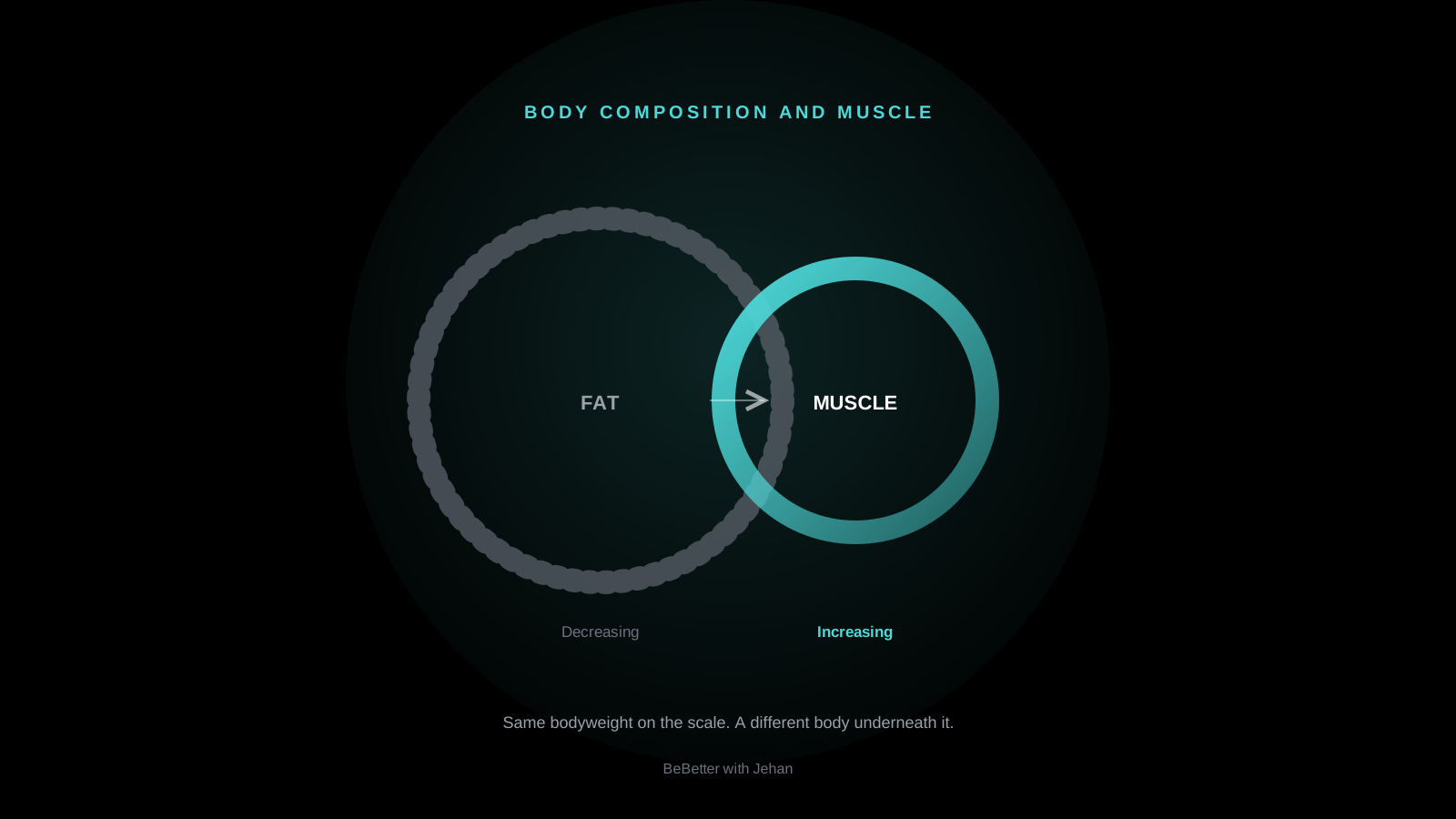
The short answer is yes, but it works far better for some people than others. This is an honest look at who recomposition suits, how long it takes, and the four conditions that need to be in place before it happens at all.


Yes, you can lose fat and build muscle at the same time. This is called body recomposition, and it is best documented in people who are new to training, returning after a break, or carrying higher body fat. It requires adequate protein, consistent resistance training, and a small calorie deficit or maintenance intake rather than an aggressive diet.
The trade-off is speed. Recomposition is slower than a dedicated fat loss phase or a dedicated muscle building phase. For lean, well-trained lifters it becomes very slow indeed, and a sequential approach usually makes more sense.
- Recomposition is real, and most achievable if you are a beginner, a returner, or carrying higher body fat.
- Set protein at 1.6 to 2.2 g per kg of bodyweight and treat it as non-negotiable.
- Lift weights at least twice a week, training each muscle group across the week.
- Sit at maintenance calories or a small deficit of roughly 10 to 20 percent, not an aggressive one.
- Judge progress on waist measurements, strength and photos across a month, not on the scale week to week.
What body recomposition actually means
Most fitness advice assumes you must pick a direction. Either you eat more than you burn and build muscle while accepting some fat gain, or you eat less than you burn and lose fat while trying to hold onto the muscle you have. Bulk or cut, in the usual language.
Body recomposition rejects that binary. The goal is to reduce fat mass and increase muscle mass over the same period, which means your bodyweight may barely change while your body looks and performs quite differently.
Body recomposition is the simultaneous reduction of fat mass and increase of lean muscle mass over the same training period. Because the two changes partly offset each other on the scale, recomposition is measured by changes in body composition, girth measurements and performance rather than by bodyweight alone.
This is why recomposition frustrates so many people. It is the one goal where the scale is close to useless as a week-to-week measure. If you lose a kilogram of fat and gain a kilogram of muscle in a month, the number has not moved and it would be easy to conclude nothing happened. In reality quite a lot happened.
For the working professionals I coach, recomposition is usually the honest description of what they actually want. Very few people come to me asking to weigh less in the abstract. They want to look leaner, feel stronger, and fit their clothes better. That is a composition goal, not a weight goal.
Is it really possible, or just marketing?
It is genuinely possible, and the evidence for it is reasonably good.
The most useful single reference is a review by Barakat and colleagues in the Strength and Conditioning Journal, which examined whether trained individuals can build muscle and lose fat concurrently. Their conclusion was that recomposition is well documented in untrained individuals, people with higher body fat, and those returning to training after a layoff, and that it remains possible in trained lifters but proceeds more slowly and requires more precise conditions (Barakat et al., 2020).
The most striking single trial is the one I referenced in my guide to protein intake. Longland and colleagues put two groups of men through four weeks of a substantial calorie deficit with hard resistance and interval training. The group eating 2.4 g of protein per kg gained lean mass while losing more fat than the lower protein group (Longland et al., 2016).
That is recomposition happening in a deficit, under supervision, in four weeks. It is worth being clear about the limitations though. The participants were young men, the setting was controlled, the training was demanding, and the study was short. It proves the effect exists. It does not tell you how much of it a 36 year old with two young children and a travel schedule should expect.
Coach's perspective
The way I explain this to clients is that your body is always doing two accounting exercises at once, one for fat and one for muscle. A calorie deficit pushes the fat account down. Resistance training and protein push the muscle account up. Those two pressures can operate at the same time, they just compete for resources.
The more untrained you are, the more responsive the muscle account is, so both can move meaningfully. The leaner and more trained you become, the more the two fight each other, and at that point picking one direction at a time gets you further.
Who it works best for
This is the part most articles skip, and it is the part that actually determines whether you should try.
| Starting point | How well recomposition works | Best approach |
|---|---|---|
| Complete beginner | Very well. Untrained muscle is highly responsive, so meaningful muscle gain alongside fat loss is realistic. | Maintenance calories or a small deficit. Focus on learning the movements and progressing load. |
| Higher body fat | Very well. Ample stored energy means the body is more willing to build muscle while in a deficit. | A moderate deficit of 15 to 20 percent works, with protein high. |
| Returning after a break | Well. Previously trained muscle is regained faster than it was originally built. | Small deficit or maintenance. Rebuild volume gradually rather than starting where you left off. |
| Trained and moderately lean | Slowly. Possible but the margins are thin and progress is hard to detect month to month. | Maintenance calories, high protein, patient progression. Expect small changes. |
| Trained and already lean | Poorly. The two goals conflict too directly at low body fat. | Sequential phases. Build in a small surplus, then diet in a controlled deficit. |
Read that table honestly and you will see why recomposition is such a good fit for most working professionals who come to coaching. The typical person contacting me has trained inconsistently for years, carries more body fat than they would like, and has not followed a structured programme with progressive overload. That is close to the ideal recomposition profile.
The four conditions it depends on
Recomposition is not something you opt into by intention. It happens when four things are true at once. Miss any of them and you will simply lose weight, or gain weight, rather than changing composition.
1. Protein high enough to support muscle growth in a deficit
This is the condition people fail most often. In a deficit your body needs more protein, not less, to hold and build tissue. Aim for 1.6 to 2.2 g per kg of bodyweight. The Longland trial used 2.4 g per kg and that is where the lean mass gain appeared. My protein guide covers exactly how to hit this, including on a vegetarian diet.
2. Resistance training with genuine progression
Muscle grows in response to a demand it has not previously met. That means the load, reps or quality of your sets has to increase over time. Doing the same three sets of ten with the same weight for twelve weeks provides no new stimulus, and no amount of protein compensates for that. My guide on how many days a week to train explains the minimum frequency this requires.
3. A modest deficit, or maintenance
This is where enthusiasm does the most damage. An aggressive deficit accelerates fat loss but makes muscle gain almost impossible and increases the share of weight lost as lean tissue. Garthe and colleagues compared two rates of weight loss in athletes and found the slower rate, around 0.7 percent of bodyweight per week, preserved and even increased lean mass and strength, whereas the faster rate did not (Garthe et al., 2011). For recomposition specifically, maintenance calories or a deficit of roughly 10 to 20 percent is the working range.
4. Sleep and recovery that actually support it
This gets treated as optional and it is not. Nedeltcheva and colleagues put participants in an identical calorie deficit and varied only their sleep. At 5.5 hours per night rather than 8.5, fat loss fell by around 55 percent and lean mass loss rose by around 60 percent, despite total weight loss being the same (Nedeltcheva et al., 2010). That study was small, with ten participants, so treat the exact percentages cautiously. The direction, however, is consistent with the wider literature and it points at exactly the wrong outcome for recomposition.
- Body recomposition means losing fat and gaining muscle over the same period, so bodyweight may barely change.
- It is best documented in beginners, returners and people with higher body fat, and is slow in lean trained lifters.
- Four conditions are required: high protein, progressive resistance training, a modest deficit or maintenance, and adequate sleep.
- Aggressive dieting defeats the purpose. A deficit of roughly 10 to 20 percent is the working range.
- Track waist measurements, strength and photos across a month. The weekly scale reading will mislead you.
How long it takes and what to expect
Recomposition operates on a timescale that tests most people's patience, so it helps to set expectations before you start rather than three weeks in.
In practice, a beginner or returner doing this properly might expect to lose somewhere in the region of 0.25 to 0.5 percent of bodyweight per week on the scale, while their waist reduces faster than that number suggests and their lifts climb steadily. Over twelve weeks that can produce a visible change even if the scale has only moved a few kilograms.
For someone already trained and reasonably lean, twelve weeks of recomposition might produce changes small enough that only measurements and photographs reveal them. That is not failure. It is simply what the process looks like at that stage, and it is a reasonable argument for choosing sequential phases instead.
The honest position is that nobody can tell you your rate in advance. Training history, genetics, age, sleep, stress and adherence all move the number, and the research gives us ranges rather than individual predictions. What you can do is set the four conditions correctly, measure properly, and read the trend across three to four weeks rather than reacting to any single data point.
Why the scale will mislead you
If you take one practical thing from this article, take this. Recomposition is the goal where relying on bodyweight will actively cause you to quit something that is working.
Bodyweight fluctuates by one to two kilograms day to day from water, sodium, carbohydrate intake, digestion and, for women, menstrual cycle phase. Layer a slow composition change underneath that noise and the signal becomes almost invisible in any given week.
Four measures together give you a far clearer picture:
- Waist circumference. The single most useful tape measurement for fat loss. Measured consistently, first thing, same place, it tracks fat change better than the scale.
- Strength trend. If your working weights or reps are climbing while your waist is shrinking, recomposition is almost certainly happening.
- Photographs. Same lighting, same position, same time of day, once every four weeks. Change you cannot perceive daily becomes obvious across a month.
- Bodyweight as a three-week average. Useful as a trend, close to meaningless as a single reading.
This is precisely why the Progress Dashboard inside the Fitness Blueprint tracks optional body measurements alongside weight, adherence and strength trends, and why it reads three-week averages rather than reacting to a single weigh-in. When the scale stalls but your waist keeps dropping, you need something that can tell you the difference.
Myth versus fact
| Common claim | What the evidence says |
|---|---|
| “Recomposition is impossible, you have to bulk or cut.” | Incorrect. It is well documented, particularly in beginners, returners and those with higher body fat. What is true is that it becomes inefficient for lean, trained lifters. |
| “You need to be in a surplus to build any muscle.” | Not always. A surplus makes muscle gain easier and faster, but muscle gain in a deficit has been demonstrated when protein is high and training is progressive. |
| “If the scale is not moving, nothing is happening.” | This is the most costly misreading in recomposition. Simultaneous fat loss and muscle gain can hold weight steady while composition changes substantially. |
| “Cardio will undo your muscle gains.” | Moderate cardio does not meaningfully impair muscle growth. Interference depends on modality, volume and how much you do, and cycling appears gentler than high-volume running. |
| “You can turn fat into muscle.” | No. They are different tissues and one does not convert into the other. You are losing one and building the other in parallel, which simply looks like conversion. |
The mistakes that stall it
1. Running too large a deficit
The instinct is to accelerate fat loss. The effect is to shut down the muscle side of the equation and increase lean tissue loss. If you are recomposing, restraint is the strategy.
2. Judging the plan on weekly bodyweight
Recomposition holds weight steady by design. Reacting to a flat scale by cutting calories further is the single most common way people break a working plan.
3. Changing the training programme constantly
Progression requires repetition. If the exercises change every few weeks you cannot tell whether you are getting stronger, and neither can your body.
4. Treating protein as a target to hit sometimes
Recomposition has a tighter protein requirement than either bulking or cutting, because you are asking for muscle gain without an energy surplus to fund it.
5. Ignoring sleep and calling it discipline
The evidence suggests inadequate sleep shifts weight loss towards lean tissue and away from fat, which is the exact opposite of what you are trying to achieve.
6. Expecting a visible change in four weeks
Twelve weeks is a realistic window to see something meaningful. Four weeks mostly tells you whether the process is set up correctly.
Your practical checklist
- Decide honestly which starting point in the table above describes you.
- If you are lean and well trained, consider sequential phases instead of recomposition.
- Set protein at 1.6 to 2.2 g per kg and plan your meals around hitting it.
- Choose a training structure you can repeat for twelve weeks, and progress load or reps deliberately.
- Set calories at maintenance or a deficit of no more than about 20 percent.
- Protect seven hours of sleep or more, and treat it as part of the programme.
- Measure your waist weekly and take photographs every four weeks.
- Review the trend every three to four weeks, not every Monday morning.
Research summary
Recomposition sits on reasonable but not overwhelming evidence, and it is worth understanding the shape of it.
Barakat and colleagues (2020) is a narrative review rather than a meta-analysis, which means it synthesises the literature and offers expert interpretation rather than pooling data statistically. It is the best available overview of who recomposition works for, and its conclusions are appropriately hedged.
Longland and colleagues (2016) is a randomised controlled trial and therefore stronger evidence for causation, but it is small, four weeks long, used a severe deficit and demanding training, and studied young men. Directionally convincing, not directly generalisable.
Garthe and colleagues (2011) studied elite athletes, so the population differs from a general audience, but the finding that slower weight loss better preserves lean mass aligns with the wider literature and with practical coaching experience.
Nedeltcheva and colleagues (2010) is a crossover trial with only ten participants. The percentages are frequently quoted with more confidence than a sample that size supports. Treat it as a strong signal about direction rather than a precise effect size.
What none of this tells us is how much muscle a specific person will gain while losing a specific amount of fat. The ranges are wide, individual variation is large, and anyone offering you a precise projection is guessing. The value of the research is in telling you what conditions make it possible, not in predicting your result.
Recomposition is mostly a setup problem.
Getting the four conditions right at the same time, and then holding them for twelve weeks, is where this succeeds or fails. That is what the Fitness Blueprint is built to do. Your Nutrition Plan sets protein and calories from your own numbers rather than a generic calculator, your Training Plan holds one structure for twelve weeks so progression actually accumulates, and your Progress Dashboard tracks waist measurements and strength trends alongside weight so a flat scale never fools you into abandoning something that is working.
DM ‘BLUEPRINT’ to get startedFor the deficit side of this specifically, see how to calculate a calorie deficit safely, and for a realistic sense of pacing, how long results actually take.
If your goal is fat loss specifically rather than recomposition, how to lose fat without losing muscle covers the three variables that decide the outcome.
Curious exactly what is included and what it costs? See the full pricing breakdown. Still deciding, or have a specific question first? Get in touch and I will answer honestly.
Frequently asked questions
How long does body recomposition take?
Expect twelve weeks to see something meaningful, and longer for a substantial change. Beginners and returners see it faster. Lean, trained lifters may need six months or more to see a difference that photographs reveal clearly.
Can you recomp at maintenance calories?
Yes, and for many people maintenance is the better choice. It removes the energy conflict that a deficit creates, so muscle gain becomes easier while fat loss still occurs through improved training and higher protein. Progress on the scale will be close to flat, which is expected.
Do I need to count calories to recomp?
You need to control them, which is not quite the same thing. Tracking for a few weeks teaches you what your intake actually is, and most people are surprised. After that, many manage well with consistent meal structures rather than daily logging.
Is recomposition better than bulking and cutting?
It depends entirely on your starting point. For a beginner or someone with higher body fat, recomposition is usually the better and more sustainable choice. For a lean, experienced lifter, separate building and cutting phases will typically produce more progress in the same time.
Will I look worse before I look better?
Generally no, which is one of recomposition's genuine advantages over a traditional bulk. Because you are not intentionally gaining fat, the direction of travel tends to be steadily positive rather than a temporary decline followed by a recovery.
Can women recomp as effectively as men?
Yes. The same principles apply, and the same starting-point logic determines how quickly it happens. Absolute rates of muscle gain are generally lower in women due to hormonal differences, but relative progress and the practical approach are comparable.
What if my weight goes up while recomposing?
If your waist is stable or shrinking and your lifts are improving, a small increase in bodyweight is likely muscle and water rather than fat, and is not a problem. If your waist is also increasing, your calories are too high and need adjusting.
References
- Barakat C, Pearson J, Escalante G, Campbell B, De Souza EO. Body Recomposition: Can Trained Individuals Build Muscle and Lose Fat at the Same Time? Strength and Conditioning Journal. 2020;42(5):7-21. Journal
- Longland TM, Oikawa SY, Mitchell CJ, Devries MC, Phillips SM. Higher compared with lower dietary protein during an energy deficit combined with intense exercise promotes greater lean mass gain and fat mass loss: a randomized trial. American Journal of Clinical Nutrition. 2016;103(3):738-746. PubMed
- Garthe I, Raastad T, Refsnes PE, Koivisto A, Sundgot-Borgen J. Effect of two different weight-loss rates on body composition and strength and power-related performance in elite athletes. International Journal of Sport Nutrition and Exercise Metabolism. 2011;21(2):97-104. PubMed
- Nedeltcheva AV, Kilkus JM, Imperial J, Schoeller DA, Penev PD. Insufficient sleep undermines dietary efforts to reduce adiposity. Annals of Internal Medicine. 2010;153(7):435-441. PubMed
- Jäger R, Kerksick CM, Campbell BI, et al. International Society of Sports Nutrition Position Stand: protein and exercise. Journal of the International Society of Sports Nutrition. 2017;14:20. PubMed
- Morton RW, Murphy KT, McKellar SR, et al. A systematic review, meta-analysis and meta-regression of the effect of protein supplementation on resistance training-induced gains in muscle mass and strength in healthy adults. British Journal of Sports Medicine. 2018;52(6):376-384. PubMed
A note on medical advice. This article is educational and reflects the current research as I read it. It is not medical advice and it cannot account for your individual circumstances. If you are managing an injury or a medical condition, are pregnant, or are unsure whether an exercise is appropriate for you, please speak to your doctor or a qualified physiotherapist first. If something here conflicts with advice from your own clinician, follow theirs.
Questions about applying any of this? Message me directly or find me on Instagram. Back to the Knowledge Hub or the homepage. You can also read more about how I coach, see what the Fitness Blueprint costs, or get in touch.