How many days a week do you really need to train?
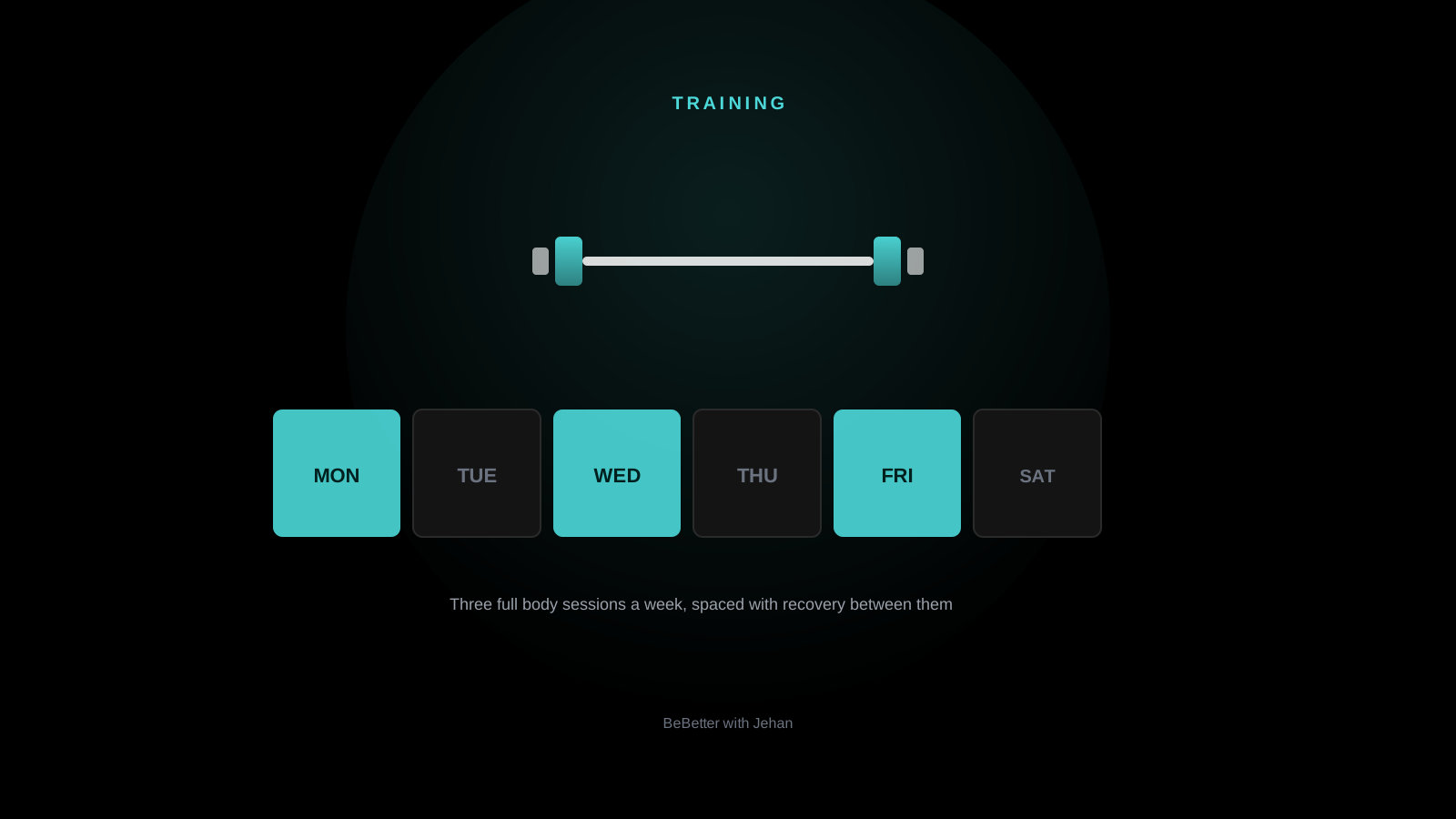
Almost certainly fewer than you have been told. Here is what the frequency and volume research actually shows, and how to build a genuinely effective week around two, three or four sessions.

Two to four resistance training sessions per week is enough for almost everyone who is not competing. What matters more than the number of days is that each muscle group is trained at least twice across the week and that you progress the load or reps over time.
Three sessions is the sweet spot for most working professionals. It allows every muscle group to be trained twice weekly, leaves recovery days between sessions, and survives a week where one day gets lost to work.
- Train two to four times a week. Three is the best default for most working professionals.
- Make sure each muscle group gets trained at least twice across the week.
- With fewer days, use full body sessions rather than body part splits.
- Aim for roughly 10 or more hard sets per muscle group per week, built up gradually.
- Progress something every week. Reps first, then load. That is what actually drives change.
What the frequency research shows
There are two separate questions hiding inside "how often should I train". The first is how many times a week you go to the gym. The second is how often each individual muscle group gets worked. The research is clear that the second question is the one that matters.
Schoenfeld, Ogborn and Krieger conducted a systematic review and meta-analysis on training frequency and found that training a muscle group at least twice per week produced superior hypertrophy compared with once per week (Schoenfeld et al., 2016). This is the single most practically useful finding in the frequency literature, and it is the reason the traditional bodybuilding split, where you hit chest on Monday and do not touch it again for seven days, is a poor choice for someone training three days a week.
The follow-up work refined this considerably. In a later review of 25 studies, the same research group found that when weekly volume was equated, higher and lower frequencies produced similar results (Schoenfeld, Grgic and Krieger, 2019).
Training frequency refers to how often a given muscle group is trained within a week, not simply how many gym sessions you complete. Training three days a week with full body sessions gives every muscle group a frequency of three. Training five days a week on a body part split may give each muscle group a frequency of only one.
Put those two findings together and you arrive at something genuinely liberating for anyone with a full calendar. Frequency is a scheduling tool, not a magic lever. If you can accumulate the necessary weekly work across three sessions, you are not at a disadvantage against someone doing five. You simply need to organise the week differently.
Why volume matters more than days
If frequency is mostly about scheduling, what actually drives muscle growth? Primarily the total amount of hard work you do per muscle group per week, usually counted in sets.
Schoenfeld, Ogborn and Krieger examined this dose-response relationship across the literature and found a graded relationship: more weekly sets were associated with more muscle growth. Treated as a continuous variable, each additional weekly set was associated with a small but statistically significant increase in effect size (Schoenfeld et al., 2017).
You will often see this summarised as "you need at least ten sets per muscle per week". I want to be careful here, because that specific threshold comes from a categorical analysis in the same paper that only reached a non-significant trend. The honest reading is that more volume tends to produce more growth up to a point, and somewhere around ten or more hard sets per muscle group per week is a sensible target, without pretending that ten is a validated cut-off.
For practical purposes this is good news. Ten to fifteen hard sets per muscle group per week is entirely achievable across three well-structured full body sessions. It is also worth saying that beginners need considerably less than this to make excellent progress, and that jumping straight to high volume is a common way to accumulate fatigue and soreness without accelerating results.
Coach's perspective
The mistake I see most often is not people training too little. It is people designing a five day programme they can sustain for eleven days, falling off it, and concluding they lack discipline.
Whenever a client tells me they can train five days a week, I build four and ask them to treat the fifth as a bonus. A programme you complete is worth vastly more than a programme you admire. Almost every client I have coached who works full time has done better on three or four honest sessions than on an ambitious plan that collapsed by week three.
What the official guidelines say
It is worth checking your plan against the public health baseline, because the minimum is lower than most fitness content implies.
The World Health Organization's 2020 guidelines on physical activity, published in the British Journal of Sports Medicine, recommend that adults undertake muscle-strengthening activities involving all major muscle groups on two or more days per week, alongside 150 to 300 minutes of moderate intensity aerobic activity, or 75 to 150 minutes of vigorous activity, per week (Bull et al., 2020).
Two days is the health floor, not the optimum for body composition. But it establishes something important: if your realistic capacity right now is two sessions a week, that is a legitimate programme with genuine benefits, not a token effort. Starting there and adding a third session later is a far better plan than waiting for a mythical quieter period in which you will suddenly train five times a week.
Two, three and four day templates
The right structure depends on how many days you genuinely have. The principle in every case is the same: with fewer days, each session must cover more of the body.
| Days per week | Best structure | Weekly frequency per muscle | Best suited to |
|---|---|---|---|
| 2 days | Two full body sessions, ideally with three or four days between them. | Twice | Beginners, very demanding schedules, or a maintenance phase during a busy quarter. |
| 3 days | Three full body sessions, or an upper, lower, full body rotation. | Two to three times | Most working professionals. The best balance of results, recovery and realism. |
| 4 days | Upper and lower body split, each performed twice. | Twice | Those with a stable schedule who want more volume per muscle group and shorter sessions. |
| 5 or more days | Push, pull, legs rotations or similar. | Twice or more | Experienced lifters with genuinely reliable time. Rarely the right answer for a demanding job. |
What each session should contain
Regardless of how many days you train, the structure of a session is broadly consistent. Cover a horizontal or vertical push, a horizontal or vertical pull, a squat pattern, a hinge pattern, and something direct for the areas you care about most. Five to seven exercises is plenty. Sessions that run past ninety minutes are usually a sign of poor rest discipline rather than dedication.
This is precisely how the Training Plan inside the Fitness Blueprint is built. One weekly structure, held for twelve weeks, arranged around the days you actually told me you have, with a demonstration video attached to every movement so there is no guesswork about technique.
Do you have to train to failure?
No, and this matters enormously for anyone fitting training around a job.
Grgic and colleagues conducted a systematic review and meta-analysis comparing training to repetition failure with stopping short of it, and found no significant difference in strength or hypertrophy outcomes, including in analyses where volume was equated (Grgic et al., 2022). Refalo and colleagues later examined proximity to failure specifically and similarly found no evidence that training to momentary failure is superior for muscle growth (Refalo et al., 2023).
The practical implication is that finishing your sets with one or two reps still available gets you essentially the same result while generating less fatigue, reducing injury risk and leaving you able to train again sooner. I ask clients to finish main lifts with one to two reps in reserve for exactly this reason. Grinding to failure on every set is one of the fastest ways to make a three day programme feel like a five day one.
Does cardio interfere with muscle growth?
This worry causes people to skip cardio entirely, which is a mistake for both health and fat loss.
Wilson and colleagues conducted a meta-analysis on concurrent training and found that interference depends on modality, frequency and duration. Notably, running produced more interference with hypertrophy and strength than cycling did, and power was the quality most affected (Wilson et al., 2012). More recent work has generally found that interference on whole-muscle growth is small when cardio volume is sensible.
In practice, two or three moderate cardio sessions a week alongside resistance training will not compromise your results, and will help both your cardiovascular health and your energy balance. If you are particularly concerned, favour cycling, swimming or brisk incline walking over high-volume running, and keep hard cardio and hard lower body sessions on separate days where your schedule allows.
- Two to four resistance sessions per week is enough for almost everyone who is not competing.
- Training each muscle group at least twice a week beats training it once, when total volume is matched.
- When weekly volume is equated, higher frequency offers no additional advantage. Frequency is a scheduling tool.
- With fewer training days, use full body sessions rather than body part splits.
- You do not need to train to failure. Finishing with one to two reps in reserve produces similar results with less fatigue.
- Moderate cardio does not meaningfully impair muscle growth, particularly cycling and walking over high-volume running.
Myth versus fact
| Common claim | What the evidence says |
|---|---|
| “You need to train five or six days a week to see results.” | Incorrect for the vast majority of people. Two to four sessions, structured properly, produce excellent results. Frequency beyond that mainly serves to spread volume, not increase it. |
| “Every session must leave you sore or it was wasted.” | Soreness reflects novelty and damage, not growth. Well-trained muscles often stop getting sore while continuing to grow. Progression, not soreness, is the useful signal. |
| “You have to train to failure for muscle growth.” | Meta-analyses have found no significant advantage for training to failure over stopping short of it, for either strength or hypertrophy. |
| “Cardio kills your gains.” | Interference is real but modest and depends on modality and volume. Sensible amounts of cardio alongside lifting will not meaningfully compromise muscle growth. |
| “Body part splits are the best way to build muscle.” | They can work at high frequencies, but they are a poor choice on two or three days a week because each muscle group would only be trained once. |
| “Short sessions are not worth doing.” | A focused 40 minute session covering the main movement patterns is considerably better than the 90 minute session you skip. |
The mistakes that waste your sessions
1. Choosing a programme for the life you wish you had
The most common failure is designing around an idealised week. Build for your genuine worst week, then treat extra sessions as a bonus.
2. Using a body part split on three days a week
Doing chest one day, back another and legs the third means every muscle group is trained once weekly, which the evidence suggests is inferior to twice.
3. Changing the programme every few weeks
Progression requires repetition of the same movements so you can add load or reps. Constant variety makes progress impossible to measure.
4. Adding volume faster than you can recover
Jumping from six sets to twenty sets per muscle group produces fatigue rather than acceleration. Build volume gradually across weeks.
5. Treating a missed session as a failed week
Two sessions completed is a successful week when three were planned. The all-or-nothing response is what actually ends programmes.
6. Skipping cardio out of fear for your gains
The interference effect is far smaller than the health and fat loss benefits you forgo by avoiding cardio entirely.
Your practical checklist
- Decide how many days you can genuinely train in a difficult week, not an ideal one.
- If that number is two or three, choose full body sessions rather than a split.
- Check that every muscle group appears at least twice across your week.
- Cover a push, a pull, a squat pattern and a hinge pattern in each full body session.
- Start at a moderate volume and build towards roughly ten or more hard sets per muscle group weekly.
- Finish your main lifts with one to two reps still in reserve.
- Keep the same movements for at least eight to twelve weeks so you can progress them.
- Add two or three moderate cardio sessions without worrying about your gains.
Research summary
Training frequency and volume are among the better studied areas in exercise science, though the picture is still incomplete.
Schoenfeld and colleagues (2016) is a systematic review and meta-analysis, the strongest form of evidence available here. Its finding that twice weekly beats once weekly per muscle group is well replicated and forms the practical basis of most modern programme design.
Schoenfeld, Grgic and Krieger (2019) reviewed 25 studies and found no additional benefit to higher frequency once volume was equated. This is an important nuance and it is what allows a three day programme to compete with a five day one.
Schoenfeld and colleagues (2017) established the volume dose-response relationship. The continuous analysis reached statistical significance, but the widely quoted "ten sets" threshold came from a categorical analysis that only produced a non-significant trend, which is why I have phrased that recommendation as a sensible target rather than a validated requirement.
Grgic and colleagues (2022) and Refalo and colleagues (2023) both examined training to failure and both found no significant advantage. Two independent reviews reaching the same conclusion strengthens confidence considerably.
Wilson and colleagues (2012) is now over a decade old and more recent work has refined its conclusions, generally finding smaller interference effects than once assumed. Its modality-specific finding, that running interferes more than cycling, has held up reasonably well.
The main limitations across this literature are that most studies run for eight to twelve weeks, many use untrained or recreationally trained participants, and sample sizes are often modest. Long-term data in busy adults training around full-time work is essentially absent. What we have is enough to design sensibly, not enough to optimise precisely.
The right number of days is the number you will actually do.
Working out the structure is the easy part. Building it around your genuine schedule, your equipment and your experience level, then progressing it sensibly for twelve weeks, is where results come from. That is what the Fitness Blueprint does. Your Training Plan is built around the days you actually have, with every movement carrying a demonstration video and explicit rules for when to add reps and when to add load. Your Progress Dashboard then tracks whether it is working, and tells you what to adjust.
DM ‘BLUEPRINT’ to get startedThe mechanism that makes those sessions work is covered in progressive overload explained.
Once you have the number of days settled, the next two questions are whether to run full body or a split and how hard each set needs to be.
Curious exactly what is included and what it costs? See the full pricing breakdown. Still deciding, or have a specific question first? Get in touch and I will answer honestly.
Frequently asked questions
Is 3 days a week enough to build muscle?
Yes. Three full body sessions per week allow every muscle group to be trained two or three times, which satisfies the frequency evidence, and accommodate enough weekly volume for substantial progress. For most people training around a full-time job, three days is the best balance available.
Is 2 days a week enough?
It is enough to make real progress, particularly as a beginner, and it meets the World Health Organization's muscle-strengthening recommendation. It is not optimal for maximising muscle growth, but it is a legitimate programme and considerably better than an ambitious plan you abandon.
How long should each session be?
Between 45 and 75 minutes for most full body sessions, including warm-up. If you are consistently running past 90 minutes, the usual culprit is long rest periods or too many exercises rather than genuinely necessary work.
Should I do full body or a split?
On two or three days a week, full body sessions are the better choice because they give each muscle group the twice-weekly frequency the evidence supports. On four days, an upper and lower split performed twice works well. Body part splits only make sense at five or more sessions weekly.
What if I miss a session?
Complete the remaining sessions and carry on. Do not attempt to cram the missed work into the following week. A week where you trained twice instead of three times is a good week with a small shortfall, not a failure that requires compensation.
Do I need rest days between sessions?
With full body training, a day between sessions is sensible so a muscle group is not worked on consecutive days. With an upper and lower split you can train on back-to-back days because the sessions target different areas.
Can I train at home with limited equipment?
Yes, though progression requires more creativity. A pair of adjustable dumbbells and a few resistance bands cover the main movement patterns adequately. The constraint is usually adding load over time, which is why home programmes lean more on rep progression and harder exercise variations.
References
- Schoenfeld BJ, Ogborn D, Krieger JW. Effects of Resistance Training Frequency on Measures of Muscle Hypertrophy: A Systematic Review and Meta-Analysis. Sports Medicine. 2016;46(11):1689-1697. PubMed
- Schoenfeld BJ, Grgic J, Krieger J. How many times per week should a muscle be trained to maximize muscle hypertrophy? A systematic review and meta-analysis of studies examining the effects of resistance training frequency. Journal of Sports Sciences. 2019;37(11):1286-1295. PubMed
- Schoenfeld BJ, Ogborn D, Krieger JW. Dose-response relationship between weekly resistance training volume and increases in muscle mass: A systematic review and meta-analysis. Journal of Sports Sciences. 2017;35(11):1073-1082. PubMed
- Grgic J, Schoenfeld BJ, Orazem J, Sabol F. Effects of resistance training performed to repetition failure or non-failure on muscular strength and hypertrophy: A systematic review and meta-analysis. Journal of Sport and Health Science. 2022;11(2):202-211. PubMed
- Refalo MC, Helms ER, Trexler ET, Hamilton DL, Fyfe JJ. Influence of Resistance Training Proximity-to-Failure on Skeletal Muscle Hypertrophy: A Systematic Review with Meta-analysis. Sports Medicine. 2023;53(3):649-665. PubMed
- Wilson JM, Marin PJ, Rhea MR, Wilson SM, Loenneke JP, Anderson JC. Concurrent training: a meta-analysis examining interference of aerobic and resistance exercises. Journal of Strength and Conditioning Research. 2012;26(8):2293-2307. PubMed
- Bull FC, Al-Ansari SS, Biddle S, et al. World Health Organization 2020 guidelines on physical activity and sedentary behaviour. British Journal of Sports Medicine. 2020;54(24):1451-1462. PubMed
A note on medical advice. This article is educational and reflects the current research as I read it. It is not medical advice and it cannot account for your individual circumstances. If you are managing an injury or a medical condition, are pregnant, or are unsure whether an exercise is appropriate for you, please speak to your doctor or a qualified physiotherapist first. If something here conflicts with advice from your own clinician, follow theirs.
Questions about applying any of this? Message me directly or find me on Instagram. Back to the Knowledge Hub or the homepage. You can also read more about how I coach, see what the Fitness Blueprint costs, or get in touch.