Full body or a split? How to structure your training week
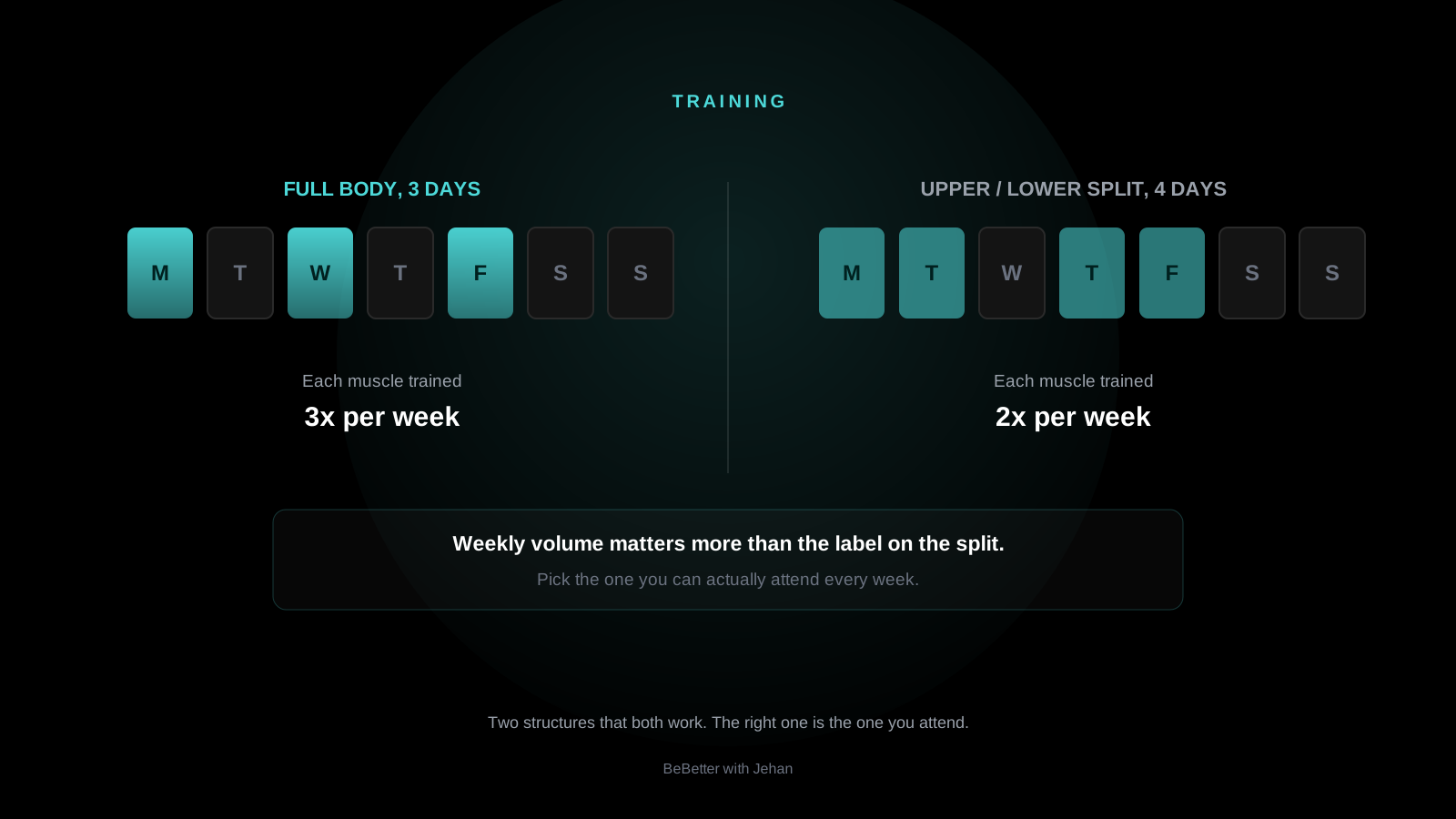
This question generates more argument than it deserves. The evidence is fairly settled, and the answer follows almost entirely from one practical constraint.

Neither structure is inherently superior. When weekly volume per muscle group is equated, outcomes are broadly similar. The deciding factor is how many days you can genuinely train. Three days or fewer, use full body. Four days or more, an upper/lower or similar split becomes the easier way to organise the work.
The label on your programme matters far less than the weekly volume each muscle receives and whether you actually attend the sessions.
- Count the days you can genuinely train on a bad week, not a good one.
- Three or fewer, run full body. Four or more, run a split.
- Aim for each major muscle group to be trained at least twice a week.
- Keep the structure fixed for eight to twelve weeks so progression is measurable.
- The best split is the one you will still be attending in week ten.
What actually decides the answer
Strip away the argument and one variable does almost all the work: how many days you will genuinely train in a normal week. Not an ideal week. A normal one, with a late meeting and a bad night of sleep in it.
The reason is arithmetic. Research generally supports training each major muscle group at least twice per week. How you achieve that depends entirely on how many sessions you have to distribute the work across.
| Days per week | Sensible structure | Frequency per muscle |
|---|---|---|
| 2 | Full body | 2x |
| 3 | Full body | 3x |
| 4 | Upper / lower, run twice | 2x |
| 5 | Upper / lower / full body, or push pull legs plus one | 2x or more |
| 6 | Push pull legs, run twice | 2x |
Notice that every row achieves at least twice-weekly frequency. That is the actual target. Full body and splits are simply two different routes to it.
Training volume is usually counted as the number of hard working sets a muscle receives per week. It is the variable most closely associated with muscle growth, and it is what your split needs to deliver, regardless of how the sessions are labelled.
What the research shows
On frequency. Schoenfeld and colleagues conducted a meta-analysis on resistance training frequency and found that training a muscle group twice per week produced superior hypertrophy compared with once per week (Schoenfeld et al., 2016). Importantly, the advantage appears to come largely from the higher weekly volume that higher frequency makes possible, rather than from frequency itself being magical.
On volume. A separate study found a dose-response relationship between weekly set volume and hypertrophy in trained men, though the same relationship did not hold for strength (Schoenfeld et al., 2019).
Put those together and the practical conclusion is straightforward. Weekly volume per muscle is the variable that matters. Frequency is the mechanism that lets you accumulate it without any single session becoming unmanageably long. The name of the split is downstream of both.
Coach's perspective
Almost nobody who asks me this question has a programming problem. They have an attendance problem wearing a programming costume.
The honest question is not which split is optimal. It is which structure you will still be running in week ten when work gets busy. I have watched a theoretically inferior three day full body plan comfortably outperform a beautifully designed five day split, purely because one got done and the other got abandoned in week four.
When full body is the right call
Full body means every session trains the whole body: a lower push, a lower pull, an upper push, an upper pull, and usually some direct arm or shoulder work.
Choose it if you train two or three days a week. At that frequency it is the only way to hit each muscle twice or more.
| Strength | Trade-off |
|---|---|
| Every muscle trained two to three times weekly on few days | Sessions are longer, typically 60 to 75 minutes |
| Missing one session still leaves the week functional | Less direct volume per muscle in any single session |
| Well suited to beginners learning the main movements | Can feel repetitive if exercise selection never varies |
| Highly schedule-resilient | Fatigue late in the session can compromise the last exercises |
That second row is the underrated benefit. If you train Monday, Wednesday and Friday and Wednesday disappears, you still trained everything twice. On a split, a missed day can mean a muscle group gets nothing that week.
When a split makes more sense
A split divides the body across sessions. The most practical version is upper/lower, run twice a week over four days.
Choose it if you train four or more days a week. At that point full body becomes hard to recover from and a split lets each session be shorter and more focused.
| Strength | Trade-off |
|---|---|
| Shorter sessions, typically 45 to 60 minutes | Requires four or more days to hit twice-weekly frequency |
| More direct volume per muscle per session | A missed session can leave a muscle group untrained that week |
| Easier to prioritise a lagging area | Less forgiving of a disrupted schedule |
| Less intra-session fatigue on later exercises | More planning required to keep weekly volume balanced |
Three structures that work
| Structure | Days | How it runs |
|---|---|---|
| Full body x3 | Mon, Wed, Fri | Every session hits all major patterns. Rotate exercise emphasis between sessions. |
| Upper / lower x4 | Mon, Tue, Thu, Fri | Upper, lower, rest, upper, lower. Each muscle twice weekly. |
| Full body x2 | Any two days | Minimum effective structure. Prioritise compound movements only. |
All three are covered in more depth in the guide on how many days a week you really need to train, which goes into the frequency evidence itself.
The missed session problem
This is the practical consideration that decides it for most working professionals, and it rarely appears in programming discussions.
On a full body plan, missing one of three sessions means every muscle was still trained twice. The week is compromised, not lost.
On a four day upper/lower split, missing Thursday means your upper body was trained once instead of twice. Miss Thursday and Friday and your lower body gets one session and your upper body gets one.
If your calendar is genuinely unpredictable, that asymmetry should push you towards full body even at four available days. Resilience to disruption is a legitimate programming variable, not a compromise.
- Weekly volume per muscle matters more than the name of the split.
- Aim for each major muscle group to be trained at least twice a week.
- Three days or fewer means full body. Four or more makes a split practical.
- Full body is considerably more resilient to a missed session.
- Keep whichever structure you choose fixed for eight to twelve weeks so progression is measurable.
- Attendance beats optimisation. The best plan is the one you will still be running in week ten.
Myth versus fact
| Common claim | What the evidence says |
|---|---|
| “Splits are for advanced lifters, full body is for beginners.” | Both work at any level. The deciding variable is available days, not experience. |
| “You need to train each muscle once a week and let it fully recover.” | Meta-analysis found twice-weekly frequency superior to once weekly for hypertrophy, largely via higher weekly volume. |
| “Full body sessions are too long to be practical.” | A well-built full body session runs 60 to 75 minutes. Three of those is less weekly gym time than five split sessions. |
| “You must change your split regularly to keep progressing.” | Frequent change makes progression impossible to measure. Hold a structure for at least eight to twelve weeks. |
| “More training days always means better results.” | Only if the extra days are recovered from and attended. Four consistent days beat six sporadic ones. |
The mistakes I see most
1. Choosing a split based on an ideal week
Plan around the number of days you hit on a bad week, then treat extra sessions as a bonus.
2. Running a five or six day split on three available days
Each muscle ends up trained once, weekly volume collapses, and progress stalls.
3. Changing the structure every few weeks
You lose the ability to measure progression, which is the mechanism that drives results.
4. Training each muscle once a week
Possible to make work with very high per-session volume, but harder and less well supported than twice weekly.
5. Putting the priority exercise last
Whatever comes first progresses fastest because you are freshest. Order reflects priority.
6. Ignoring how a missed session affects the week
On a split this can leave a muscle group untrained. Build for the weeks that go wrong.
Your practical checklist
- Count the days you can genuinely train on a bad week.
- Three or fewer, choose full body. Four or more, choose upper/lower.
- Confirm every major muscle group appears at least twice across your week.
- Put your highest priority movement first in the session.
- Fix the structure for at least eight to twelve weeks.
- Record every session so you can see whether progression is happening.
- If you miss sessions repeatedly, reduce the planned days rather than fighting the calendar.
Research summary
Schoenfeld and colleagues (2016) is a systematic review and meta-analysis on training frequency. Its central finding, that twice-weekly beats once-weekly for hypertrophy, is well replicated. The important nuance is that the benefit appears to operate largely through the additional weekly volume that higher frequency enables.
Schoenfeld and colleagues (2019) examined weekly set volume in trained men and found a dose-response relationship for hypertrophy but not strength. Sample size was modest, as is typical in this literature.
Limitations worth stating. Very few studies directly compare named splits head to head with volume equated, which is exactly the comparison people want. Most of what is written about split selection, including much of this article, is reasoned inference from the frequency and volume literature rather than direct evidence that one split beats another. Study durations are typically eight to twelve weeks, and adherence in a supervised trial bears little resemblance to adherence around a full-time job. Treat the structural advice here as sound practice, not proven optimum.
The right structure is the one built around your actual week.
Choosing between full body and a split takes five minutes. Building a week that survives travel, late meetings and a bad month is the part that decides your result. The Training Plan inside the Fitness Blueprint is built around the days you can genuinely train, with a demonstration video on every movement and explicit progression rules, and it is held steady for twelve weeks so progress can actually accumulate.
DM ‘BLUEPRINT’ to get startedThe Fitness Blueprint is ₹14,999 at present, reduced from a recommended price of ₹24,999. Flexible payment over 3 or 6 months can be arranged. See what is included.
Curious exactly what is included and what it costs? See the full pricing breakdown. Still deciding, or have a specific question first? Get in touch and I will answer honestly.
Frequently asked questions
Is full body better than a split?
Neither is inherently better. When weekly volume per muscle is equated, outcomes are similar. What decides it is how many days you can train: three or fewer favours full body, four or more makes a split practical.
How many days a week should I train?
Two to four resistance sessions suits almost everyone who is not competing. Three is the sweet spot for most working professionals.
Is the bro split bad?
It is not harmful, but training each muscle once a week makes it hard to reach sufficient weekly volume per muscle, and the frequency research modestly favours training a muscle at least twice weekly.
Can I do full body four or five times a week?
You can, but sessions must be shorter and you need to rotate exercise emphasis to manage fatigue. At that frequency most people find a split easier to organise.
What if I miss a session on a split?
This is the main practical risk. Missing one day of a four day split can mean a muscle group goes untrained that week. Full body is far more forgiving of a disrupted week.
Does the order of exercises matter?
Somewhat. Whatever you place first in a session tends to progress fastest because you are freshest. Put your priority movement first.
References
- Schoenfeld BJ, Ogborn D, Krieger JW. Effects of Resistance Training Frequency on Measures of Muscle Hypertrophy: A Systematic Review and Meta-Analysis. Sports Medicine. 2016;46(11):1689-1697. PubMed
- Schoenfeld BJ, Contreras B, Krieger J, et al. Resistance Training Volume Enhances Muscle Hypertrophy but Not Strength in Trained Men. Medicine and Science in Sports and Exercise. 2019;51(1):94-103. PubMed
- Grgic J, Schoenfeld BJ, Orazem J, Sabol F. Effects of resistance training performed to repetition failure or non-failure on muscular strength and hypertrophy: A systematic review and meta-analysis. Journal of Sport and Health Science. 2022;11(2):202-211. PubMed
A note on medical advice. This article is educational and reflects the research as I read it. It is not medical or dietetic advice and it cannot account for your individual circumstances. If you are managing a medical condition, are pregnant, are taking medication affected by diet or activity, or are recovering from injury, please speak to your doctor or a registered dietitian first. If anything here conflicts with advice from your own clinician, follow theirs.
Questions about applying any of this? Message me directly or find me on Instagram. Back to the Knowledge Hub or the homepage. You can also read more about how I coach, see what the Fitness Blueprint costs, or get in touch.