Do you have to train to failure to build muscle?
This is the single most useful thing a working professional can learn about training, because it changes how recoverable your whole week is.

No. Two independent systematic reviews with meta-analysis found no significant difference in strength or muscle growth between sets taken to repetition failure and sets stopped short of it, including where total training volume was equated.
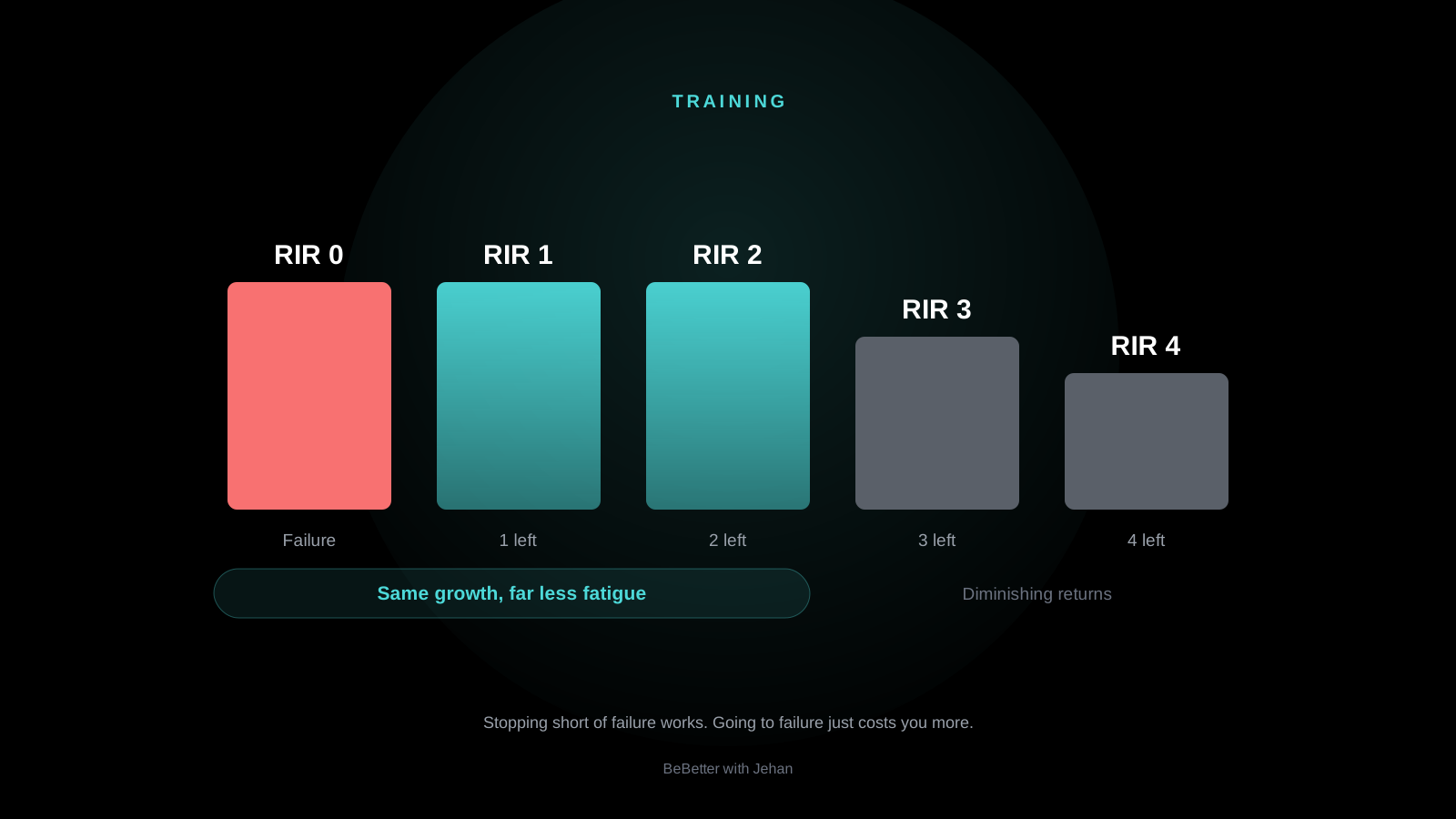
Stopping with roughly one to three repetitions in reserve produces comparable results with materially less fatigue, lower injury risk, and a faster return to your next session.
- Take most working sets to roughly one to three reps in reserve.
- Judge a set by whether it was genuinely hard, not by whether you failed.
- Keep progressing load or reps week to week. That is what drives the result.
- Save the occasional failure set for safe machine or isolation work.
- If every session leaves you wrecked, you are training for fatigue rather than adaptation.
What the research actually found
Two separate research groups asked this question and independently reached the same answer, which matters far more than any single study.
Grgic and colleagues (2022) conducted a systematic review and meta-analysis comparing resistance training performed to repetition failure against training stopped short of it. They found no significant difference in either muscular strength or hypertrophy outcomes, including in the subset of studies where training volume was equated between conditions (Grgic et al., 2022).
Refalo and colleagues (2023) approached it slightly differently, examining proximity to failure specifically rather than a simple failure versus non-failure split. They found no evidence that training to momentary failure is superior for muscle growth (Refalo et al., 2023).
Two reviews, different teams, different analytical approaches, same conclusion. That is about as much confidence as this literature offers on any question.
Repetition failure is the point in a set where you cannot complete another repetition with good technique despite maximal effort. It is not the point where the set becomes uncomfortable, which arrives considerably earlier.
What reps in reserve means
Reps in reserve, usually shortened to RIR, is simply how many more repetitions you could have done before failing. It is the most practical way to describe effort without requiring you to actually fail.
| Reps in reserve | What it feels like | Verdict |
|---|---|---|
| RIR 0 | You physically could not complete another rep | Effective, but the most fatiguing option available |
| RIR 1 | One more was possible, and it would have been ugly | Effective, and the sensible ceiling for most work |
| RIR 2 | Two more, the last one would have been a grind | The sweet spot for most working sets |
| RIR 3 | Three more, clearly hard but controlled | Effective, particularly on compound lifts |
| RIR 4 or more | You stopped well before it got difficult | Probably too easy to drive much adaptation |
The useful range for a working professional sits between RIR 1 and RIR 3. Below that you are paying a fatigue cost for no measurable return. Above it you are likely under-stimulating.
Why failure costs more than it returns
If failure produces the same result, the question becomes what it costs. The answer is quite a lot.
| Cost | Why it matters for someone with a job |
|---|---|
| Longer recovery between sessions | Your Wednesday session suffers because Monday was maximal |
| Reduced total weekly volume | Fatigue accumulates and later sets in the same session degrade |
| Higher injury risk on compounds | Technique breaks down precisely at the point of failure |
| Greater psychological load | Dreading a session is the most reliable predictor of skipping it |
| Slower progression tracking | Erratic performance makes it harder to see whether you are progressing |
That last row is the one people miss. The mechanism behind results is progressive overload, which requires you to reliably beat last week. If every session is a maximal effort, your week-to-week performance becomes noisy and the progression becomes hard to read.
Coach's perspective
The clients who arrive most frustrated are almost always training the hardest. They grind every set, they are permanently sore, they take that as evidence of effort, and their numbers have not moved in months.
What I ask for instead is boring and it works. Leave one to two reps in the tank on almost everything, and put your competitive energy into beating last week's logbook rather than surviving today's session. The sessions get easier and the numbers start moving, which is a strange thing to experience the first time.
How to apply this in your own sessions
| Exercise type | Target RIR | Reasoning |
|---|---|---|
| Heavy compounds (squat, deadlift, press) | 2 to 3 | Technique degrades fastest here and the injury cost is highest |
| Machine compounds (leg press, chest press) | 1 to 2 | Safer to push, still fatiguing systemically |
| Isolation work (curls, lateral raises, calves) | 0 to 1 | Low risk, low systemic cost, fine to take close to failure |
| First session on a new exercise | 3 to 4 | Learn the movement before loading it hard |
| Deload or a bad week | 3 to 4 | Maintain the habit without accumulating fatigue |
If you train three days a week, as covered in the guide on how many days a week you actually need, this matters even more. With only three sessions, each one needs to leave you able to complete the next.
When failure is genuinely useful
The evidence says failure is not required. It does not say it is useless. Two situations justify it.
Calibration. Most people who are new to training badly overestimate how close to failure they are. Taking one set on a safe machine exercise genuinely to failure, occasionally, recalibrates your internal sense of effort. Without that reference point, "two reps in reserve" often means six.
Low-cost isolation work. A failed lateral raise costs you nothing. A failed squat can cost you a training block. Where the risk and systemic fatigue are both low, there is little reason not to push close.
- Two independent meta-analyses found no significant advantage for training to failure, for strength or hypertrophy.
- One to three reps in reserve is the practical target for most working sets.
- Failure costs recovery, weekly volume, technique quality and adherence.
- Judge a set by whether it was genuinely hard, not by whether you failed.
- Occasional failure on safe isolation work helps calibrate your sense of effort.
- Progression across weeks matters far more than intensity within a single session.
Myth versus fact
| Common claim | What the evidence says |
|---|---|
| “If you do not train to failure you are leaving gains on the table.” | Two meta-analyses found no significant difference in strength or hypertrophy, including with volume equated. |
| “No pain, no gain.” | Soreness reflects novelty and damage, not adaptation. Trained muscles often stop getting sore while continuing to grow. |
| “Stopping short means the set was wasted.” | A set at two reps in reserve is a hard set. The useful range is wide, and effort does not have to be maximal to be sufficient. |
| “Failure training is more time-efficient.” | It requires longer rest periods and degrades subsequent sets, so a session often takes longer, not less. |
| “Elite lifters train to failure constantly.” | Most well-coached strength athletes deliberately manage proximity to failure and reserve true maximal efforts for specific phases. |
The mistakes I see most
1. Confusing discomfort with failure
The set gets uncomfortable long before you actually fail. Many people stop at RIR 5 believing they reached RIR 0.
2. Taking heavy compounds to failure
This is where technique collapses and injury risk peaks, for no measurable additional benefit.
3. Using failure to compensate for no progression
Grinding harder does not substitute for adding reps or load over time.
4. Training to failure on every set of every session
Fatigue compounds across the week and your later sessions quietly deteriorate.
5. Never approaching failure at all
The opposite error. If you always stop at RIR 5, the stimulus is genuinely insufficient.
6. Judging a session by how destroyed you feel
Recovery cost is not a measure of adaptation. Your logbook is.
Your practical checklist
- Pick a target RIR for each exercise type and write it in your plan.
- Default to two reps in reserve on compounds, one on isolation work.
- Record weight, sets and reps every session so progression is visible.
- Occasionally take one isolation set to failure to recalibrate your sense of effort.
- If you cannot beat last week for three weeks running, check sleep and calories before adding intensity.
- Notice whether you are dreading sessions. That usually means the intensity is too high, not too low.
- Keep technique as the hard limit. If form breaks, the set is over regardless of RIR.
Research summary
Grgic and colleagues (2022) is a systematic review with meta-analysis, which sits above individual studies in evidence quality. Its volume-equated subgroup analysis is the most useful part, because it isolates proximity to failure from total work done.
Refalo and colleagues (2023) examined proximity to failure as a continuous variable rather than a binary. Independent replication of the same conclusion meaningfully raises confidence.
Limitations worth stating. Most of these studies run eight to twelve weeks in untrained or recreationally trained participants, with modest sample sizes. Long-term data in trained lifters is thin, and it remains possible that advanced trainees respond differently. Measuring proximity to failure accurately is also genuinely difficult, since it relies on participant self-report. The direction of the finding is well supported; the precise optimal RIR for a given person is not established, which is why the recommendation here is a range rather than a number.
Knowing the right effort level is not the same as having it written down.
Every exercise in the Training Plan inside the Fitness Blueprint carries its own target rep range and explicit progression rules, so you are never guessing how hard a set should be or when to add load. Your Progress Dashboard then tracks whether the progression is actually happening across the twelve weeks.
DM ‘BLUEPRINT’ to get startedThe Fitness Blueprint is ₹14,999 at present, reduced from a recommended price of ₹24,999. Flexible payment over 3 or 6 months can be arranged. See what is included.
Curious exactly what is included and what it costs? See the full pricing breakdown. Still deciding, or have a specific question first? Get in touch and I will answer honestly.
Frequently asked questions
Do you have to train to failure to build muscle?
No. Two independent systematic reviews with meta-analysis found no significant difference in muscle growth between sets taken to failure and sets stopped short of it, including when total volume was equated.
What does RIR mean?
Reps in reserve. It is how many more repetitions you could have completed with good form before failing. RIR 2 means you stopped with two reps left in the tank.
Is training to failure ever useful?
Occasionally, and mostly on safer machine or isolation exercises where a failed rep carries little risk. It can also help you calibrate what genuine effort feels like when you are new to training.
Will I still make progress if I never go to failure?
Yes, provided the sets are genuinely hard and you are progressing the load or reps over time. Stopping short is not the same as training easy.
How do I know if I am two reps short?
Most people are poor at judging this at first and stop far earlier than they think. Occasionally taking one set to failure on a safe exercise recalibrates your sense of it.
Does this apply to strength as well as size?
Yes. The Grgic meta-analysis examined both strength and hypertrophy and found no significant advantage for failure training in either.
References
- Grgic J, Schoenfeld BJ, Orazem J, Sabol F. Effects of resistance training performed to repetition failure or non-failure on muscular strength and hypertrophy: A systematic review and meta-analysis. Journal of Sport and Health Science. 2022;11(2):202-211. PubMed
- Refalo MC, Helms ER, Trexler ET, Hamilton DL, Fyfe JJ. Influence of Resistance Training Proximity-to-Failure on Skeletal Muscle Hypertrophy: A Systematic Review with Meta-analysis. Sports Medicine. 2023;53(3):649-665. PubMed
- Schoenfeld BJ, Grgic J, Ogborn D, Krieger JW. Strength and hypertrophy adaptations between low- vs. high-load resistance training: a systematic review and meta-analysis. Journal of Strength and Conditioning Research. 2017;31(12):3508-3523. PubMed
A note on medical advice. This article is educational and reflects the research as I read it. It is not medical or dietetic advice and it cannot account for your individual circumstances. If you are managing a medical condition, are pregnant, are taking medication affected by diet or activity, or are recovering from injury, please speak to your doctor or a registered dietitian first. If anything here conflicts with advice from your own clinician, follow theirs.
Questions about applying any of this? Message me directly or find me on Instagram. Back to the Knowledge Hub or the homepage. You can also read more about how I coach, see what the Fitness Blueprint costs, or get in touch.