Can you build muscle with light weights?
Many people believe you need heavy weights to build muscle. That matters if you train at home with dumbbells or bands, or prefer to avoid heavy loads.
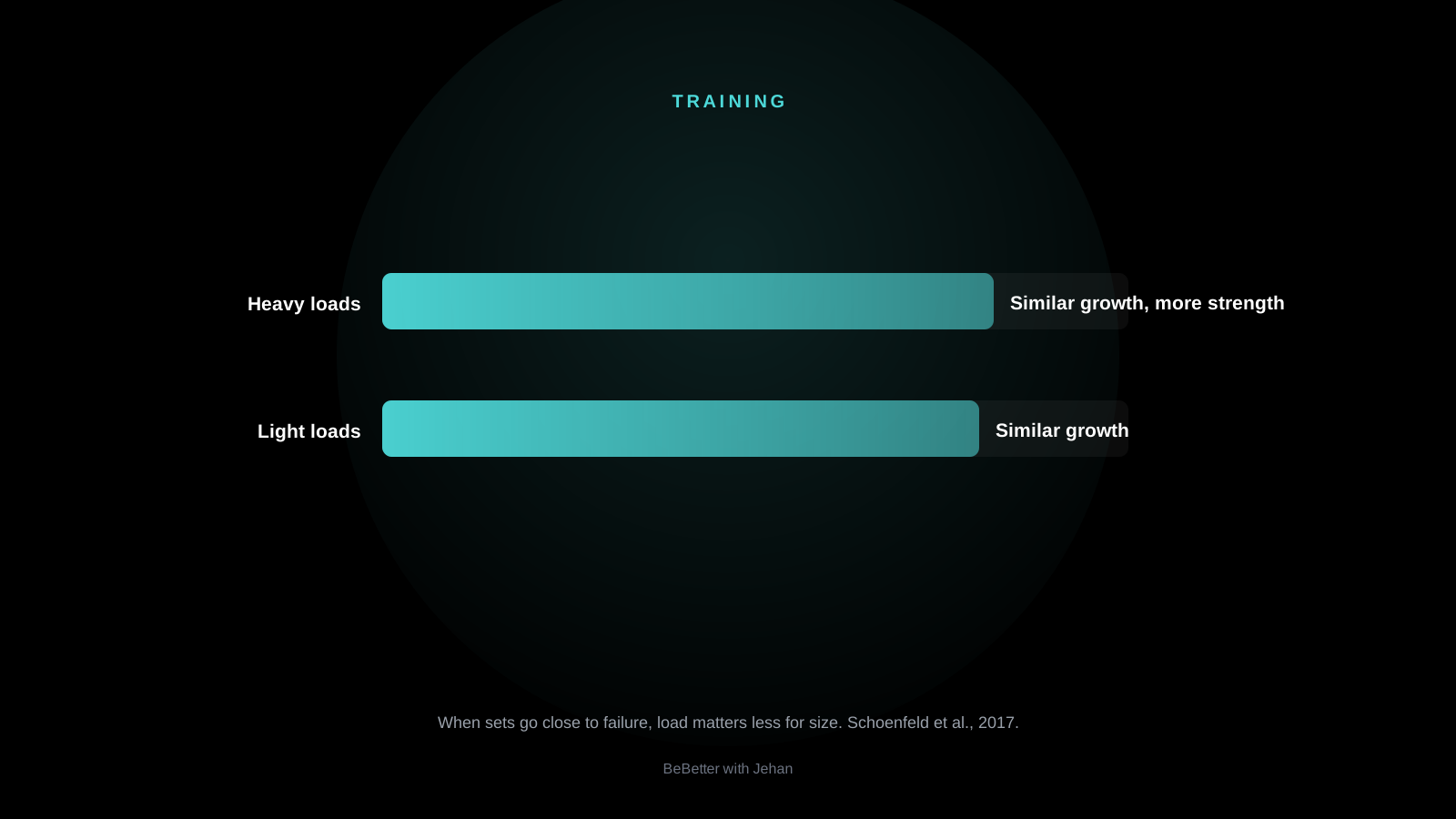
Yes. A meta-analysis found that light and heavy loads produced similar muscle growth when sets were taken close to failure. Heavy loads produced more strength.
With lighter weights, the key is making each set genuinely hard.
- Light loads build muscle if sets go close to failure.
- Heavy loads build more strength.
- With light loads, you will need more repetitions.
- Progress over time, even without heavier weights.
- Combine light and moderate loads if you can.
What the research found
Schoenfeld and colleagues pooled studies comparing low-load and high-load training. Muscle growth was similar between the two when sets were taken to or near failure, while heavy-load training produced greater strength gains (Schoenfeld et al., 2017).
| Outcome | Light loads, close to failure | Heavy loads |
|---|---|---|
| Muscle growth | Similar | Similar |
| Strength | Less | More |
| Repetitions needed | More | Fewer |
Load is how heavy the weight is relative to the most you can lift once. Light loads allow many repetitions; heavy loads allow few.
Why effort matters more than load
What appears to drive growth is how close each set comes to failure, rather than the weight alone. A separate meta-analysis found no significant advantage for going all the way to failure over stopping one to three repetitions short (Grgic et al., 2022). With light loads, getting within a few repetitions of failure simply takes more repetitions. More in do you have to train to failure.
Applying this at home
- Choose dumbbells or bands that let you reach near-failure within about 15 to 30 repetitions.
- Slow the lowering phase to make light weights harder.
- Add repetitions, sets or harder variations over time.
- Track your sessions so progress is visible, as covered in progressive overload.
Coach's perspective
Clients who train at home often assume they are wasting their time. They are not, as long as the sets are genuinely hard.
Where light-load training falls short is strength. If getting stronger matters to you, include some heavier work when you can.
- Light and heavy loads built similar muscle when sets went close to failure.
- Heavy loads built more strength.
- Light-load sets need more repetitions to be effective.
- Progress over time through reps, tempo and harder variations.
- Mix load ranges if you can.
Myth versus fact
| Common claim | What the evidence says |
|---|---|
| “You need heavy weights to build muscle.” | Light loads built similar muscle when sets went close to failure. |
| “Light weights only tone.” | Toning is muscle growth plus fat loss; light loads can build muscle. |
| “High reps are pointless.” | They work if the set is hard enough. |
The mistakes I see most
1. Stopping light sets far from failure
Easy sets do little for growth.
2. Never progressing
You still need to make sessions harder over time.
3. Expecting strength gains to match heavy training
Heavy loads build more strength.
4. Rushing repetitions
Controlled reps make light loads more effective.
Your practical checklist
- Pick a weight you can lift for 15 to 30 controlled repetitions.
- Take most sets within a few repetitions of failure.
- Record repetitions each session.
- Add reps, sets or tempo when sets become easier.
- Include heavier work if strength matters to you.
Research summary
Schoenfeld and colleagues (2017) is a systematic review and meta-analysis. Most included studies were short and involved untrained or recreationally trained people.
Grgic and colleagues (2022) is a meta-analysis on proximity to failure. Together they support effort over load for growth, though very light loads taken to failure can be uncomfortable.
A plan built for the equipment you have.
Your Training Plan is built for your setup, gym or home, with substitutions for every movement and clear progression rules. Send me a message and I will walk you through the next steps.
Start my BlueprintOpens WhatsApp with a short message ready to send. Prefer to share your details directly? Complete the client intake form.
The Fitness Blueprint is ₹14,999 at present, reduced from a recommended price of ₹24,999. Flexible payment over 3 or 6 months can be arranged. See what is included.
Curious exactly what is included and what it costs? See the full pricing breakdown. Still deciding, or have a specific question first? Get in touch and I will answer honestly.
Frequently asked questions
Can you build muscle with light weights?
Yes. A meta-analysis found that light and heavy loads produced similar muscle growth when sets were taken close to failure.
Do light weights build strength?
Less than heavy weights. The same meta-analysis found heavy loads produced greater strength gains.
How many reps should I do with light weights?
Enough to take the set close to failure. With light loads, that often means higher repetitions.
Can bodyweight exercises build muscle?
Yes, if they are hard enough and you progress them over time.
References
- Schoenfeld BJ, Grgic J, Ogborn D, Krieger JW. Strength and hypertrophy adaptations between low- vs. high-load resistance training: a systematic review and meta-analysis. Journal of Strength and Conditioning Research. 2017;31(12):3508-3523. PubMed
- Grgic J, Schoenfeld BJ, Orazem J, Sabol F. Effects of resistance training performed to repetition failure or non-failure on muscular strength and hypertrophy: A systematic review and meta-analysis. Journal of Sport and Health Science. 2022;11(2):202-211. PubMed
A note on medical advice. This article is educational and reflects the research as I read it. It is not medical or dietetic advice and it cannot account for your individual circumstances. If you are managing a medical condition, are pregnant, are taking medication affected by diet or activity, or are recovering from injury, please speak to your doctor or a registered dietitian first. If anything here conflicts with advice from your own clinician, follow theirs.
Questions about applying any of this? Message me directly or find me on Instagram. Back to the Knowledge Hub or the homepage. You can also read more about how I coach, see what the Fitness Blueprint costs, or get in touch.