Progressive overload explained, and how to actually apply it
If you strip training down to the single thing that decides whether you make progress, this is it. Everything else is detail arranged around this one principle.

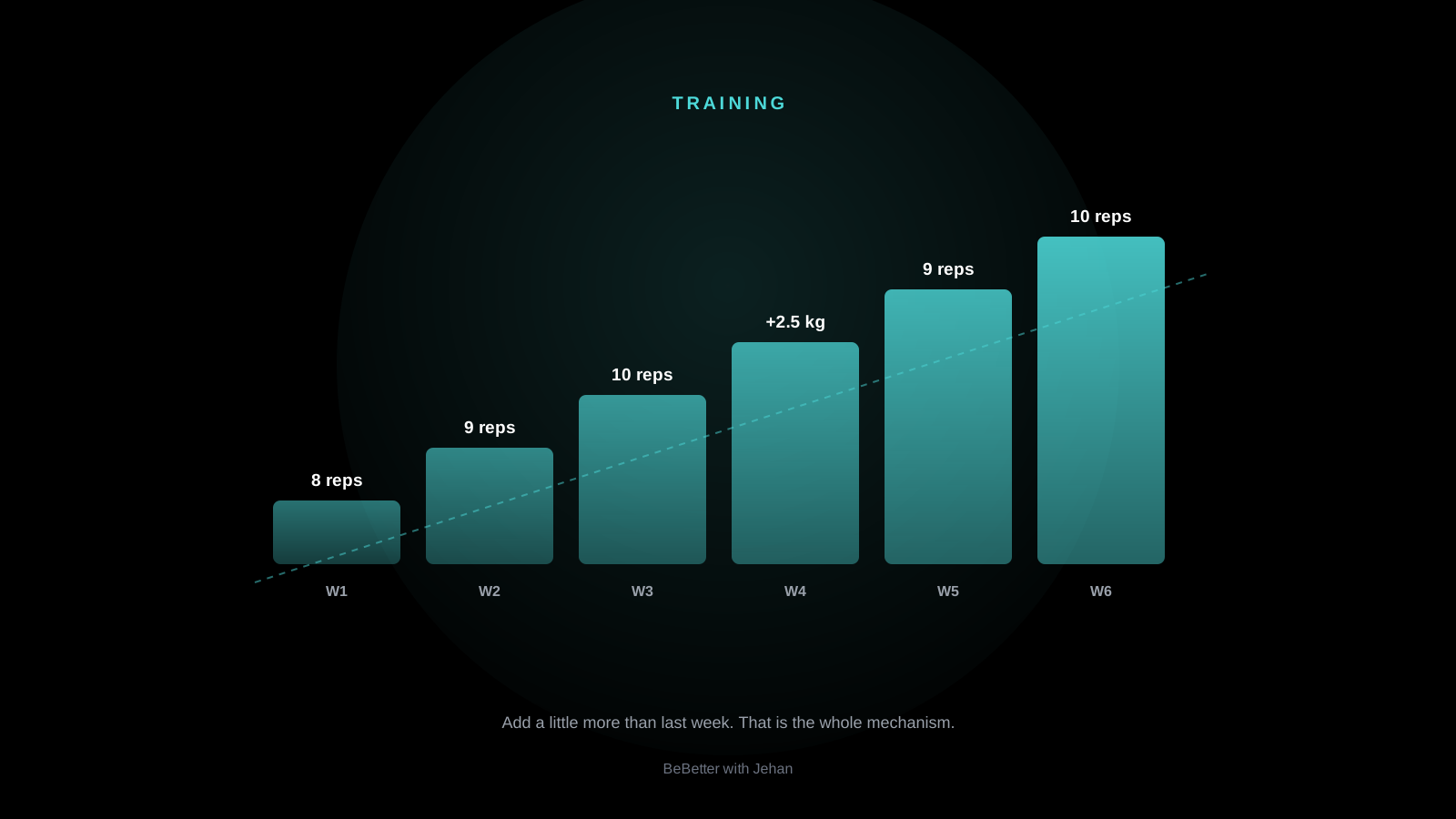
Progressive overload means gradually increasing the demand you place on a muscle over time, so it has a continued reason to adapt. In practice the simplest method is to add one repetition per set each week at the same weight until you reach the top of your rep range, then increase the load by the smallest available increment and start climbing again.
You do not need to train to failure, and you do not need to change exercises frequently. Repetition of the same movements is what makes progression measurable in the first place.
- Keep the same exercises for at least eight to twelve weeks so progress is measurable.
- Each week, aim to add one rep per set at the same weight.
- When every set hits the top of the range with clean form, add the smallest weight increment.
- Finish main lifts with one to two reps still in reserve.
- Write down what you lifted. Progression you cannot see is progression you cannot manage.
What progressive overload actually means
Your body adapts to demands placed on it, and only to demands it is not already comfortable meeting. Lift the same weight for the same reps every week and you have given your body no reason to change anything. It is already capable of that work.
Progressive overload is simply the deliberate practice of making the work slightly harder over time. Not dramatically harder, and not every single session. Slightly harder, consistently, across months.
Progressive overload is the gradual increase of stress placed on the body during training, achieved by increasing load, repetitions, sets, range of motion or training quality over time. It is the underlying requirement for continued adaptation in both strength and muscle size.
The word doing the work in that definition is gradual. This is not a licence to add weight every session until something hurts. The increments are small and the timescale is months, which is exactly why it works and exactly why most people abandon it.
Why it is the mechanism that matters
Schoenfeld's review of hypertrophy mechanisms describes three proposed drivers of muscle growth: mechanical tension, metabolic stress and muscle damage (Schoenfeld, 2010). Mechanical tension is generally considered the primary one, and progressive overload is how you increase mechanical tension systematically rather than accidentally.
This is why I am relaxed about a great many training questions and inflexible about this one. Exercise selection matters somewhat. Training split matters somewhat. Whether you train morning or evening matters very little. Whether the demand on the muscle increases over time matters more than all of them combined.
It also explains something that frustrates people. Someone can train consistently for a year, never miss a session, and look almost identical at the end of it. Consistency without progression is just repetition. Attendance is not the same as overload.
The simplest way to apply it
This is the method I give almost every client, and it is the same one built into the Training Plan inside the Blueprint. It uses two variables only.
| Week | What you do | Example on a 3 x 8-12 exercise |
|---|---|---|
| Weeks 1 to 2 | Learn the movement. Sit at the bottom of the rep range with a weight you control cleanly. | 20 kg x 8, 8, 8 |
| Week 3 | Same weight. Add one rep per set. | 20 kg x 9, 9, 9 |
| Week 4 | Same weight. Add one rep per set. | 20 kg x 10, 10, 10 |
| Week 5 | Continue until every set reaches the top of the range. | 20 kg x 12, 12, 12 |
| Week 6 | Add the smallest weight increment. Reps drop back to the bottom. | 22.5 kg x 8, 8, 8 |
| Week 7 onward | Repeat the cycle indefinitely. | 22.5 kg x 9, 9, 9 |
That is the entire system. It is called double progression because two variables move: reps within a range, then load. It requires no periodisation software and no spreadsheet, only a record of what you lifted last time.
The smallest increment matters more than people expect. Jumping 5 kg on a movement where 2.5 kg is available means you drop too far down the rep range and spend three weeks recovering ground you did not need to lose.
Coach's perspective
The single most common reason a client is not progressing is that they cannot tell me what they lifted last week. Not because they are careless, but because nobody told them the record was the point.
Progressive overload is less a training technique than a bookkeeping habit. If you know last week's numbers, adding one rep is obvious. If you do not, every session becomes a guess, and guessing tends to average out at exactly what you did before. Writing it down is the intervention.
Six ways to progress beyond adding weight
Load is the most obvious lever but far from the only one, which matters if you train at home or your gym has limited increments.
| Lever | How it works | Best used when |
|---|---|---|
| Add reps | One more rep per set at the same weight | Your default week to week method |
| Add load | Smallest available increment once reps top out | You have reached the top of the range |
| Add a set | Increase weekly volume for that muscle | Progress has stalled and recovery is good |
| Improve range of motion | Same weight, fuller movement | Technique is limiting the stimulus |
| Slow the lowering phase | Three seconds down rather than one | Load options are limited, such as at home |
| Reduce rest | Same work in less time | Conditioning is a goal, though this trades against strength |
For home training, the last three matter most. A pair of adjustable dumbbells plus tempo and range of motion will carry a beginner a surprisingly long way, which I cover further in the guide on how many days a week you actually need to train.
You do not need to train to failure
This matters enormously for anyone fitting training around a job, so it is worth being clear about.
Grgic and colleagues conducted a systematic review and meta-analysis comparing sets taken to repetition failure against sets stopped short of it. They found no significant difference in strength or hypertrophy outcomes, including where volume was equated (Grgic et al., 2022). Refalo and colleagues examined proximity to failure specifically and similarly found no evidence that training to momentary failure is superior for muscle growth (Refalo et al., 2023).
The practical consequence is that stopping with one or two reps in reserve gets you essentially the same result with less fatigue, lower injury risk, and a faster return to the next session. Grinding every set to failure is one of the quickest ways to make a three day programme feel like a five day one.
On load specifically, Schoenfeld and colleagues found that when sets are taken close to failure, hypertrophy is similar across a wide loading spectrum, while maximal strength gains favour heavier loads (Schoenfeld et al., 2017). If your goal is size, you have flexibility. If it is strength, heavier work earns its place.
What to do when progress stalls
Every progression stalls eventually. That is expected, not a failure of the plan. Work through this in order.
| Check | Why it matters | Action |
|---|---|---|
| Is it actually stalled? | One flat week is normal variation | Wait another week before changing anything |
| Sleep | Recovery capacity drops sharply with poor sleep | Address sleep before adjusting training |
| Calories | Progress slows in an aggressive deficit | Check your deficit is 15 to 20 percent, not more |
| Total volume | Too much work impairs recovery, too little understimulates | Adjust weekly sets for that muscle gradually |
| Technique drift | Range of motion often shortens as load rises | Reduce weight, restore full range, rebuild |
| Genuine plateau | You have exhausted linear progression | Change the rep range, or reduce load 10 percent and rebuild |
Notice that four of the six have nothing to do with the training programme. Stalls are most often a recovery problem wearing a training costume.
- Progressive overload is the gradual increase in demand placed on a muscle, and it is the mechanism behind every training result.
- Double progression is the simplest reliable method: add reps to the top of the range, then add the smallest load increment.
- Keep the same exercises for eight to twelve weeks so progression is measurable.
- You do not need to train to failure. One to two reps in reserve produces comparable results with less fatigue.
- Load, reps, sets, range of motion and tempo are all valid progression levers.
- Most stalls are caused by sleep, calories or recovery rather than by the programme.
Myth versus fact
| Common claim | What the evidence says |
|---|---|
| “You should change your workout constantly to confuse the muscles.” | Muscles do not get confused. Frequent change makes progression impossible to measure, which removes the main driver of adaptation. |
| “If you are not sore, the session did not work.” | Soreness reflects novelty and damage, not growth. Trained muscles often stop getting sore while continuing to grow. Progression is the signal that matters. |
| “You must train to failure on every set.” | Meta-analyses find no significant advantage for failure training over stopping short, for strength or hypertrophy. |
| “Light weights cannot build muscle.” | When sets are taken close to failure, hypertrophy is comparable across a broad loading range. Maximal strength is the outcome that genuinely favours heavy loads. |
| “Progressive overload means adding weight every session.” | That pace is unsustainable beyond the first few weeks. Adding a rep is progression. So is better range of motion at the same weight. |
The mistakes I see most
1. Not recording what you lifted
Without last week's numbers, progression is guesswork, and guesswork tends to reproduce exactly what you did before.
2. Changing exercises every few weeks
Variety feels productive but makes progress impossible to measure and removes the mechanism that drives it.
3. Jumping the load too far
Moving 5 kg where 2.5 kg exists drops you too far down the rep range and costs weeks of unnecessary rebuilding.
4. Adding weight at the cost of range of motion
A heavier half-repetition is not progression. The stimulus has usually decreased, not increased.
5. Training every set to failure
No meaningful benefit over stopping short, and considerably more fatigue to recover from.
6. Treating one flat week as a plateau
Normal variation. Give it two to three weeks before you conclude anything.
Your practical checklist
- Choose exercises you can repeat for at least eight to twelve weeks.
- Record weight, sets and reps for every working set, every session.
- Start at the bottom of your rep range with a weight you control cleanly.
- Add one rep per set each week at the same weight.
- When every set reaches the top of the range, add the smallest weight increment available.
- Finish main lifts with one to two reps in reserve rather than going to failure.
- If a lift stalls for three weeks, check sleep, calories and volume before changing the programme.
- Review your logbook monthly. Progress across months is the only meaningful timescale.
Research summary
Schoenfeld (2010) is a narrative review of hypertrophy mechanisms rather than a meta-analysis. It is widely cited and useful for framing, but it synthesises and interprets rather than pooling data statistically.
Schoenfeld and colleagues (2017) on low versus high load is a systematic review and meta-analysis, which is stronger evidence. Its central finding, that hypertrophy is similar across loads when sets approach failure while maximal strength favours heavy loads, is well replicated.
Grgic and colleagues (2022) and Refalo and colleagues (2023) both examined training to failure and independently reached the same conclusion. Two separate reviews agreeing meaningfully increases confidence.
Limitations worth stating: most of this literature runs eight to twelve weeks, uses untrained or recreationally trained participants, and involves modest sample sizes. Long-term data in busy adults training around full-time work is essentially absent. The double progression method itself is a practical convention that fits the evidence well, rather than a protocol that has been isolated and tested against alternatives in controlled trials. It is sound practice, not proven optimum.
Progression is simple. Remembering to do it for twelve weeks is not.
Knowing you should add a rep is easy. Having the exact exercises, sets, rep ranges and progression rules written down, with a record of every session, is what turns it into results. That is what the Training Plan in the Fitness Blueprint provides, with a demonstration video on every movement and explicit rules for when to add reps and when to add load. Your Progress Dashboard tracks your strength trend so a stall is visible before it becomes a month.
DM ‘BLUEPRINT’ to get startedThe Fitness Blueprint is ₹14,999 at present, reduced from a recommended price of ₹24,999. Flexible payment over 3 or 6 months can be arranged. See what is included.
Two questions follow naturally from this: how close to failure each set should be, and how to structure the week the progression sits inside.
Curious exactly what is included and what it costs? See the full pricing breakdown. Still deciding, or have a specific question first? Get in touch and I will answer honestly.
Frequently asked questions
What is progressive overload in simple terms?
Gradually asking your muscles to do more than they are comfortable with, over time. In practice that usually means adding a repetition or a small amount of weight compared with what you did last week for the same exercise.
How quickly should I add weight?
Only once you can complete every set at the top of your target rep range with good form. Then take the smallest available increase, which usually drops you back to the bottom of the range, and climb again.
Do I have to train to failure to progress?
No. Meta-analyses have found no significant advantage for training to failure over stopping short of it, for either strength or muscle growth. Finishing with one or two reps in reserve produces comparable results with less fatigue.
Can I progress with light weights?
Yes. When sets are taken close to failure, hypertrophy is similar across a wide range of loads. Maximal strength gains do favour heavier loads, so if strength is your priority, heavier work matters more.
What if I cannot add weight or reps this week?
One flat week is normal and not a failure. If it persists for three or more weeks on the same exercise, look at sleep, calories, total training volume and stress before changing the programme itself.
Does progressive overload apply to bodyweight training?
Yes, though the levers differ. You progress by adding reps, slowing the tempo, increasing range of motion, reducing rest, or moving to a harder variation of the same movement.
References
- Schoenfeld BJ. The mechanisms of muscle hypertrophy and their application to resistance training. Journal of Strength and Conditioning Research. 2010;24(10):2857-2872. PubMed
- Schoenfeld BJ, Grgic J, Ogborn D, Krieger JW. Strength and hypertrophy adaptations between low- vs. high-load resistance training: a systematic review and meta-analysis. Journal of Strength and Conditioning Research. 2017;31(12):3508-3523. PubMed
- Grgic J, Schoenfeld BJ, Orazem J, Sabol F. Effects of resistance training performed to repetition failure or non-failure on muscular strength and hypertrophy: A systematic review and meta-analysis. Journal of Sport and Health Science. 2022;11(2):202-211. PubMed
- Refalo MC, Helms ER, Trexler ET, Hamilton DL, Fyfe JJ. Influence of Resistance Training Proximity-to-Failure on Skeletal Muscle Hypertrophy: A Systematic Review with Meta-analysis. Sports Medicine. 2023;53(3):649-665. PubMed
A note on medical advice. This article is educational and reflects the research as I read it. It is not medical or dietetic advice and it cannot account for your individual circumstances. If you are managing a medical condition, are pregnant, are taking medication affected by diet or activity, or are recovering from injury, please speak to your doctor or a registered dietitian first. If anything here conflicts with advice from your own clinician, follow theirs.
Questions about applying any of this? Message me directly or find me on Instagram. Back to the Knowledge Hub or the homepage. You can also read more about how I coach, see what the Fitness Blueprint costs, or get in touch.