How long does it really take to see results?
Almost everyone who gives up does so in a specific window: after the initial enthusiasm has gone and before the visible changes arrive. Knowing where that window sits is genuinely useful.

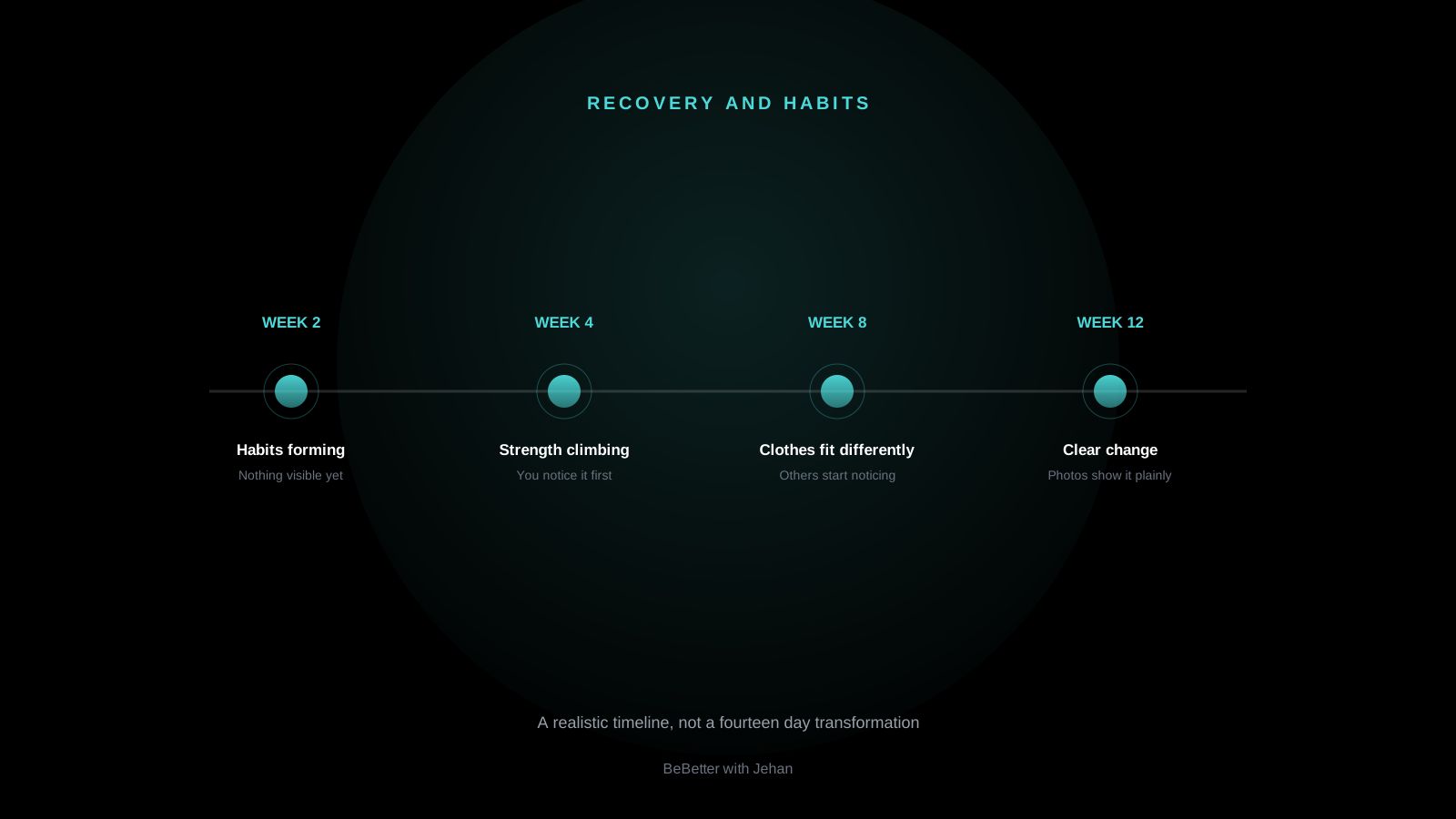
Expect to feel changes in energy and strength within 2 to 4 weeks, to notice visible changes yourself around weeks 6 to 8, and to see clear change that others comment on by around week 12. Beginners move faster than experienced trainees, and fat loss becomes visible sooner than muscle gain.
The most common reason people conclude a plan is not working is that they assess it at week three or four, which is almost always too early.
- Nothing meaningful is visible before about week four. That is normal, not failure.
- Judge progress on measurements, strength and photos, not the daily scale.
- Take photos every four weeks in the same light and position.
- Expect 0.5 to 1 percent of bodyweight lost per week if fat loss is the goal.
- The gap between weeks three and eight is where most people quit. Plan for it.
The realistic timeline, week by week
These ranges assume you are training consistently, eating in a sensible deficit or at maintenance, and getting adequate protein. They are typical patterns rather than guarantees, and individual variation is genuinely large.
| Timeframe | What is happening | What you can actually perceive |
|---|---|---|
| Weeks 1 to 2 | Neurological adaptation to the movements. Habits beginning to form. | Better coordination, less soreness after the first sessions. Nothing visible. |
| Weeks 3 to 4 | Strength climbing steadily. Roughly 1.5 to 3 kg of fat lost at a sensible rate. | Lifts moving up. Clothes marginally looser. Mirror mostly unchanged. |
| Weeks 5 to 8 | Measurable composition change. Waist reducing faster than the scale suggests. | You start noticing it. Waistband, fit of shirts, energy through the day. |
| Weeks 9 to 12 | Accumulated change becomes clearly visible. | Others begin commenting. Photos show plain differences. |
| Months 4 to 6 | Continued fat loss, or genuine muscle gain becoming apparent. | Substantial change from the starting point. |
| Months 6 to 12 | Muscle development becomes the dominant visible change. | The point where people ask what you have been doing. |
The pattern to notice is that internal change precedes visible change by roughly a month. Your strength log improves well before the mirror does. That lag is the entire reason strength tracking matters as a motivational tool, not just a training one.
What actually changes the speed
| Factor | Effect on speed | Notes |
|---|---|---|
| Training history | Large | Complete beginners progress fastest. Experienced trainees see slower visible change. |
| Starting body fat | Large | More body fat generally means faster and more visible early fat loss. |
| Consistency | Largest single factor | Four solid sessions weekly beats six sessions then a fortnight off. |
| Protein intake | Moderate to large | Determines how much of the loss is fat rather than muscle. |
| Sleep | Moderate to large | Affects the composition of the weight you lose and your training quality. |
| Age | Moderate | Progress tends to be somewhat slower, but the direction and principles are unchanged. |
| Deficit size | Moderate | Aggressive deficits move the scale faster but cost muscle, worsening the visible result. |
Consistency deserves the top spot. Someone training three times a week for twelve straight weeks reliably outperforms someone training six times a week for three weeks and then stopping, even though the second person trained harder on any given day.
Why you cannot see it in the mirror
You see yourself every day, which makes you the worst available judge of gradual change. Change of one percent a week is invisible day to day and obvious across two months.
There is also the scale problem. Bodyweight fluctuates by one to two kilograms daily from water, sodium, carbohydrate intake, digestion and, for women, menstrual cycle phase. Layer a slow genuine change underneath that noise and any single reading is close to meaningless.
Four measures together give a far clearer picture, and this is exactly what I ask clients to track:
- Waist circumference weekly. The single most useful tape measurement for fat loss, and it often moves when the scale does not.
- Strength trend. If your working weights are climbing while your waist reduces, it is working, whatever the scale says.
- Photos every four weeks. Same light, same position, same time of day. This is where invisible change becomes obvious.
- Bodyweight as a three-week average. Useful as a trend, near meaningless as a single reading.
This is the same logic behind reading three-week trends in the body recomposition guide, where the scale is particularly misleading because fat loss and muscle gain partly cancel out.
Coach's perspective
If I could change one thing about how people approach this, it would be the assessment window. Clients message me at week three convinced nothing is happening. Their lifts have gone up, their waist is down a centimetre, and they cannot see either because they are looking in a mirror.
I ask for photos at weeks one, four, eight and twelve for exactly this reason. Almost every client who compares week one against week eight is surprised, and several have told me they would have quit at week five without them. The photographs are not vanity. They are the measurement instrument that actually works.
The window where most people quit
There is a predictable danger zone, and it sits roughly between weeks three and eight.
By week three the novelty has worn off. The initial motivation that carried the first fortnight has gone. Real change has started but is not yet visible. The gap between effort invested and visible reward is at its widest, and this is when people conclude it is not working.
Understanding this in advance changes how you handle it. If you know weeks three to eight will feel unrewarding, you can plan around it: rely on strength numbers and tape measurements rather than the mirror, and treat the absence of visible change as expected rather than as evidence of failure.
This is also the reasoning behind the Milestone reviews at weeks 4, 8 and 12 inside the Blueprint. Week four lands precisely when people most need to see that something measurable has happened.
How long the habit itself takes
Separately from physical change, there is the question of when training stops requiring willpower.
Lally and colleagues examined habit formation in a real-world setting and found a median of around 66 days to reach automaticity, with a very wide range of roughly 18 to 254 days depending on the individual and the behaviour (Lally et al., 2010). Notably, missing a single day did not meaningfully derail the process.
Two things follow. First, the widely repeated claim that habits take 21 days is not supported. Second, the range is so wide that comparing your own adjustment period to anyone else is fairly pointless.
The practical takeaway is the more useful one: one missed session does not break anything. The all-or-nothing response to a missed week ends far more programmes than the missed week itself ever would.
- Feel changes in 2 to 4 weeks, notice them yourself around weeks 6 to 8, see clear change by week 12.
- Internal change precedes visible change by roughly a month, which is why strength tracking matters early on.
- Consistency affects your timeline more than any other single factor.
- The scale is the least useful measure. Use waist, strength, photos and a three-week weight average.
- Weeks three to eight is the danger zone where most people quit, just before visible change arrives.
- Habits take a median of around 66 days to become automatic, with an enormous individual range.
Myth versus fact
| Common claim | What the evidence says |
|---|---|
| “You should see results in two weeks.” | You may feel better in two weeks. Visible physical change in that timeframe is not realistic at any sustainable rate of progress. |
| “If the scale has not moved in a fortnight, it is not working.” | Two flat weeks sit comfortably inside normal fluctuation, particularly if you are also gaining muscle. Check waist and strength before concluding anything. |
| “It takes 21 days to form a habit.” | Research found a median closer to 66 days, with a range from 18 to 254. The 21 day figure has no good evidence behind it. |
| “Faster results are better results.” | Faster scale movement usually means a larger share of the loss is lean tissue, which produces a worse visible outcome at the same bodyweight. |
| “If I take a week off I will lose all my progress.” | Strength and muscle decline slowly over short breaks, and previously trained muscle is regained faster than it was first built. |
The mistakes I see most
1. Assessing progress at week three
Almost always too early. Real change has begun but is not yet perceptible, which is a recipe for quitting unnecessarily.
2. Using the mirror as the primary measure
You see yourself daily, which makes you least able to detect gradual change. Photographs four weeks apart work far better.
3. Not taking starting photos
The single most regretted omission. Without a week one photo you have nothing meaningful to compare against.
4. Chasing a faster timeline with a bigger deficit
This accelerates scale movement while worsening the composition of the loss, so the visible result gets worse, not better.
5. Comparing your timeline to someone else's
Training history, starting body fat, sleep, age and consistency all shift it substantially.
6. Treating one missed week as a failed programme
It is not. The abandonment that follows is what actually ends the result.
Your practical checklist
- Take starting photos this week, in consistent light and position. Do not skip this.
- Measure your waist and record it weekly at the same time of day.
- Record every training session so you can see strength climbing before anything is visible.
- Weigh yourself consistently but only read the three-week average.
- Book a proper review at week four, eight and twelve rather than assessing daily.
- Expect weeks three to eight to feel unrewarding, and decide now how you will handle it.
- Compare week one and week eight photos side by side before drawing any conclusion.
- If you miss a session or a week, resume the next one. Do not restart or compensate.
Research summary
Lally and colleagues (2010) is the reference behind the habit formation figures. It examined real-world habit formation and produced the median of 66 days along with the wide 18 to 254 day range. The width of that range is the genuinely useful finding, because it means individual variation dominates.
Garthe and colleagues (2011) supports the rate-of-loss guidance underpinning the fat loss portion of the timeline. It studied elite athletes, so the population differs from a general audience.
Barakat and colleagues (2020) informs the expectations around muscle gain and recomposition, particularly the point that beginners and returners progress considerably faster than trained individuals. It is a narrative review rather than a meta-analysis.
The important limitation: the week-by-week timeline in this article is not a research finding. No study has established when visible change appears for a general population, because "visible" is subjective and depends on starting point, lighting, body fat distribution and who is looking. The timeline reflects the direction of the evidence combined with what I observe in coaching, and it is offered as a realistic expectation rather than a measured result. Anyone giving you precise dates is guessing, including me. The ranges are wide on purpose.
Most people quit before the evidence arrives.
The problem is rarely the plan. It is assessing it at week three with the wrong instrument. The Progress Dashboard in the Fitness Blueprint tracks waist measurements, strength trends and three-week weight averages together, with Milestone reviews at weeks 4, 8 and 12 landing exactly when people most need to see that something measurable has happened. The AI-assisted analysis reads the trend underneath the weekly noise, so a working plan does not get abandoned for looking flat.
DM ‘BLUEPRINT’ to get startedThe Fitness Blueprint is ₹14,999 at present, reduced from a recommended price of ₹24,999. Flexible payment over 3 or 6 months can be arranged. See what is included.
The behavioural timeline runs alongside the physical one. The 21-day habit myth covers how long consistency actually takes to become automatic.
Curious exactly what is included and what it costs? See the full pricing breakdown. Still deciding, or have a specific question first? Get in touch and I will answer honestly.
Frequently asked questions
How long before I see results from working out?
You will typically feel improvements in energy and strength within two to four weeks, notice visible changes yourself around week six to eight, and see clear change others comment on by around week twelve. Beginners tend to move faster than experienced trainees.
Why can I not see any change after 4 weeks?
Four weeks is usually too early for visible change, particularly at a sensible rate of fat loss. At 0.5 to 1 percent of bodyweight per week, four weeks is roughly 2 to 3 kg for an 80 kg person, which is real but rarely obvious in the mirror.
How long does it take to build noticeable muscle?
Longer than fat loss. Beginners may see meaningful change in three to four months. For experienced trainees, visible muscle gain is measured across six to twelve months, which is why patience matters more as you progress.
Is it normal to see no change on the scale for two weeks?
Entirely normal. Bodyweight fluctuates by one to two kilograms daily from water, food volume and hormonal factors. Only the three-week trend carries useful information.
How long does it take to form a fitness habit?
Research on habit formation found a median of around 66 days to reach automaticity, with a very wide range from 18 to 254 days depending on the person and behaviour. The popular 21 day claim is not supported.
Will I lose progress if I take two weeks off?
Very little. Strength and muscle decline slowly over a couple of weeks, and previously trained muscle returns faster than it was originally built. A fortnight off is not the setback most people fear.
References
- Lally P, van Jaarsveld CHM, Potts HWW, Wardle J. How are habits formed: Modelling habit formation in the real world. European Journal of Social Psychology. 2010;40(6):998-1009. Journal
- Barakat C, Pearson J, Escalante G, Campbell B, De Souza EO. Body Recomposition: Can Trained Individuals Build Muscle and Lose Fat at the Same Time? Strength and Conditioning Journal. 2020;42(5):7-21. Journal
- Garthe I, Raastad T, Refsnes PE, Koivisto A, Sundgot-Borgen J. Effect of two different weight-loss rates on body composition and strength and power-related performance in elite athletes. International Journal of Sport Nutrition and Exercise Metabolism. 2011;21(2):97-104. PubMed
- Nedeltcheva AV, Kilkus JM, Imperial J, Schoeller DA, Penev PD. Insufficient sleep undermines dietary efforts to reduce adiposity. Annals of Internal Medicine. 2010;153(7):435-441. PubMed
A note on medical advice. This article is educational and reflects the research as I read it. It is not medical or dietetic advice and it cannot account for your individual circumstances. If you are managing a medical condition, are pregnant, are taking medication affected by diet or activity, or are recovering from injury, please speak to your doctor or a registered dietitian first. If anything here conflicts with advice from your own clinician, follow theirs.
Questions about applying any of this? Message me directly or find me on Instagram. Back to the Knowledge Hub or the homepage. You can also read more about how I coach, see what the Fitness Blueprint costs, or get in touch.