The 21-day habit myth, and how long habits actually take
This matters more than it sounds, because the 21-day claim sets an expectation that quietly convinces people they have failed at around week four.

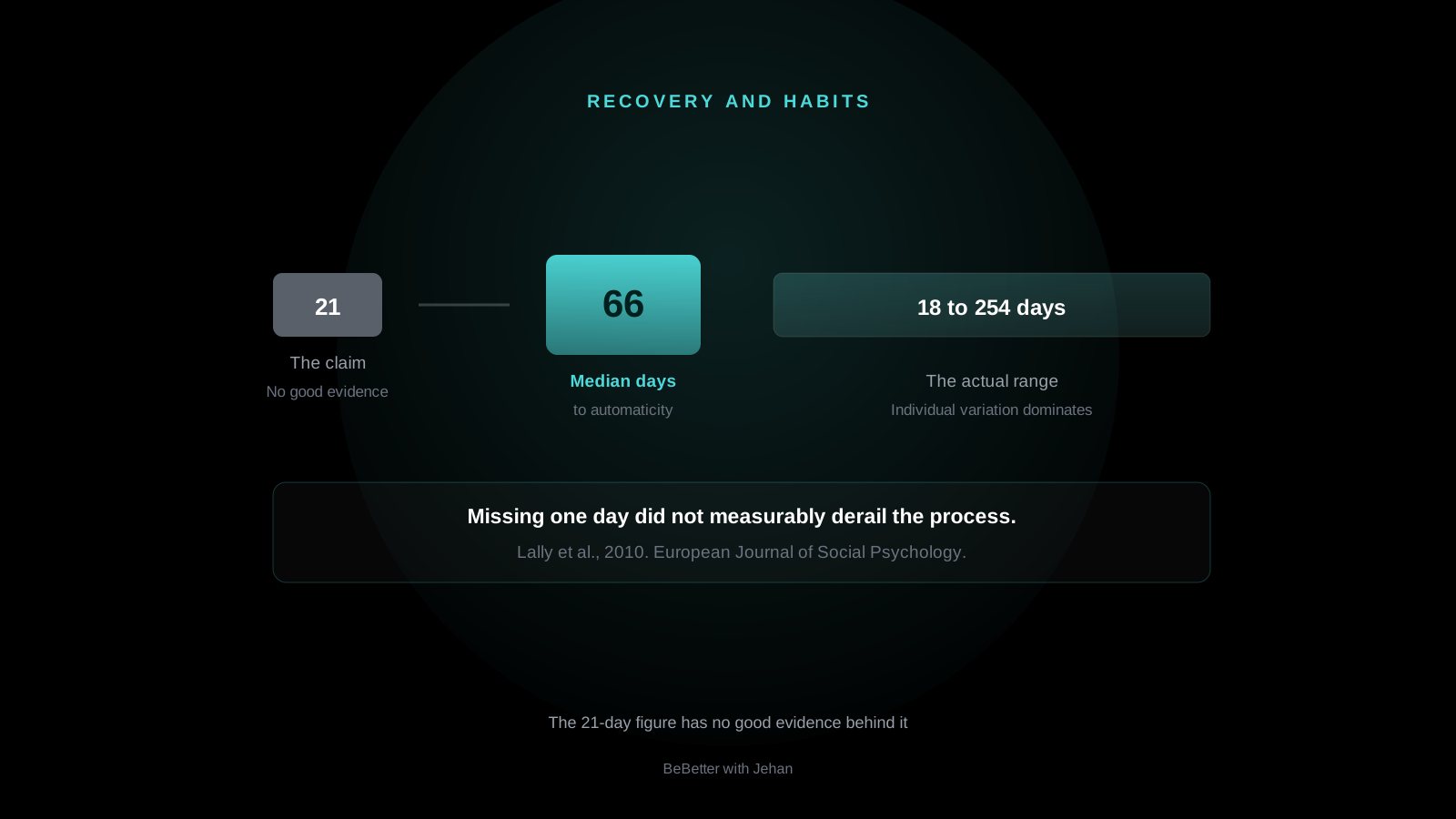
Research on real-world habit formation found a median of about 66 days to reach automaticity, with a range spanning 18 to 254 days depending on the individual and the behaviour. The 21-day figure has no good evidence behind it.
The most useful finding is often overlooked: missing a single day did not materially derail the process. It is the all-or-nothing response to a missed day that causes the damage, not the missed day.
- Expect roughly two to three months, not three weeks.
- Individual variation is enormous. Comparing your timeline to anyone else's is pointless.
- One missed day does not undo the process. The panic response does.
- Attach the new behaviour to something already fixed in your day.
- Keep it small enough that a bad week cannot break it.
What the research found
Lally and colleagues tracked participants adopting a new eating, drinking or activity behaviour in their normal daily lives, asking them to repeat it in a consistent context and measuring how automatic it felt over 12 weeks (Lally et al., 2010).
| Finding | Detail |
|---|---|
| Median time to automaticity | About 66 days |
| Observed range | 18 to 254 days |
| Effect of missing one day | No meaningful impact on the formation process |
| Pattern of change | Automaticity rose steeply early, then flattened |
Automaticity is the point at which a behaviour happens without requiring a conscious decision. It is the practical definition of a habit: you are not choosing to do it each time, you simply do it.
Where 21 days came from
The 21-day figure is generally traced to observations published in the 1960s about how long patients took to adjust psychologically to changes in their appearance after surgery. That observation was later repeated in self-help writing, gradually detached from its original context, and became a general claim about habit formation.
It was never a finding about forming new habits, and no good evidence has since supported it as one. It survives because it is short, memorable and encouraging, which is precisely what makes it harmful.
Coach's perspective
This is not an academic quibble. The 21-day claim has a specific and damaging consequence that I see constantly.
Someone starts training, works hard for three weeks, and it still feels like an effort. They were told it would be automatic by now. So they conclude something is wrong with them, specifically that they lack discipline, and they quit at about week four. They were entirely on schedule. They just had the wrong schedule.
Why the range matters more than the median
Most summaries of this research report 66 days and stop. The 18 to 254 day range is the more useful number.
A range that wide means individual variation dominates. Your adjustment period is not a measure of your discipline, and comparing it to someone else's is close to meaningless.
| Faster to automate | Slower to automate |
|---|---|
| Simple, single actions | Multi-step behaviours |
| Same time and place each day | Variable timing or location |
| Low effort, e.g. a glass of water | High effort, e.g. a full gym session |
| Attached to an existing routine | Requiring a new slot in the day |
| Immediately pleasant | Only rewarding much later |
Read that right-hand column and the implication for training is obvious. A gym session is multi-step, effortful, often at variable times, and its reward arrives months later. It is close to a worst case for rapid automation, which is exactly why expecting it in three weeks is unrealistic.
The missed day finding
This is the single most practically useful result in the paper and it is almost never quoted.
Missing one opportunity to perform the behaviour did not materially affect the formation process. The habit did not reset. Progress was not undone.
That matters because the real damage from a missed session is almost never the session itself. One skipped workout in twelve weeks is statistically irrelevant. What ends programmes is the response: the sense that the streak is broken, that the week is ruined, that you may as well restart on Monday. Then Monday becomes next month.
This is the same principle behind expressing adherence as a score out of five rather than as pass or fail. A four out of five week is a good week. Treating it as a failure is what turns one missed session into a missed month.
Why intention is not enough
Habit formation matters because intention on its own is a surprisingly weak predictor of behaviour.
A systematic review and meta-analysis of 25 samples covering 29,600 people put the physical activity intention-behaviour gap at 47.6 percent. Nearly half the people who intended to be physically active did not follow through (Feil et al., 2023).
Those people were not short of information or motivation at the point of intending. The gap sits between deciding and doing, which is precisely the gap that an automated habit closes. It is also why structure tends to outperform motivation over a twelve week block.
How to actually build the habit
Four things follow directly from the research.
Keep the context constant. The study asked participants to repeat the behaviour in a consistent context, and that consistency is part of the mechanism. Same days, same time, same place beats fitting it in wherever it lands.
Attach it to something already fixed. Existing routines are reliable anchors. Training immediately after work, or walking straight after lunch, borrows the stability of something that already happens.
Start smaller than feels necessary. Effortful behaviours sit at the slow end of the range. Three sessions you will reliably attend automate faster than five you will not.
Plan for the miss in advance. You will miss sessions across twelve weeks. Decide now that the response is to resume at the next scheduled session, without compensating and without restarting.
- Median time to automaticity was about 66 days, not 21.
- The observed range was 18 to 254 days, so individual variation dominates.
- Missing a single day did not meaningfully affect habit formation.
- The 21-day claim came from surgical recovery observations, not habit research.
- Nearly half of people who intend to be active do not follow through, so intention alone is weak.
- Consistent context and attachment to an existing routine are the most reliable practical levers.
Myth versus fact
| Common claim | What the evidence says |
|---|---|
| “It takes 21 days to form a habit.” | Research found a median of about 66 days, with a range of 18 to 254. The 21-day figure has no good evidence behind it. |
| “If you break the streak you have to start over.” | Missing a single opportunity did not materially affect the formation process in the study. |
| “If it still feels hard at week three, you lack discipline.” | At week three you are less than a third of the way to the median. Effort at that stage is expected, not diagnostic. |
| “Motivation is what keeps people consistent.” | Motivation fluctuates. A meta-analysis found nearly half of intenders fail to act, which is why structure outperforms intention. |
| “Everyone forms habits at roughly the same rate.” | The 18 to 254 day range makes comparing your timeline to anyone else's largely meaningless. |
The mistakes I see most
1. Expecting it to feel automatic in three weeks
This single expectation causes more quitting at week four than any training or nutrition error.
2. Restarting after a missed session
The research found one miss does not derail the process. Restarting treats a non-event as a failure.
3. Changing the time and place constantly
Consistent context is part of the mechanism. Variable timing slows automation considerably.
4. Starting with five sessions a week
Effortful, frequent behaviours automate slowest. Three reliable sessions beat five aspirational ones.
5. Relying on motivation to carry it
Motivation is highest at the start and lowest exactly when you need it. Structure does not fluctuate.
6. Comparing your adjustment to someone else's
With an 18 to 254 day range, the comparison carries almost no information.
Your practical checklist
- Choose fixed days and a fixed time for training, and protect them.
- Attach each new behaviour to something already reliable in your day.
- Start with the smallest version you will genuinely complete every week.
- Write down now what you will do when you miss a session: resume next time, do not compensate.
- Expect two to three months before it feels automatic, not three weeks.
- Judge the week on a score out of five, never pass or fail.
- Review at week eight rather than week three, when the timeline is actually meaningful.
Research summary
Lally and colleagues (2010) tracked 96 participants adopting a self-chosen behaviour over 12 weeks in their normal lives, which gives it strong ecological validity compared with a laboratory design.
Its limitations are real and worth naming. The sample was small and drawn largely from a student population. The 254 day upper bound was extrapolated from curve fitting rather than directly observed, since the study only ran 12 weeks. The behaviours studied were mostly simple, such as drinking water or eating fruit, and a full gym session is considerably more complex, so the 66 day median may well understate what training requires. The single missed-day finding also comes from a subset analysis rather than being the study's primary design.
None of that undermines the central point. Even on the most conservative reading, the evidence is comfortably against 21 days and firmly in favour of a much longer and much more variable timeline.
Feil and colleagues (2023) is a systematic review and meta-analysis of 25 samples covering 29,600 people, published in the British Journal of Sports Medicine, and is substantially stronger evidence than the habit formation work.
Habits form around structure, not around motivation.
The research point is that consistency in a fixed context is what automates behaviour, and that one missed session does not undo it. Both are built into how the Fitness Blueprint works: a training week fixed around the days you can genuinely attend, adherence scored out of five rather than pass or fail, and Resources covering exactly how to restart after a break without treating it as starting over.
DM ‘BLUEPRINT’ to get startedThe Fitness Blueprint is ₹14,999 at present, reduced from a recommended price of ₹24,999. Flexible payment over 3 or 6 months can be arranged. See what is included.
Curious exactly what is included and what it costs? See the full pricing breakdown. Still deciding, or have a specific question first? Get in touch and I will answer honestly.
Frequently asked questions
How long does it actually take to form a habit?
Research on real-world habit formation found a median of about 66 days to reach automaticity, with a range from 18 to 254 days depending on the person and the behaviour.
Where did the 21-day claim come from?
It is generally traced to observations about patients adjusting to changes in appearance after surgery, later repeated in self-help writing. It was never a finding about forming new habits and has no good supporting evidence.
Does missing one day ruin a habit?
No. The Lally study found that missing a single opportunity did not materially affect the habit formation process. All-or-nothing thinking causes far more damage than the missed day itself.
Why do some habits form faster than others?
Simpler behaviours performed in a consistent context tend to become automatic faster. More complex behaviours, like a full gym session, sit at the longer end of the range.
What makes a habit stick?
Consistent repetition in a consistent context. Attaching the new behaviour to something already fixed in your day is the most reliable practical approach.
Is motivation or consistency more important?
Consistency. A meta-analysis found nearly half of people who intend to be physically active do not follow through, so intention alone is a weak predictor of behaviour.
References
- Lally P, van Jaarsveld CHM, Potts HWW, Wardle J. How are habits formed: Modelling habit formation in the real world. European Journal of Social Psychology. 2010;40(6):998-1009. Journal
- Feil K, Fritsch J, Rhodes RE. The intention-behaviour gap in physical activity: a systematic review and meta-analysis of the action control framework. British Journal of Sports Medicine. 2023;57(19):1265-1271. PubMed
A note on medical advice. This article is educational and reflects the research as I read it. It is not medical or dietetic advice and it cannot account for your individual circumstances. If you are managing a medical condition, are pregnant, are taking medication affected by diet or activity, or are recovering from injury, please speak to your doctor or a registered dietitian first. If anything here conflicts with advice from your own clinician, follow theirs.
Questions about applying any of this? Message me directly or find me on Instagram. Back to the Knowledge Hub or the homepage. You can also read more about how I coach, see what the Fitness Blueprint costs, or get in touch.