How to stay consistent with exercise when work gets busy
Most fitness plans are built for normal weeks. Most people abandon them during busy ones. The fix is to plan for the busy week in advance.

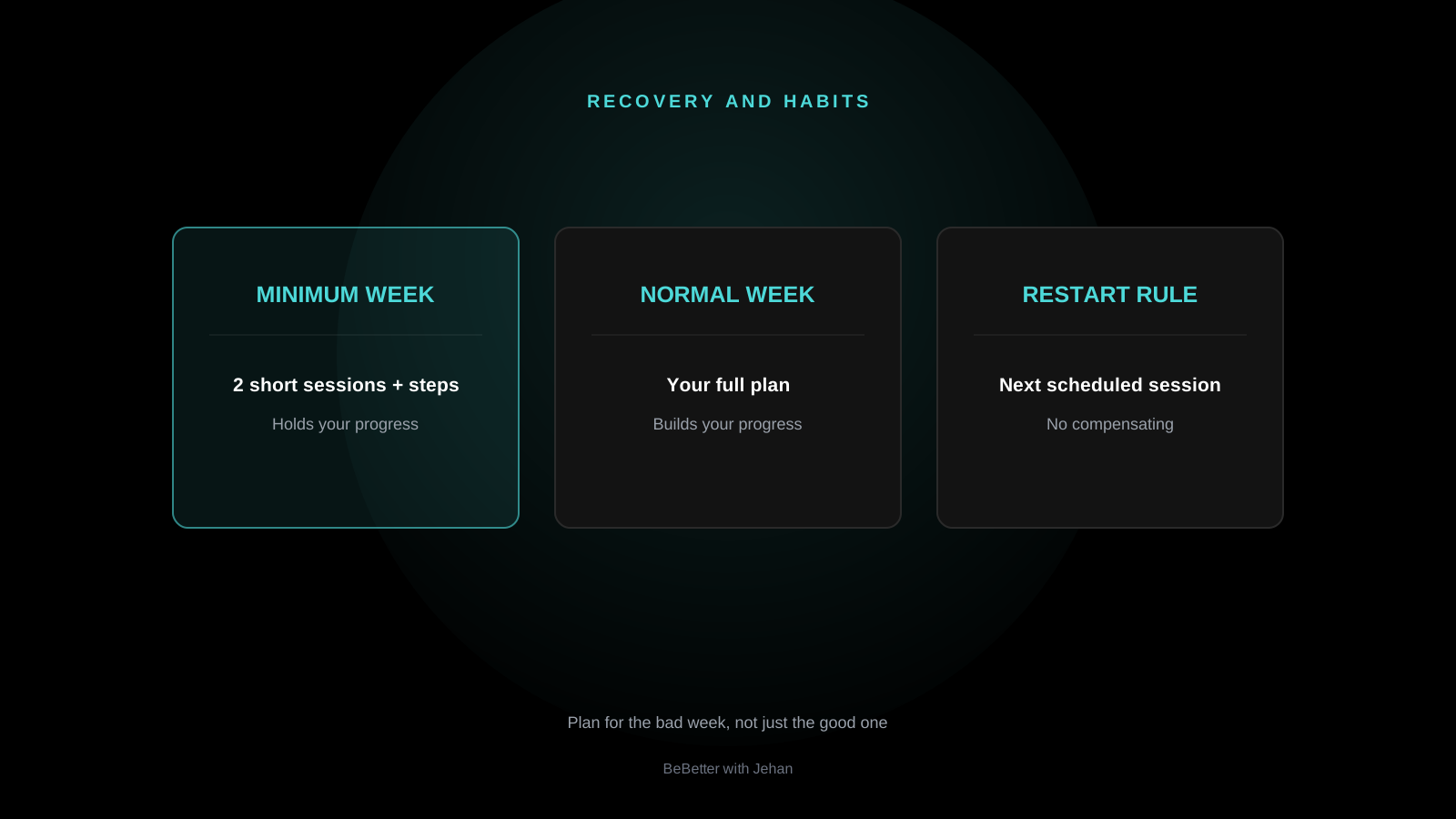
Plan for the busy week before it arrives. Keep a minimum week, such as two short sessions plus daily steps, for demanding periods, and when you miss a session, restart at the next one rather than starting over. Do not rely on motivation: a meta-analysis found nearly half of people who intend to be active do not follow through.
Consistency comes from structure, not willpower.
- Decide your minimum week before you need it.
- Two short sessions and daily steps hold most progress.
- Missing a day does not undo a habit.
- Restart at the next scheduled session, without compensating.
- Fixed times and places beat motivation.
Why busy weeks break plans
A meta-analysis of 29,600 people put the physical activity intention-behaviour gap at 47.6 percent: nearly half of people who intended to be active did not follow through (Feil et al., 2023). Busy weeks widen that gap, because a plan built for a normal week stops fitting, and the only alternative most people have is to stop.
Plan a minimum week
| Week | Training | Purpose |
|---|---|---|
| Normal week | Your full plan | Builds progress |
| Minimum week | Two short sessions plus daily steps | Holds progress and the habit |
Short sessions are worthwhile. A review of time-efficient training describes studies in which a single set three times a week improved strength and muscle size (Iversen et al., 2021). How to structure them is in can a 30-minute workout build muscle.
A minimum week is a reduced version of your plan, decided in advance, that you use during busy periods instead of stopping altogether.
The restart rule
In habit research, missing a single opportunity did not meaningfully affect habit formation (Lally et al., 2010). The damage usually comes from the response: deciding the week is ruined and starting again next Monday. The rule is simple: restart at the next scheduled session, and do not try to make up the missed one. More in the 21-day habit myth.
Structure beats motivation
- Train at fixed times and in a fixed place where possible.
- Attach sessions to something already in your day, such as straight after work.
- Keep your gym bag packed.
- Decide your minimum week on a calm day, not in the middle of a busy one.
Coach's perspective
The clients who get the best results are rarely the ones with the most free time. They are the ones who decided in advance what a bad week looks like.
When work explodes, they do not decide whether to train. They switch to the minimum week they already agreed to.
- Nearly half of people who intend to be active do not follow through.
- Plan a minimum week before you need it.
- Short sessions hold progress during busy periods.
- Missing a day does not undo a habit; restart at the next session.
- Structure is more reliable than motivation.
Myth versus fact
| Common claim | What the evidence says |
|---|---|
| “If I cannot do my full plan, there is no point training.” | Short sessions still improve strength and size. |
| “Missing a week means starting from scratch.” | Habits and fitness are more durable than that. |
| “Consistent people are just more disciplined.” | They usually have better structure, decided in advance. |
The mistakes I see most
1. Having only one version of your plan
When it stops fitting, there is nothing to fall back on.
2. Compensating for missed sessions
Doubling up often leads to the next skipped session.
3. Waiting for a calm week to restart
The calm week rarely arrives.
4. Relying on motivation
Motivation is lowest exactly when work is busiest.
Your practical checklist
- Write down your normal week.
- Write down your minimum week: two short sessions and daily steps.
- Decide which sessions you will keep when work is busy.
- Commit to the restart rule: next scheduled session, no compensating.
- Review after a busy period what worked.
Research summary
Feil and colleagues (2023) is a meta-analysis of 29,600 people in the British Journal of Sports Medicine. Lally and colleagues (2010) is a small real-world study of habit formation. Iversen and colleagues (2021) is a narrative review of time-efficient training.
Interpretation: the minimum week and restart rule are practical coaching strategies built on these findings, not tested protocols in their own right.
A plan with a busy-week version built in.
Your Blueprint includes a missed-session plan and a reset system for demanding periods, so a busy month never becomes a lost one. Send me a message and I will walk you through the next steps.
Start my BlueprintOpens WhatsApp with a short message ready to send. Prefer to share your details directly? Complete the client intake form.
The Fitness Blueprint is ₹14,999 at present, reduced from a recommended price of ₹24,999. Flexible payment over 3 or 6 months can be arranged. See what is included.
Curious exactly what is included and what it costs? See the full pricing breakdown. Still deciding, or have a specific question first? Get in touch and I will answer honestly.
Frequently asked questions
How do I stay consistent with exercise when I am busy?
Plan a minimum week in advance, such as two short sessions and daily steps, and use it during demanding periods instead of stopping completely.
Does missing a workout ruin my progress?
No. In habit research, missing a single day did not meaningfully affect habit formation. What matters is restarting at the next session.
Is motivation enough to stay consistent?
Usually not. A meta-analysis found nearly half of people who intend to be active do not follow through.
How little exercise is enough to maintain progress?
A review describes studies where a single set three times a week improved strength and size, so short sessions in busy weeks are worthwhile.
References
- Feil K, Fritsch J, Rhodes RE. The intention-behaviour gap in physical activity: a systematic review and meta-analysis of the action control framework. British Journal of Sports Medicine. 2023;57(19):1265-1271. PubMed
- Lally P, van Jaarsveld CHM, Potts HWW, Wardle J. How are habits formed: Modelling habit formation in the real world. European Journal of Social Psychology. 2010;40(6):998-1009. Journal
- Iversen VM, Norum M, Schoenfeld BJ, Fimland MS. No Time to Lift? Designing Time-Efficient Training Programs for Strength and Hypertrophy: A Narrative Review. Sports Medicine. 2021;51(10):2079-2095. PubMed
A note on medical advice. This article is educational and reflects the research as I read it. It is not medical or dietetic advice and it cannot account for your individual circumstances. If you are managing a medical condition, are pregnant, are taking medication affected by diet or activity, or are recovering from injury, please speak to your doctor or a registered dietitian first. If anything here conflicts with advice from your own clinician, follow theirs.
Questions about applying any of this? Message me directly or find me on Instagram. Back to the Knowledge Hub or the homepage. You can also read more about how I coach, see what the Fitness Blueprint costs, or get in touch.