Can a 30-minute workout actually build muscle?
Lack of time is one of the most common reasons people give for not training. The research suggests a short session, spent on the right movements, does far more than most people assume.
Yes. A review of time-efficient training recommends prioritising multi-joint exercises through a full range of motion, including at minimum one leg pressing movement, one upper-body pull and one upper-body push. It also describes studies in which performing only a single set three times a week was effective for increasing strength and muscle size.
Thirty minutes is not the limit. Spending it on isolation work and long rests is.
- Build every session around three multi-joint movements.
- Cover a leg press or squat, an upper pull and an upper push.
- Keep the warm-up short and specific.
- Train two or three times a week so the volume adds up.
- Get cardio through daily steps rather than spending session time on it.
What the research found
Iversen and colleagues reviewed how resistance training can be carried out most efficiently for people who have limited time. Their practical recommendations were clear: prioritise bilateral, multi-joint exercises through a full range of motion, and include at minimum one leg pressing exercise, one upper-body pulling exercise and one upper-body pushing exercise. Machines or free weights can both be used, depending on your goals, what is available and your preference (Iversen et al., 2021).
The review also notes that several studies have found a single set performed three times a week to be effective for increasing strength and hypertrophy. That is a minimum, not an optimum, but it shows how much a modest commitment can achieve.
A multi-joint exercise moves more than one joint and trains several muscle groups at once. A squat works the thighs, glutes and trunk together, which is why these movements give you more per minute than isolation exercises.
How to structure 30 minutes
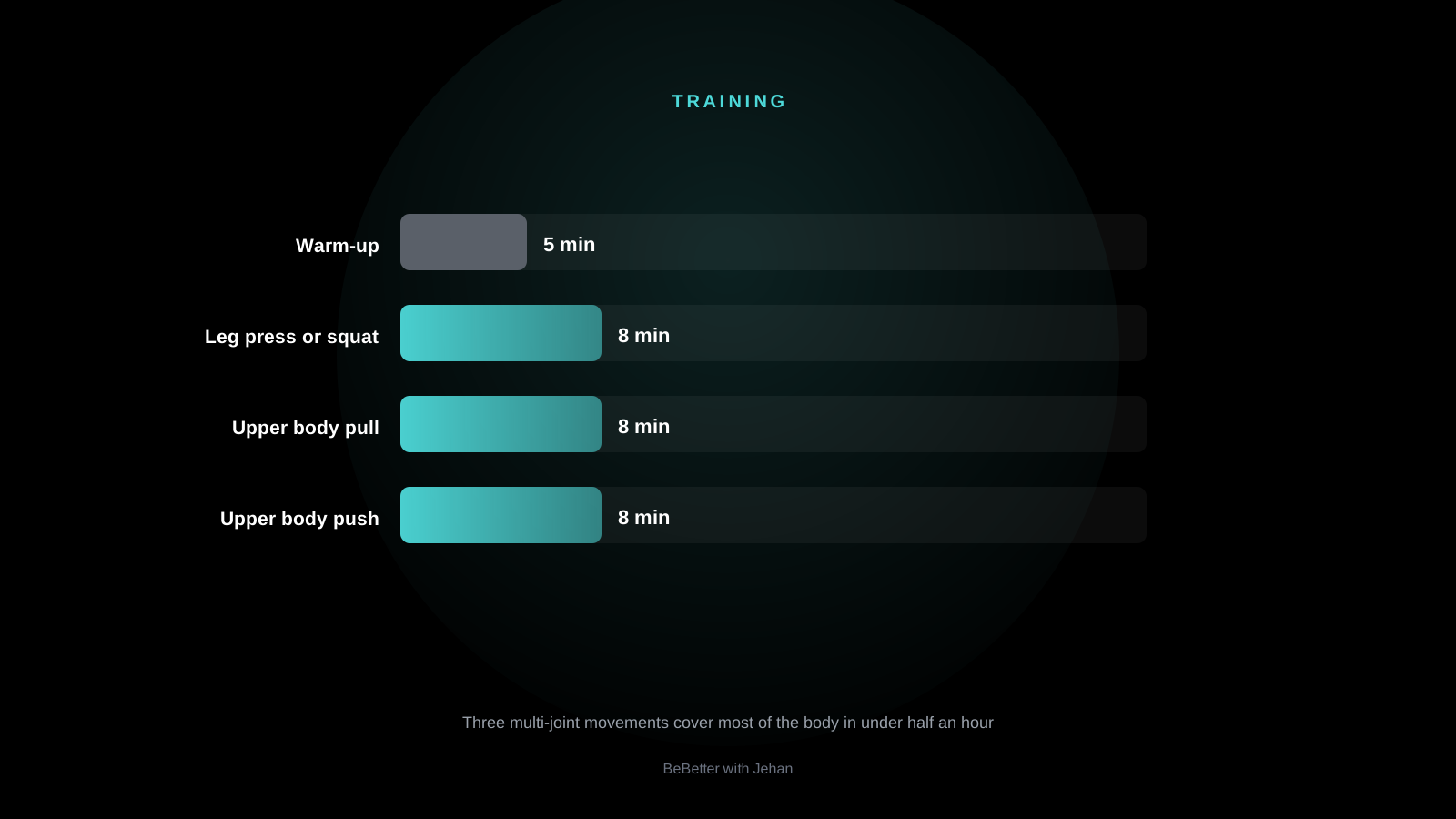
| Block | Time | Example |
|---|---|---|
| Warm-up | About 5 minutes | A lighter set or two of your first exercise |
| Leg pressing movement | About 8 minutes | Squat, leg press or split squat |
| Upper-body pull | About 8 minutes | Lat pulldown, row or pull-up |
| Upper-body push | About 8 minutes | Bench press, push-up or shoulder press |
Across two or three sessions a week, this structure accumulates meaningful weekly volume for most of the body. How much volume is useful is covered in how many sets per week you need.
Coach's perspective
The busiest clients I work with often get better results than people with unlimited time, because they cannot waste a session. Every minute goes to the movements that matter.
If you only have thirty minutes, I would rather you did three hard compound exercises well than spent an hour drifting between machines. Short and consistent beats long and occasional.
Getting more from less time
- Keep warm-ups specific. One or two lighter sets of your first movement is usually enough.
- Pair movements. Alternating an upper push and an upper pull lets one muscle group rest while the other works.
- Make each set count. Take working sets close to failure, as covered in training to failure.
- Move cardio outside the session. Daily steps cover it without using your gym time. See how many steps you need.
Where short sessions fall short
Short sessions are effective, but they are a trade-off. Thirty minutes leaves little room for direct work on smaller muscles such as the calves and rear shoulders, and less room to accumulate high weekly volume. For most busy people the trade is worth it. If your goals become more specific, longer or more frequent sessions start to matter more.
- A 30-minute session can build muscle if it is spent on multi-joint movements.
- Cover a leg press or squat, an upper pull and an upper push.
- Even a single set three times a week has been effective in some studies.
- Pairing movements and short warm-ups save time.
- Short and consistent beats long and occasional.
Myth versus fact
| Common claim | What the evidence says |
|---|---|
| “You need at least an hour for a proper workout.” | A review of time-efficient training found short, well-structured sessions effective for strength and size. |
| “Short workouts are only for maintenance.” | Studies have shown meaningful gains from modest weekly commitments. |
| “Machines are less effective than free weights.” | Both work. The review recommends choosing based on goals, availability and preference. |
The mistakes I see most
1. Spending short sessions on isolation work
Curls and raises are fine, but they are the least time-efficient use of thirty minutes.
2. Long rests on your phone
Rest periods quietly consume a short session. Pair movements to use the time.
3. Using cardio to fill the session
If time is limited, strength work is harder to replace. Walk instead.
4. Training once and calling it a week
Two to three short sessions add up. One rarely does.
Your practical checklist
- Pick one leg press or squat, one upper pull and one upper push.
- Keep the warm-up to one or two lighter sets.
- Pair the upper push and pull to save time.
- Train two or three times a week.
- Record your weights so you can progress them.
Research summary
Iversen and colleagues (2021) is a narrative review, which synthesises research and expert judgement rather than statistically pooling data. That makes it a strong practical guide but a less formal form of evidence than a meta-analysis. The authors state it is aimed at the general public with limited time, not athletes optimising every adaptation.
Schoenfeld and colleagues (2017) supports the volume reasoning: short sessions work best when repeated across the week to accumulate enough weekly sets.
Limitations: the minimum effective dose differs between people, and studies showing benefits from very low volumes typically involve less trained participants.
A training week built around the time you actually have.
Your Training Plan is built around the days and session length you can genuinely commit to, with a demonstration video on every movement. Answer a few quick questions to see what your training week would look like.
Start my BlueprintEight quick questions, about 2 minutes, and you see a preview of your own Blueprint before you message me. The Fitness Blueprint is ₹14,999 at present, reduced from a recommended price of ₹24,999. Flexible payment over 3 or 6 months can be arranged. See what is included.
Curious exactly what is included and what it costs? See the full pricing breakdown. Still deciding, or have a specific question first? Get in touch and I will answer honestly.
Frequently asked questions
Is 30 minutes enough to build muscle?
For many people, yes, particularly when the time is spent on multi-joint exercises and the sessions are repeated across the week. A review of time-efficient training describes studies where even a single set three times a week improved strength and size.
What should a 30-minute workout include?
At minimum, one lower-body pressing movement such as a squat or leg press, one upper-body pull and one upper-body push, as recommended in a review of time-efficient training.
Should I do cardio in the same 30 minutes?
If time is genuinely limited, prioritise the strength work and get your cardio through daily steps instead.
How often should I do 30-minute workouts?
Two to three times a week works well for most people, with each session covering the main movement patterns.
References
- Iversen VM, Norum M, Schoenfeld BJ, Fimland MS. No Time to Lift? Designing Time-Efficient Training Programs for Strength and Hypertrophy: A Narrative Review. Sports Medicine. 2021;51(10):2079-2095. PubMed
- Schoenfeld BJ, Ogborn D, Krieger JW. Dose-response relationship between weekly resistance training volume and increases in muscle mass: A systematic review and meta-analysis. Journal of Sports Sciences. 2017;35(11):1073-1082. PubMed
A note on medical advice. This article is educational and reflects the research as I read it. It is not medical or dietetic advice and it cannot account for your individual circumstances. If you are managing a medical condition, are pregnant, are taking medication affected by diet or activity, or are recovering from injury, please speak to your doctor or a registered dietitian first. If anything here conflicts with advice from your own clinician, follow theirs.
Questions about applying any of this? Message me directly or find me on Instagram. Back to the Knowledge Hub or the homepage. You can also read more about how I coach, see what the Fitness Blueprint costs, or get in touch.