How many steps a day do you need to lose fat?
Steps are the most underrated fat loss lever available to a desk worker, and the most widely quoted number attached to them has no research behind it.

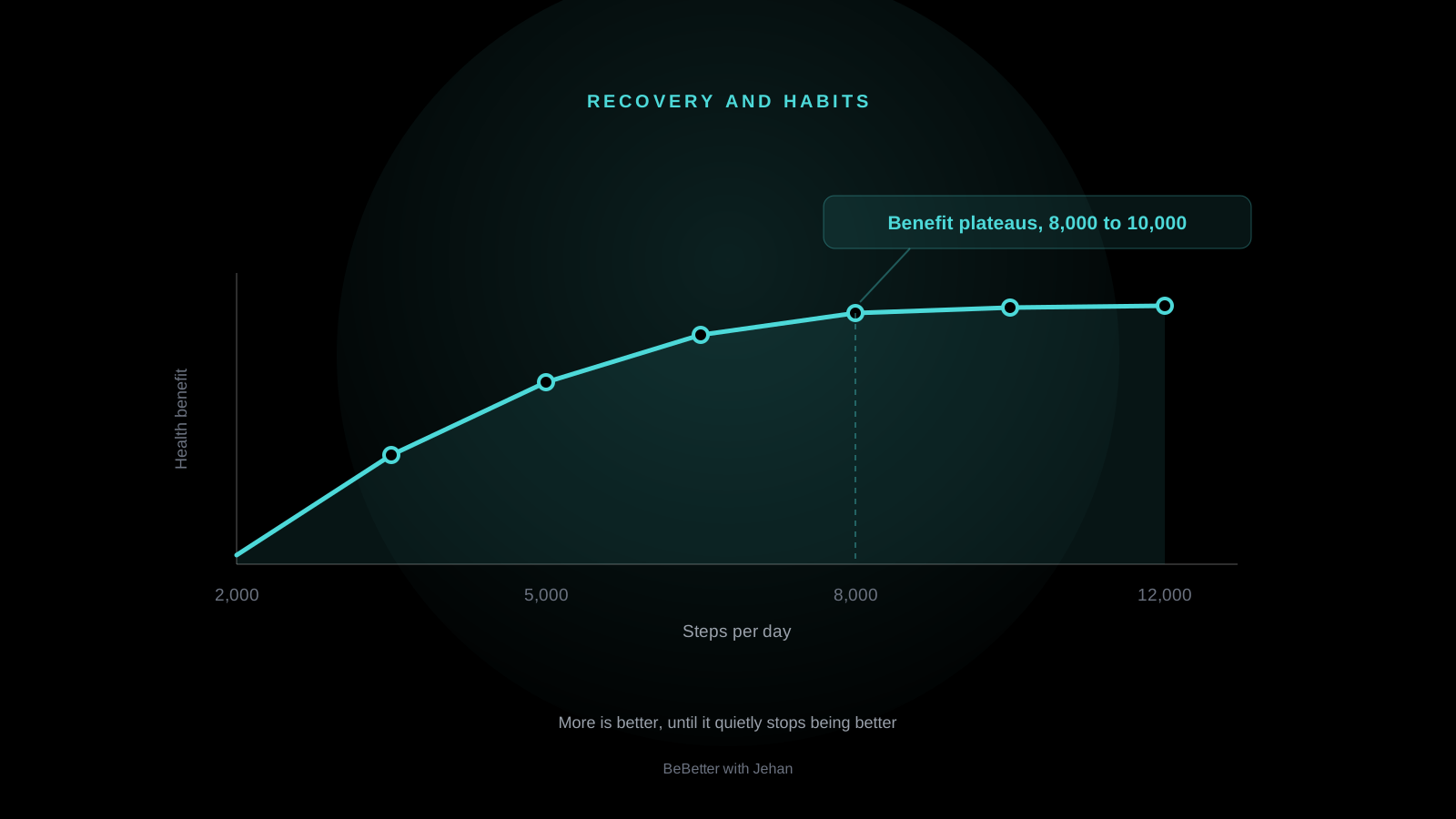
There is no step target derived specifically for fat loss. For general health, a meta-analysis of 15 cohorts found mortality risk fell progressively and then plateaued at 8,000 to 10,000 steps per day for adults under 60, and 6,000 to 8,000 for those aged 60 and over. For fat loss, steps work by raising daily energy expenditure, so what matters is a consistent increase above your current average rather than hitting a specific round number.
The widely quoted 10,000 figure is not a research finding. The paper states directly that there is little evidence supporting it.
- Find your current daily average before setting any target.
- Add roughly 2,000 to it rather than jumping straight to a round number.
- The steepest benefit is at the low end. 3,000 to 6,000 beats 9,000 to 12,000.
- Steps raise energy expenditure at almost no recovery cost, unlike hard cardio.
- Watch for steps quietly falling as a deficit progresses. It is a common cause of stalls.
What the research actually found
The largest analysis on this question pooled 15 international cohorts covering 47,471 adults, with 3,013 deaths recorded over the follow-up period (Paluch et al., 2022).
| Age group | Mortality risk plateaued at |
|---|---|
| Under 60 | 8,000 to 10,000 steps per day |
| 60 and over | 6,000 to 8,000 steps per day |
Two further findings are worth knowing. The three more active quartiles showed a 40 to 53 percent lower risk of death compared with the least active quartile, whose average was roughly 3,500 steps. And once total step volume was accounted for, stepping rate was largely attenuated, suggesting how many steps you take matters more than how fast you take them.
I want to be precise about what this study does and does not tell you. It measured all-cause mortality, not fat loss. It is excellent evidence that walking more is good for you and that the benefit curve flattens. It is not evidence about body composition, and it should not be presented as such.
NEAT stands for non-exercise activity thermogenesis: the energy you burn through everything that is not deliberate exercise, sleeping or digesting food. Walking, fidgeting, standing and moving around the office all fall under it, and it varies substantially between people.
Where 10,000 came from
The 10,000 figure is widely reported to originate from a 1960s Japanese pedometer marketing campaign rather than from any research programme. The Paluch paper opens by noting that although 10,000 steps per day is widely promoted, there is little evidence to support that specific recommendation.
This is not a reason to dismiss step counting. It is a reason to stop treating 10,000 as a pass mark. Someone averaging 4,000 who reaches 7,000 has captured most of the available benefit. Someone at 9,500 chasing 10,000 is optimising a rounding error.
Coach's perspective
When a client stalls, steps are one of the first two things I check, alongside whether intake has drifted. It is remarkable how often the answer is there.
What happens is subtle and nobody notices it. You start a deficit, you have slightly less energy, and without deciding anything you take the lift instead of the stairs, drive instead of walking, and move less around the house. Steps drop from 9,000 to 6,000 across a month. Your carefully calculated deficit quietly shrank by a couple of hundred calories a day and you never touched your food.
Why steps matter for fat loss
Steps influence fat loss through energy expenditure, and they have one property that makes them uniquely valuable to someone managing training around a job: they cost almost nothing in recovery.
| Lever | Effect on deficit | Recovery cost | Effect on adherence |
|---|---|---|---|
| Eat less food | Direct and immediate | None physically | Falls as hunger rises |
| Add hard cardio | Moderate | Meaningful | Competes with lifting |
| Add daily steps | Moderate and cumulative | Minimal | Generally improves |
| Add lifting volume | Small directly | High | Limited by recovery |
That third row is why steps are the first lever I reach for when someone needs a larger deficit. Cutting food further compromises adherence and protein intake. Adding hard cardio competes with the resistance training that protects your muscle, as covered in how to lose fat without losing muscle. Walking does neither.
Steps also sit inside the wider activity picture. The WHO recommends 150 to 300 minutes of moderate activity weekly for adults, plus muscle-strengthening on two or more days (Bull et al., 2020). Walking contributes directly to the first of those.
Setting your own target
Do not start from a round number. Start from your own baseline.
| Current average | First target | Eventual target |
|---|---|---|
| Under 3,000 | 5,000 | 7,000 to 8,000 |
| 3,000 to 5,000 | 6,500 | 8,000 to 9,000 |
| 5,000 to 7,000 | 8,000 | 9,000 to 10,000 |
| 7,000 to 9,000 | 9,500 | 10,000 plus if convenient |
| Over 9,000 | Hold it | Consistency beats increase |
Measure your current average across a normal week before changing anything. Most people are surprised, usually downwards. Then add roughly 2,000 and hold it until it feels unremarkable.
Getting the steps in around a desk job
The reason step targets fail is that people try to add a 40 minute walk to a day that has no 40 minute gap in it. Distributing it works better.
- A 15 minute walk after lunch. Roughly 1,500 steps, and it doubles as a break you were going to take anyway.
- Get off one stop early. Usually 1,000 to 2,000 steps with no additional time cost.
- Take calls standing and walking. Genuinely effective if your work involves regular calls.
- One deliberate evening walk. 20 minutes is around 2,000 steps, and it also helps wind down before sleep.
- Stairs by default. Small individually, meaningful across a month.
Those five habits together add roughly 5,000 to 6,000 steps to a sedentary day without requiring a single block of dedicated exercise time.
- Mortality benefit plateaus at 8,000 to 10,000 steps for under-60s, and 6,000 to 8,000 for those 60 and over.
- The 10,000 figure is a marketing legacy, not a research finding.
- That evidence concerns mortality, not fat loss. For fat loss the mechanism is energy expenditure.
- Steps raise your deficit at almost no recovery cost, unlike additional hard cardio.
- Start from your own average and add roughly 2,000 rather than chasing a round number.
- Falling step counts are a very common and largely invisible cause of stalled fat loss.
Myth versus fact
| Common claim | What the evidence says |
|---|---|
| “You need 10,000 steps a day.” | The largest meta-analysis states there is little evidence for this specific figure. Benefit plateaued at 8,000 to 10,000 for under-60s. |
| “Walking does not burn enough to matter.” | Across a week the cumulative expenditure is substantial, and unlike hard cardio it does not compromise recovery or lifting. |
| “You have to walk fast for it to count.” | Once total step volume was accounted for, stepping rate was largely attenuated in the mortality analysis. |
| “Steps can replace resistance training.” | They cannot. Steps add expenditure; resistance training is what protects muscle while you lose fat. |
| “If I train hard I do not need to worry about daily movement.” | An hour of training does not offset fifteen sedentary hours. The two are largely independent contributors. |
The mistakes I see most
1. Setting 10,000 as a pass mark
It turns a useful habit into a daily failure for anyone averaging 4,000, and the figure has no research basis.
2. Not measuring the baseline first
Without knowing your current average you cannot set a sensible increase or notice when it drifts.
3. Letting steps fall as the deficit progresses
Extremely common, entirely invisible, and one of the most frequent causes of an unexplained stall.
4. Adding hard cardio instead of steps
Costs recovery and competes with lifting, for a similar effect on expenditure.
5. Trying to add it all in one block
A 40 minute walk needs a 40 minute gap. Distributing across the day works far better.
6. Treating steps as a substitute for lifting
They serve different purposes. Steps add deficit, lifting protects muscle.
Your practical checklist
- Record your daily step average across one normal week before changing anything.
- Set a first target roughly 2,000 above that average.
- Pick two specific habits from the list above and attach them to existing routines.
- Track your weekly step average, not individual days.
- Recheck your average every four weeks, especially while in a deficit.
- If fat loss stalls, check step drift before cutting calories further.
- Keep resistance training separate. Steps add deficit, lifting protects muscle.
Research summary
Paluch and colleagues (2022) is a harmonised meta-analysis of 15 prospective cohorts, N = 47,471, published in the Lancet Public Health. Harmonised analysis across cohorts is methodologically strong, and the age-stratified plateau finding is its most useful contribution.
The limitation that matters most here. These are observational cohort studies measuring all-cause mortality. They establish association, not causation, and they say nothing directly about fat loss or body composition. People who walk more differ from people who walk less in many ways that are difficult to fully adjust for. Using this paper as fat-loss evidence would be overreaching, which is why this article uses it for the health and plateau argument and reasons about fat loss separately through energy expenditure.
Bull and colleagues (2020) is the WHO guideline development paper, representing expert consensus across a large evidence base rather than a single trial.
What is genuinely not established: there is no well-supported step target specifically for fat loss, and anyone quoting one with precision is going beyond the evidence. Individual variation in NEAT is also large, so the same step count means different things for different people.
Steps only work if someone is watching them.
The problem with steps is not knowing they matter. It is that they drift downward silently while you are focused on food and training. Your Progress Dashboard in the Fitness Blueprint tracks steps weekly alongside weight, sleep and adherence, so when progress slows the AI-assisted analysis can show you whether your step average quietly fell rather than leaving you to cut calories on a guess.
DM ‘BLUEPRINT’ to get startedThe Fitness Blueprint is ₹14,999 at present, reduced from a recommended price of ₹24,999. Flexible payment over 3 or 6 months can be arranged. See what is included.
Curious exactly what is included and what it costs? See the full pricing breakdown. Still deciding, or have a specific question first? Get in touch and I will answer honestly.
Frequently asked questions
How many steps a day should I walk to lose fat?
There is no fat-loss-specific step target in the research. For general health, benefits plateau around 8,000 to 10,000 steps for adults under 60. For fat loss, what matters is that steps raise your daily energy expenditure, so the useful target is a consistent increase on your current average.
Is 10,000 steps a day necessary?
No. The Paluch meta-analysis states plainly that there is little evidence supporting the 10,000 figure. Mortality risk plateaued at 8,000 to 10,000 steps for under-60s and 6,000 to 8,000 for those 60 and over.
Where did 10,000 steps come from?
It is widely reported to originate from a 1960s Japanese pedometer marketing campaign rather than from research. The Paluch paper notes it is widely promoted despite little supporting evidence.
Do steps help more than cardio for fat loss?
They are not competing. Steps add energy expenditure at very low recovery cost, which makes them easier to sustain alongside resistance training than additional hard cardio.
Do I need to walk fast for it to count?
For mortality outcomes, the Paluch analysis found stepping rate was largely attenuated once total step volume was accounted for. Total steps appear to matter more than pace.
What if I cannot hit a high step count?
Increase from wherever you are. The steepest part of the benefit curve is at the low end, so moving from 3,000 to 6,000 is a larger gain than moving from 9,000 to 12,000.
References
- Paluch AE, Bajpai S, Bassett DR, et al. Daily steps and all-cause mortality: a meta-analysis of 15 international cohorts. The Lancet Public Health. 2022;7(3):e219-e228. PubMed
- Bull FC, Al-Ansari SS, Biddle S, et al. World Health Organization 2020 guidelines on physical activity and sedentary behaviour. British Journal of Sports Medicine. 2020;54(24):1451-1462. PubMed
- Garthe I, Raastad T, Refsnes PE, Koivisto A, Sundgot-Borgen J. Effect of two different weight-loss rates on body composition and strength and power-related performance in elite athletes. International Journal of Sport Nutrition and Exercise Metabolism. 2011;21(2):97-104. PubMed
A note on medical advice. This article is educational and reflects the research as I read it. It is not medical or dietetic advice and it cannot account for your individual circumstances. If you are managing a medical condition, are pregnant, are taking medication affected by diet or activity, or are recovering from injury, please speak to your doctor or a registered dietitian first. If anything here conflicts with advice from your own clinician, follow theirs.
Questions about applying any of this? Message me directly or find me on Instagram. Back to the Knowledge Hub or the homepage. You can also read more about how I coach, see what the Fitness Blueprint costs, or get in touch.