Does sitting all day undo your workouts?
If you work at a desk, you may sit for nine or ten hours a day and train for one. It is reasonable to wonder whether that hour is enough.

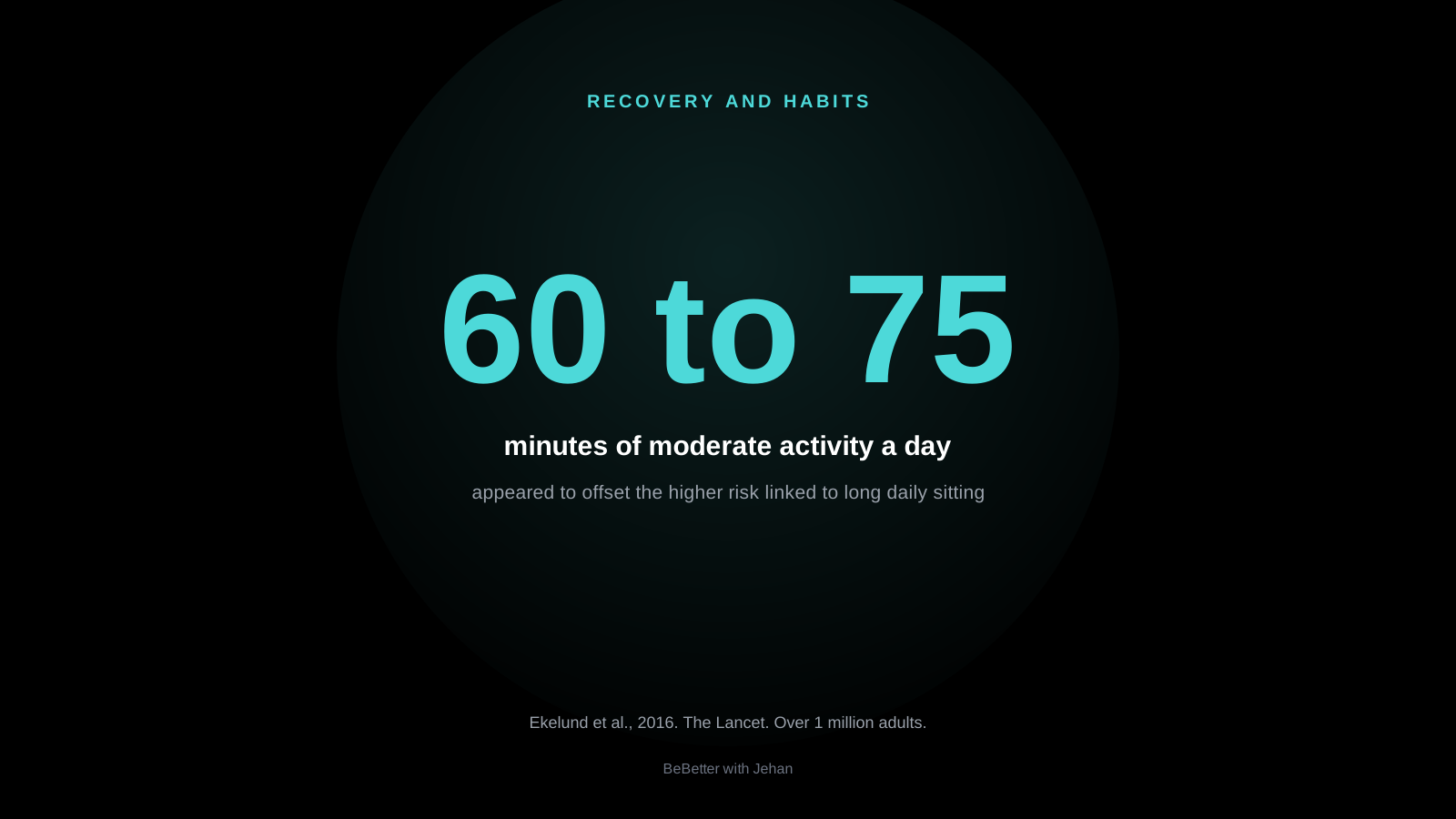
Not entirely, but it matters. A meta-analysis of more than one million adults found that about 60 to 75 minutes of moderate activity a day appeared to eliminate the higher risk of death linked to long sitting time. Lower activity levels did not offset it fully.
Your workout helps, and daily movement around it matters too.
- Long sitting is linked to higher health risk.
- About 60 to 75 minutes of moderate activity a day appeared to offset it.
- That total includes walking, not only gym sessions.
- Break up long sitting where you can.
- Daily steps are the easiest place to start.
What the research found
Ekelund and colleagues pooled data from more than one million adults followed for between 2 and 18 years (Ekelund et al., 2016).
| Finding | Result |
|---|---|
| Most active group, about 60 to 75 minutes of moderate activity a day | No increased risk of death with high sitting time |
| Lower activity levels | Higher sitting time associated with higher risk |
| High TV-viewing time | Risk reduced, but not eliminated, by high activity |
Moderate-intensity activity is activity that raises your breathing and heart rate, such as brisk walking. It does not need to be a gym session.
What the guidelines say
The World Health Organization recommends that adults do 150 to 300 minutes of moderate activity a week, plus muscle-strengthening activity on two or more days, and that they limit sedentary time and replace it with physical activity of any intensity (Bull et al., 2020). The 60 to 75 minutes a day in the meta-analysis is considerably more, which is why daily walking matters for desk workers.
Moving more around a desk job
- Walk during phone calls.
- Take a short walk after lunch.
- Use stairs instead of lifts.
- Stand or move between meetings.
- Build steps gradually, as covered in how many steps a day you need; a meta-analysis found health benefits rise with steps before levelling off (Paluch et al., 2022).
Coach's perspective
Many of my clients train hard three times a week and then sit for ten hours a day. The training is valuable, but it is only part of the picture.
The biggest change is usually not more workouts. It is walking more in the hours between them.
- Long daily sitting is linked to higher health risk.
- About 60 to 75 minutes of moderate activity a day appeared to offset the risk.
- That activity can include brisk walking.
- High activity reduced but did not eliminate the risk from heavy TV viewing.
- Daily steps are the easiest place to start.
Myth versus fact
| Common claim | What the evidence says |
|---|---|
| “One workout cancels a day of sitting.” | Lower activity levels did not fully offset high sitting time in the meta-analysis. |
| “Only gym sessions count.” | Moderate activity, including brisk walking, counts. |
| “Standing desks solve the problem.” | Movement matters more than simply standing. |
The mistakes I see most
1. Treating the workout as the only activity of the day
Movement around it matters too.
2. Sitting through every call
Walking calls add up quickly.
3. Aiming for 75 minutes overnight
Build up gradually from where you are.
4. Ignoring evenings
TV time is when sitting often adds up most.
Your practical checklist
- Note roughly how long you sit on a workday.
- Add a short walk after lunch.
- Take one call a day on foot.
- Track your daily steps.
- Build towards more daily activity over several weeks.
Research summary
Ekelund and colleagues (2016) is a harmonised meta-analysis of observational cohorts. It shows associations, not cause and effect, and measured mortality rather than fitness or body composition.
Bull and colleagues (2020) is the WHO guideline development paper. Paluch and colleagues (2022) is a meta-analysis of daily steps and mortality, also observational.
A plan that accounts for your working day.
Your Blueprint builds in daily steps and activity targets alongside your training, and your Progress Dashboard tracks them each week. Send me a message and I will walk you through the next steps.
Start my BlueprintOpens WhatsApp with a short message ready to send. Prefer to share your details directly? Complete the client intake form.
The Fitness Blueprint is ₹14,999 at present, reduced from a recommended price of ₹24,999. Flexible payment over 3 or 6 months can be arranged. See what is included.
Curious exactly what is included and what it costs? See the full pricing breakdown. Still deciding, or have a specific question first? Get in touch and I will answer honestly.
Frequently asked questions
Does sitting all day undo exercise?
Not entirely, but long sitting carries its own risk. A large meta-analysis found that about 60 to 75 minutes of moderate activity a day appeared to eliminate the higher risk of death linked to high sitting time.
How much activity offsets sitting at a desk?
In the meta-analysis, people in the most active group, roughly 60 to 75 minutes of moderate activity a day, showed no increased risk with high sitting time.
Does TV time count the same as work sitting?
Not exactly. High activity reduced, but did not eliminate, the risk linked to high TV-viewing time.
What can I do at a desk job?
Walk during calls, take short movement breaks, use stairs and build daily steps alongside your training.
References
- Ekelund U, Steene-Johannessen J, Brown WJ, et al. Does physical activity attenuate, or even eliminate, the detrimental association of sitting time with mortality? A harmonised meta-analysis of data from more than 1 million men and women. The Lancet. 2016;388(10051):1302-1310. PubMed
- Bull FC, Al-Ansari SS, Biddle S, et al. World Health Organization 2020 guidelines on physical activity and sedentary behaviour. British Journal of Sports Medicine. 2020;54(24):1451-1462. PubMed
- Paluch AE, Bajpai S, Bassett DR, et al. Daily steps and all-cause mortality: a meta-analysis of 15 international cohorts. The Lancet Public Health. 2022;7(3):e219-e228. PubMed
A note on medical advice. This article is educational and reflects the research as I read it. It is not medical or dietetic advice and it cannot account for your individual circumstances. If you are managing a medical condition, are pregnant, are taking medication affected by diet or activity, or are recovering from injury, please speak to your doctor or a registered dietitian first. If anything here conflicts with advice from your own clinician, follow theirs.
Questions about applying any of this? Message me directly or find me on Instagram. Back to the Knowledge Hub or the homepage. You can also read more about how I coach, see what the Fitness Blueprint costs, or get in touch.