Does poor sleep sabotage fat loss?
This is the variable almost every fat loss plan ignores, including plenty of good ones. It is also the one where the evidence is more striking than most people expect, and where the honest caveats matter.
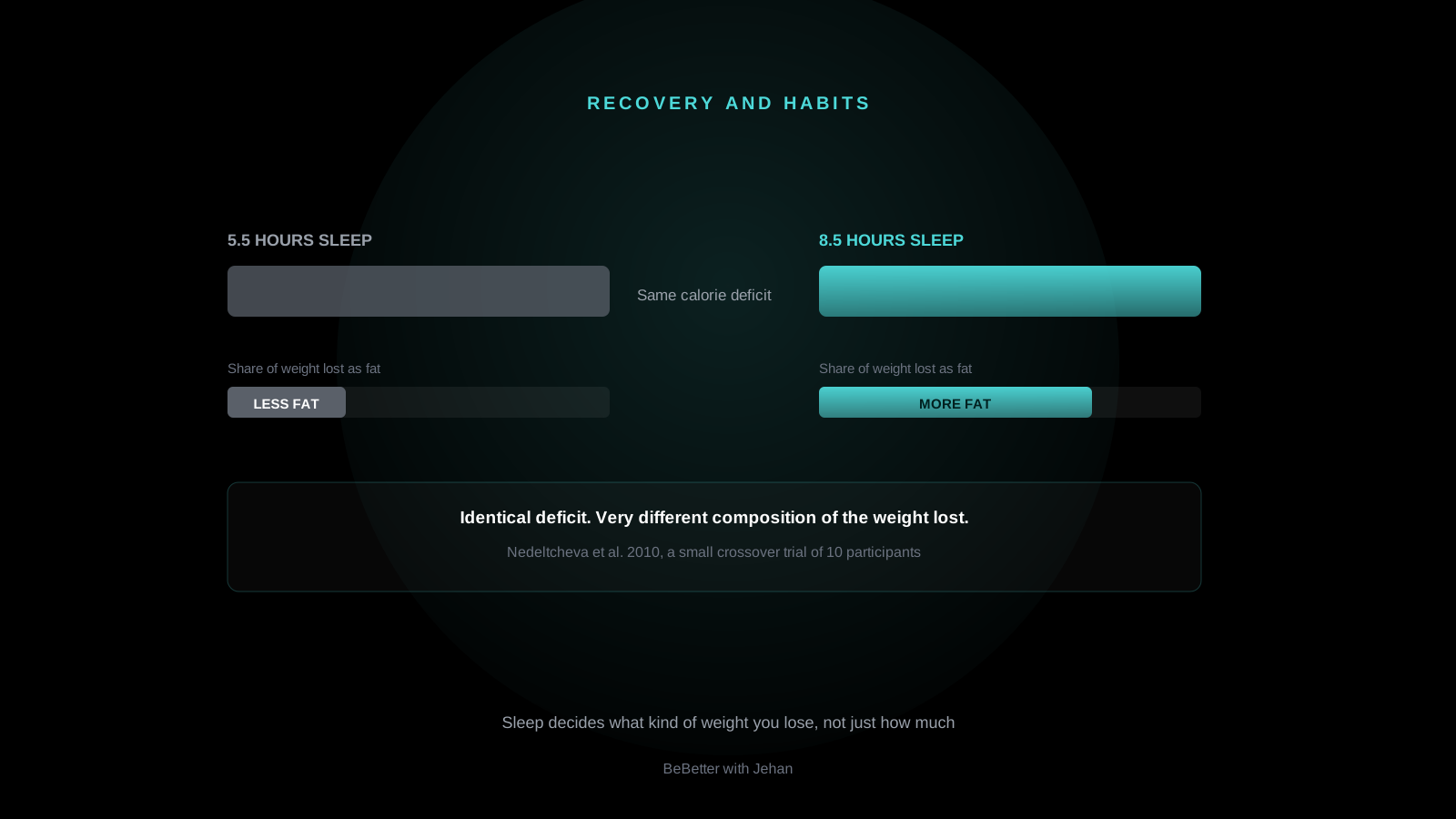
Yes, though not in the way most people assume. Poor sleep does not usually stop you losing weight. It appears to change what kind of weight you lose. In one controlled trial, participants on an identical calorie deficit lost a similar total amount of weight, but those sleeping 5.5 hours rather than 8.5 hours lost substantially less of it as fat and more as lean tissue.
Sleep also affects appetite regulation, training quality and adherence, all of which compound over a twelve week block.
- Aim for seven to nine hours. Consistency of timing matters as much as duration.
- If sleep is poor, set your deficit at the gentler end rather than the aggressive end.
- Keep protein high, since it becomes more protective when recovery is compromised.
- Protect sleep before adding training volume. An extra hour in bed often beats an extra session.
- Track sleep alongside weight so you can see the relationship in your own data.
What the research actually found
The study that gets quoted most here is Nedeltcheva and colleagues, published in the Annals of Internal Medicine. It is worth walking through properly, because it is both more interesting and more limited than the headline suggests.
Participants were placed on an identical calorie deficit. The only variable that changed was sleep: 5.5 hours per night in one condition, 8.5 hours in the other. Total weight lost was similar in both. The composition of that weight was not. In the short sleep condition, fat loss fell by roughly 55 percent and the loss of lean mass rose by around 60 percent (Nedeltcheva et al., 2010).
That is a large effect for a single variable, and it is why sleep appears in the Resources library inside the Blueprint rather than being treated as a lifestyle nicety.
Now the caveat, which matters and is usually omitted. This was a crossover trial with ten participants. Ten. The percentages get repeated across the internet with a confidence that a sample that size does not support. The direction of the finding is consistent with the wider literature and with what I observe in coaching. The precise magnitude should be treated as indicative rather than as a number you can plan around.
Body composition describes the proportion of your bodyweight that is fat mass versus lean mass, which includes muscle. Two people at an identical weight can look and perform very differently depending on this split, which is why the composition of weight lost matters more than the total.
Why sleep changes the composition of loss
The proposed mechanisms involve hormonal and recovery pathways. Sleep restriction is associated with changes in hormones involved in appetite and in the anabolic environment that supports muscle retention. Recovery from resistance training also depends heavily on sleep.
I want to be careful with the level of confidence here. The mechanisms are plausible and supported, but the field is more complicated than a simple hormone story, and popular content routinely overstates how precisely we understand it. What is reasonably well established is the observable outcome: on the same deficit, worse sleep tends to produce a worse body composition result.
The practical logic is straightforward regardless of mechanism. A calorie deficit is a stress. Resistance training is a stress. Sleep is when you recover from both. Remove a large share of the recovery and the body has less capacity to protect the tissue you want to keep. That is the same reasoning behind keeping the deficit itself moderate, which I cover in the guide to setting a calorie deficit.
Coach's perspective
When a client stalls, sleep is the second thing I check, right after whether their intake has quietly drifted. It is checked before training volume, before exercise selection, and long before anything exotic.
The reason is that sleep is where the returns are largest and the intervention is cheapest. Nobody enjoys hearing it, because it is less interesting than changing a programme. But I have watched more plateaus resolve from an extra hour in bed than from any adjustment I have ever made to a training split.
Sleep, appetite and adherence
Beyond composition there is a simpler and arguably more important effect. Short sleep tends to make a deficit harder to stick to.
Sleep restriction is associated with increased perceived hunger and stronger cravings, particularly for energy-dense food. Whether that operates through appetite hormones, reduced impulse control, or simply more waking hours in which to eat is debated. The practical consequence is not.
| What it affects | Typical direction | Why it matters over 12 weeks |
|---|---|---|
| Perceived hunger | Increases | Makes the same deficit feel considerably harder |
| Cravings for energy-dense food | Increase | Small unplanned additions accumulate quickly |
| Spontaneous daily movement | Tends to decrease | Reduced step count silently shrinks your deficit |
| Training quality | Declines | Weaker sessions mean less stimulus to retain muscle |
| Adherence generally | Declines | The largest single predictor of whether any plan works |
That fourth row is easy to miss. Tired people move less without deciding to. Steps fall, non-exercise activity falls, and the deficit you carefully calculated quietly narrows without a single change to your food.
What short sleep does to your training
Progressive overload requires you to do slightly more than last week. That gets considerably harder when you are underslept.
The practical effect is not usually dramatic. It is that the set which should have been ten reps becomes eight, week after week, and the progression described in the guide to progressive overload stops advancing. Since progression is the mechanism behind adaptation, a stalled progression means a stalled result, even though nothing about the programme itself is wrong.
This is why I would rather a client train three times a week having slept properly than five times a week exhausted. The five sessions look more committed. The three sessions produce more.
What to do if your sleep is genuinely limited
Plenty of people reading this have a new baby, a demanding job with early calls, or shift work. Telling them to sleep nine hours is useless advice. Here is what actually helps.
| Adjustment | Why it helps |
|---|---|
| Set the deficit at 15 percent rather than 20 | Lower total stress load when recovery capacity is reduced |
| Keep protein at the higher end, 1.8 to 2.2 g per kg | Protein becomes more protective when recovery is compromised |
| Prioritise consistent sleep timing over total duration | Regular timing is often more achievable and still helps |
| Reduce training frequency rather than intensity | Fewer quality sessions beat more poor ones |
| Protect the sleep you do get | Dark, cool room. Caffeine cut-off by early afternoon. Screens down before bed. |
| Expect a slower rate and plan for it | A realistic slower timeline beats an aggressive one you abandon |
None of that is glamorous. All of it works better than pretending the constraint does not exist.
- Poor sleep does not usually stop weight loss. It appears to shift the loss away from fat and towards lean tissue.
- In one controlled trial, 5.5 hours versus 8.5 hours on an identical deficit cut fat loss substantially and increased lean mass loss.
- That trial had only ten participants, so treat the direction as reliable and the exact percentages as indicative.
- Short sleep also increases hunger, reduces spontaneous movement and degrades training quality.
- If sleep is genuinely limited, run a gentler deficit, keep protein high and reduce training frequency rather than quality.
- Sleep is usually the second thing worth checking when progress stalls, after intake drift.
Myth versus fact
| Common claim | What the evidence says |
|---|---|
| “Sleep does not matter if your calories are right.” | Calories determine how much weight you lose. Sleep appears to influence how much of that loss is fat rather than muscle. |
| “You can simply catch up at the weekend.” | Recovery sleep helps, but consistent timing across the week tends to work better than accumulating a deficit and repaying it in two nights. |
| “Everyone needs exactly eight hours.” | Individual requirements vary. Seven to nine hours suits most adults, and the meaningful comparison in the research is chronic short sleep against adequate sleep. |
| “Training hard makes up for poor sleep.” | Training is the stimulus, sleep is a large part of the recovery. Adding stimulus without recovery generally produces worse results, not better. |
| “Sleep only matters for building muscle, not for fat loss.” | The most striking evidence here is specifically about fat loss, where short sleep shifted the composition of weight lost in the wrong direction. |
The mistakes I see most
1. Treating sleep as optional discipline
It is a physiological input to your result, not a measure of how committed you are.
2. Adding a training session instead of an hour of sleep
When you are already underslept, the extra session usually costs more in recovery than it delivers in stimulus.
3. Running an aggressive deficit on poor sleep
Two large stressors stacked together. This is the combination most likely to cost you muscle.
4. Not tracking sleep at all
If it is not recorded, you cannot see the relationship between your worst sleep weeks and your worst progress weeks.
5. Blaming metabolism for a sleep problem
Chronic short sleep explains a great many stalled plateaus that get attributed to something more exotic.
6. Using alcohol to fall asleep
It shortens time to sleep onset but degrades sleep quality, which is the part that matters here.
Your practical checklist
- Record your sleep hours weekly alongside your weight and training.
- Aim for seven to nine hours, with consistent timing across the week.
- Set a caffeine cut-off in the early afternoon and hold it for two weeks to see if it helps.
- Keep the bedroom dark and cool, and get screens out of the last stretch before bed.
- If sleep is genuinely limited, drop your deficit to around 15 percent.
- Keep protein at the higher end of the range while recovery is compromised.
- Reduce training frequency before reducing training quality.
- When progress stalls, check intake drift first and sleep second, before touching the programme.
Research summary
Nedeltcheva and colleagues (2010) is the central reference. It is a randomised crossover trial, which is a strong design because participants act as their own controls. Its serious limitation is sample size: ten participants. The widely quoted 55 percent and 60 percent figures come from that small sample and are repeated far more confidently than is warranted. Treat the direction as sound and the magnitude as indicative.
Garthe and colleagues (2011) is included here because it establishes the related principle that total stress matters: faster weight loss preserved lean mass less effectively than slower loss. It studied elite athletes, so the population differs from a general audience.
What we do not know well: the precise dose-response relationship between hours slept and body composition outcomes is not established. Nobody can tell you that seven hours produces a specific percentage better result than six. The mechanisms are plausible but more complex than popular summaries suggest. And almost all of this work is short-term and conducted in controlled conditions, not across twelve weeks in people with jobs and children. The honest position is that sleep clearly matters, the direction is consistent, and the precise size of the effect for any individual is unknown.
Sleep is a training variable, so it should be tracked like one.
Most plans never look at sleep at all, which is why stalls get blamed on the programme. Your Progress Dashboard in the Fitness Blueprint tracks sleep alongside weight, adherence and steps, so when progress slows the AI-assisted analysis can show you whether your worst progress weeks line up with your worst sleep weeks. Your Resources library covers stress and recovery in more depth.
DM ‘BLUEPRINT’ to get startedThe Fitness Blueprint is ₹14,999 at present, reduced from a recommended price of ₹24,999. Flexible payment over 3 or 6 months can be arranged. See what is included.
One mechanism worth knowing: short sleep reduces spontaneous daily movement, so your step count often falls without you deciding anything.
Curious exactly what is included and what it costs? See the full pricing breakdown. Still deciding, or have a specific question first? Get in touch and I will answer honestly.
Frequently asked questions
How many hours of sleep do I need to lose fat?
Most adults do best somewhere between seven and nine hours. The research showing impaired fat loss compared 5.5 hours against 8.5 hours, so the meaningful comparison is chronic short sleep against adequate sleep, not seven hours against eight.
Can I lose weight on five hours of sleep?
Yes, weight will still come off in a calorie deficit. The concern is the composition of that loss. The available evidence suggests short sleep shifts the balance away from fat and towards lean tissue, which is the opposite of what you want.
Does poor sleep make you hungrier?
It appears to affect appetite regulation and tends to increase perceived hunger and cravings, which makes adherence harder. This is a well-described direction of effect, though the size of it varies considerably between individuals.
Is it better to sleep more or train more?
If you are chronically short on sleep, protecting sleep is usually the better return. Training on inadequate recovery produces worse sessions and worse adaptation. An extra hour in bed frequently beats an extra session.
Can I catch up on sleep at the weekend?
Partially, but it is not a clean substitute. Consistent sleep timing across the week tends to work better than accumulating a deficit and attempting to repay it, though weekend recovery sleep is certainly better than none.
What if I genuinely cannot sleep more?
Then optimise what you control: consistent timing, a dark cool room, limiting caffeine after early afternoon, and reducing screens before bed. And set your calorie deficit at the gentler end, because your recovery capacity is lower.
References
- Nedeltcheva AV, Kilkus JM, Imperial J, Schoeller DA, Penev PD. Insufficient sleep undermines dietary efforts to reduce adiposity. Annals of Internal Medicine. 2010;153(7):435-441. PubMed
- Garthe I, Raastad T, Refsnes PE, Koivisto A, Sundgot-Borgen J. Effect of two different weight-loss rates on body composition and strength and power-related performance in elite athletes. International Journal of Sport Nutrition and Exercise Metabolism. 2011;21(2):97-104. PubMed
- Helms ER, Aragon AA, Fitschen PJ. Evidence-based recommendations for natural bodybuilding contest preparation: nutrition and supplementation. Journal of the International Society of Sports Nutrition. 2014;11:20. PubMed
A note on medical advice. This article is educational and reflects the research as I read it. It is not medical or dietetic advice and it cannot account for your individual circumstances. If you are managing a medical condition, are pregnant, are taking medication affected by diet or activity, or are recovering from injury, please speak to your doctor or a registered dietitian first. If anything here conflicts with advice from your own clinician, follow theirs.
Questions about applying any of this? Message me directly or find me on Instagram. Back to the Knowledge Hub or the homepage. You can also read more about how I coach, see what the Fitness Blueprint costs, or get in touch.