How to calculate a calorie deficit safely
Almost everyone who comes to me having failed at fat loss made the same mistake, and it was not eating too much. It was cutting too hard, too fast, and losing the muscle that made the result worth having.

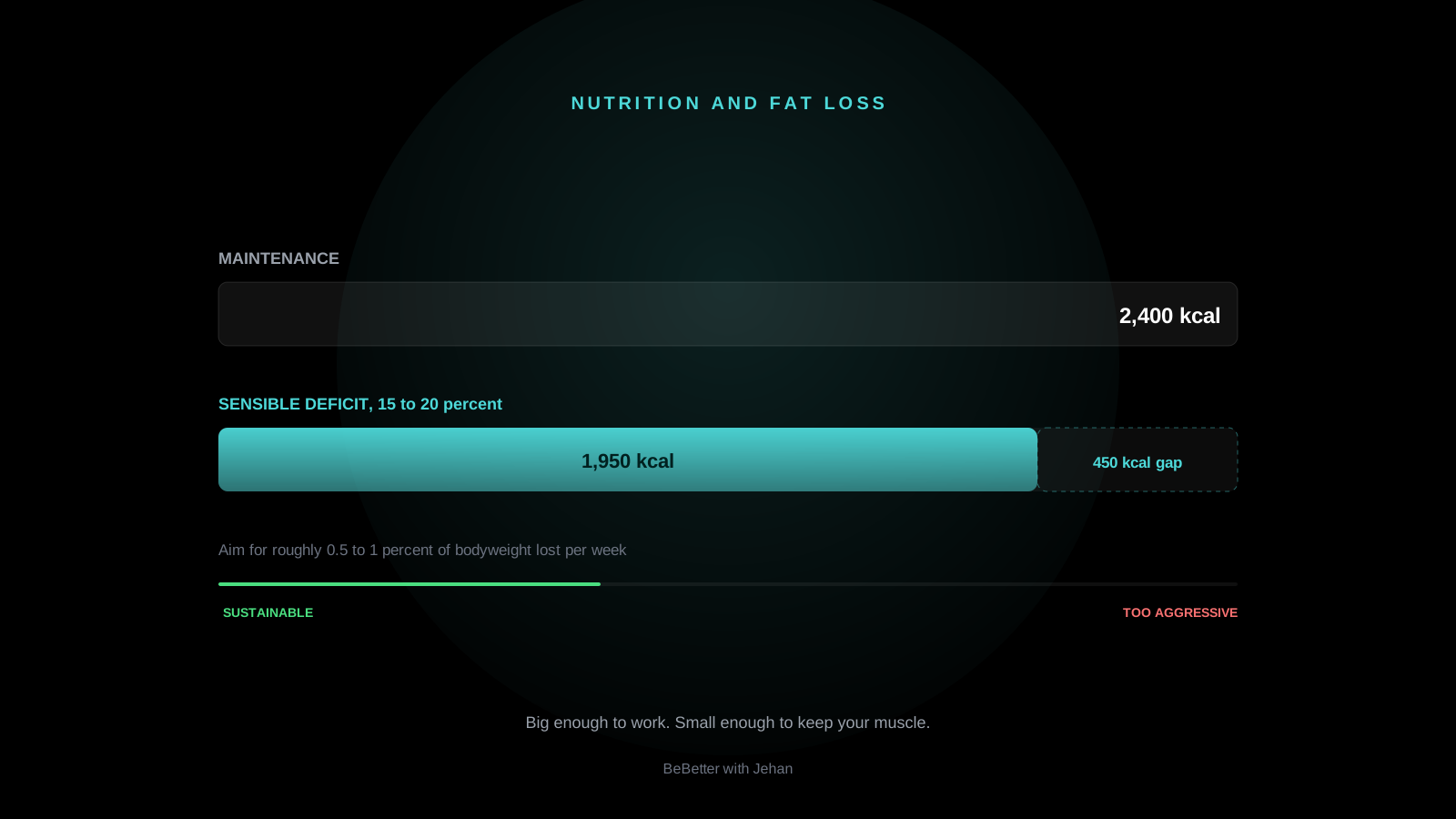
Set your deficit at 15 to 20 percent below your maintenance calories, which should produce a loss of roughly 0.5 to 1 percent of bodyweight per week. For an 80 kg person eating 2,400 kcal at maintenance, that means around 1,950 kcal a day and 0.4 to 0.8 kg lost per week.
Do not set intake below your basal metabolic rate, and pair the deficit with adequate protein and resistance training. Without those two, a deficit takes muscle as readily as it takes fat.
- Estimate maintenance calories, then confirm it against two to three weeks of real data.
- Subtract 15 to 20 percent. That is your target.
- Never set intake below your BMR.
- Keep protein at 1.6 to 2.2 g per kg and lift weights at least twice a week.
- Judge progress on a three-week trend, never on a single weigh-in.
Why deficit size decides what you lose
A calorie deficit means your body needs more energy than you are giving it, so it makes up the difference from storage. The question that matters is which storage. It can draw on body fat, which is the entire point, or it can break down muscle tissue, which is not.
Two things push that decision towards fat. Resistance training gives your body an active reason to keep muscle. Adequate protein gives it the raw material to do so. A third factor decides how hard your body has to fight at all, and that is the size of the deficit itself.
A modest deficit lets fat cover most of the shortfall. An aggressive one outstrips what fat can release comfortably, and the body starts drawing on lean tissue to close the gap. This is the mechanism behind the most frustrating outcome in fat loss: reaching your goal weight and still not being happy with how you look. You lost weight. A meaningful share of it just was not fat.
Maintenance calories are the number of calories that keep your bodyweight stable. Everything in fat loss is defined relative to this figure, which is why estimating it correctly matters more than any other calculation you will do.
Step one: find your maintenance calories
Estimate it
Start with an equation. Mifflin-St Jeor is the one I use, because it performs reasonably well across general populations. It estimates your basal metabolic rate, the energy your body uses at complete rest, which you then multiply by an activity factor to get maintenance.
| Activity level | Description | Multiplier |
|---|---|---|
| Sedentary | Desk job, little deliberate movement | 1.2 |
| Lightly active | Desk job plus 1 to 3 training sessions a week | 1.375 |
| Moderately active | 3 to 5 sessions a week, reasonably active otherwise | 1.55 |
| Very active | 6 or more sessions a week, or physical job | 1.725 |
Most working professionals sit between 1.375 and 1.55, and almost everyone overestimates their own activity level. If you are genuinely unsure, take the lower one.
Then correct it against reality
This is the step people skip, and it matters more than the equation. An estimate is a starting hypothesis, not a fact about your body. Track your intake and your weight for two to three weeks. If your weight is stable, then whatever you actually ate is your true maintenance, whatever the calculator claimed.
Equations carry meaningful individual error. Your real maintenance can sit a few hundred calories either side of the prediction because of body composition, non-exercise movement and genuine metabolic variation. Two weeks of honest data beats any formula.
Step two: set the deficit
Subtract 15 to 20 percent from maintenance. That is the whole calculation.
| Maintenance | 15 percent deficit | 20 percent deficit | Expected weekly loss |
|---|---|---|---|
| 2,000 kcal | 1,700 kcal | 1,600 kcal | 0.3 to 0.6 kg |
| 2,200 kcal | 1,870 kcal | 1,760 kcal | 0.35 to 0.7 kg |
| 2,400 kcal | 2,040 kcal | 1,920 kcal | 0.4 to 0.8 kg |
| 2,600 kcal | 2,210 kcal | 2,080 kcal | 0.45 to 0.9 kg |
| 2,800 kcal | 2,380 kcal | 2,240 kcal | 0.5 to 1.0 kg |
Which end you choose depends on circumstances. Go towards 15 percent if you are already fairly lean, training hard, sleeping poorly or under significant work stress. Go towards 20 percent if you are carrying more body fat and have reasonable recovery capacity. Body recomposition, which I cover in the guide to losing fat and building muscle at once, works better at the gentler end or even at maintenance.
Step three: check the rate, not the day
The deficit is a hypothesis. The rate of loss tells you whether it was right.
Target roughly 0.5 to 1 percent of bodyweight per week. Garthe and colleagues compared two rates of weight loss in elite athletes and found the slower rate, around 0.7 percent per week, preserved and in some cases increased lean mass and strength, while the faster rate did not (Garthe et al., 2011). Helms and colleagues reach a similar conclusion for lean athletes in a deficit (Helms et al., 2014).
Bodyweight fluctuates by one to two kilograms day to day from water, sodium, carbohydrate intake, digestion and, for women, menstrual cycle phase. A single weigh-in tells you almost nothing. A three-week average tells you nearly everything. This is precisely why the Progress Dashboard reads three-week trends rather than reacting to Monday morning.
Coach's perspective
Nearly every client who arrives frustrated has run too large a deficit at some point, often 1,200 or 1,400 calories, and concluded their metabolism is broken. It rarely is. They set a target that no working adult could hold, held it for three weeks, then ate normally again and regained the weight, minus some of the muscle.
I would rather someone lose 0.4 kg a week for twelve weeks than 1.2 kg a week for three and then stop. The first person is 5 kg down with their strength intact. The second is 3 kg down, softer than when they started, and convinced they have failed.
The floor you should not go below
Whatever percentage you apply, there is a floor. Your intake should not fall below your basal metabolic rate, the energy your body needs for basic function before any activity at all.
For most adults that is somewhere between 1,400 and 1,800 kcal. This is why the widely circulated 1,200 calorie target is a poor idea for the majority of people: it usually sits below the floor, which makes muscle loss and dropped adherence very likely.
If your calculated deficit takes you below your BMR, the deficit is too large. Reduce it, and if you want faster progress add movement instead of subtracting more food. Steps are the most underrated lever available to a desk worker, and unlike further food restriction they do not compromise recovery.
When the scale stops moving
Before you cut calories again, work through these in order. In my experience the answer is in the first two roughly nine times out of ten.
| Check | What usually happened | What to do |
|---|---|---|
| Has intake drifted? | Portions creep, untracked oil, weekend meals | Track precisely for one week before changing anything |
| Has movement dropped? | Steps fall as a deficit progresses, often unconsciously | Check your step average against a month ago |
| Is it actually a stall? | One flat week inside normal fluctuation | Look at the three-week average, not the last reading |
| Is water masking it? | Higher salt, more carbs, poor sleep, hard training | Wait another week before acting |
| Genuine adaptation | Real, but smaller and slower than most people assume | Reduce intake modestly or add steps, not both at once |
- Set your deficit at 15 to 20 percent below maintenance, not more.
- Confirm your maintenance against two to three weeks of real data rather than trusting an equation.
- Target 0.5 to 1 percent of bodyweight lost per week.
- Never set intake below your basal metabolic rate.
- A deficit without adequate protein and resistance training will cost you muscle.
- Judge everything on three-week trends. Single weigh-ins are noise.
Myth versus fact
| Common claim | What the evidence says |
|---|---|
| “A bigger deficit means faster, better results.” | Faster scale movement, yes. Better results, no. Larger deficits increase the proportion of weight lost as lean tissue and are far harder to sustain. |
| “3,500 calories equals one pound, so the maths is exact.” | It is a useful approximation, not a precise rule. Real energy balance shifts as you lose weight and as activity changes, which is why you adjust from observed results. |
| “Eating too little puts you in starvation mode so you stop losing.” | Metabolic adaptation is real but modest. What actually happens with very low intake is muscle loss, reduced spontaneous movement, and broken adherence. |
| “You must eat 1,200 calories to lose fat.” | For most adults this sits below BMR and is unnecessarily aggressive. Most people lose fat perfectly well on considerably more. |
| “If the scale has not moved this week, the plan has failed.” | Weekly fluctuation of one to two kilograms is normal. Only the multi-week trend carries information. |
The mistakes I see most
1. Trusting the calculator over your own data
An equation is a starting estimate with real individual error. Two to three weeks of tracked intake and weight is far more reliable.
2. Setting the deficit too aggressively
The most common single error, and the one that costs muscle and adherence simultaneously.
3. Cutting calories again after one flat week
Almost always premature. Check intake drift, step count and the three-week average first.
4. Dropping protein while dropping calories
Protein requirements rise in a deficit, not fall. Cut carbohydrate or fat if something has to go.
5. Removing food instead of adding movement
Steps cost you nothing in recovery. Further restriction costs you both recovery and adherence.
6. Abandoning resistance training during a cut
Training is what tells your body to keep the muscle. Without it, a deficit takes lean tissue much more readily.
Your practical checklist
- Estimate your BMR and multiply by an honest activity factor.
- Track intake and weight for two to three weeks to confirm real maintenance.
- Subtract 15 to 20 percent to set your target.
- Check the result is above your BMR. If not, reduce the deficit.
- Set protein at 1.6 to 2.2 g per kg and keep it there.
- Train with resistance at least twice a week.
- Weigh yourself consistently and read the three-week average only.
- Reassess after four weeks against the 0.5 to 1 percent per week target.
Research summary
Garthe and colleagues (2011) is the most directly relevant study here. It compared slow and fast weight loss in elite athletes and found the slower rate better preserved lean mass and performance. Its limitation is the population: elite athletes are not general-population desk workers, and they were training and eating under supervision.
Helms and colleagues (2014) is a review producing recommendations for natural bodybuilders in contest preparation. Its guidance on rate of loss and protein aligns with the wider literature, but the population is again a specific one, and its higher protein figures should not be read as general advice.
Where the evidence is weaker than people imply: the precise optimal deficit for a given individual is not established. The 15 to 20 percent range is a well-reasoned convention supported by the direction of the evidence, not a figure that has been isolated in a controlled trial for general populations. Metabolic adaptation is real but its magnitude is frequently overstated in popular content. Anyone giving you an exact calorie number with total confidence is overstating what is actually known.
The number is the easy part. Holding it is not.
Working out a deficit takes ten minutes. Eating to it through work dinners, travel and a bad month is the part that decides your result. That is what the Nutrition Plan in the Fitness Blueprint is built around: your calories and protein calculated from your own body with the BMR floor respected, a full day of meals written out, and swap options for the days that go sideways. Your Progress Dashboard then reads your three-week trend and tells you whether the deficit is actually working.
DM ‘BLUEPRINT’ to get startedThe Fitness Blueprint is ₹14,999 at present, reduced from a recommended price of ₹24,999. Flexible payment over 3 or 6 months can be arranged. See what is included.
Before cutting food further, adding daily steps is usually the cheaper lever. And protecting muscle while the deficit runs decides what the result actually looks like.
Curious exactly what is included and what it costs? See the full pricing breakdown. Still deciding, or have a specific question first? Get in touch and I will answer honestly.
Frequently asked questions
How big should a calorie deficit be?
For most people, 15 to 20 percent below maintenance. That typically means losing 0.5 to 1 percent of bodyweight per week. Larger deficits accelerate scale weight loss but increase the share of that loss coming from muscle.
How do I find my maintenance calories?
Estimate with an equation such as Mifflin-St Jeor, then adjust from reality. Track intake and weight for two to three weeks. If weight is stable, that intake is your maintenance, regardless of what the calculator predicted.
Is a 1,200 calorie diet a good idea?
For most adults, no. It usually sits far below the body's basic requirement, drives muscle loss, and is very hard to sustain. Deficits should not push intake below your BMR, and 1,200 does so for the majority of people.
How fast should I lose weight?
Around 0.5 to 1 percent of bodyweight per week. For an 80 kg person that is roughly 0.4 to 0.8 kg. Slower is generally better for muscle retention, and research in athletes supports the slower end.
Why has my weight stopped moving in a deficit?
Usually one of four things: intake has drifted upward, movement has drifted downward, you are looking at a single weigh-in rather than a three-week trend, or water retention is masking real fat loss. Check in that order before cutting calories again.
Do I need to count calories forever?
No. Counting for a period teaches you what portions actually contain, which most people badly misjudge. After that, many people maintain results with consistent meal structures rather than daily logging.
References
- Garthe I, Raastad T, Refsnes PE, Koivisto A, Sundgot-Borgen J. Effect of two different weight-loss rates on body composition and strength and power-related performance in elite athletes. International Journal of Sport Nutrition and Exercise Metabolism. 2011;21(2):97-104. PubMed
- Helms ER, Aragon AA, Fitschen PJ. Evidence-based recommendations for natural bodybuilding contest preparation: nutrition and supplementation. Journal of the International Society of Sports Nutrition. 2014;11:20. PubMed
- Longland TM, Oikawa SY, Mitchell CJ, Devries MC, Phillips SM. Higher compared with lower dietary protein during an energy deficit combined with intense exercise promotes greater lean mass gain and fat mass loss: a randomized trial. American Journal of Clinical Nutrition. 2016;103(3):738-746. PubMed
- Jäger R, Kerksick CM, Campbell BI, et al. International Society of Sports Nutrition Position Stand: protein and exercise. Journal of the International Society of Sports Nutrition. 2017;14:20. PubMed
A note on medical advice. This article is educational and reflects the research as I read it. It is not medical or dietetic advice and it cannot account for your individual circumstances. If you are managing a medical condition, are pregnant, are taking medication affected by diet or activity, or are recovering from injury, please speak to your doctor or a registered dietitian first. If anything here conflicts with advice from your own clinician, follow theirs.
Questions about applying any of this? Message me directly or find me on Instagram. Back to the Knowledge Hub or the homepage. You can also read more about how I coach, see what the Fitness Blueprint costs, or get in touch.