Can you spot-reduce belly fat?
Losing belly fat is one of the most searched fitness goals. The most common advice, more ab exercises, is also one of the least effective.
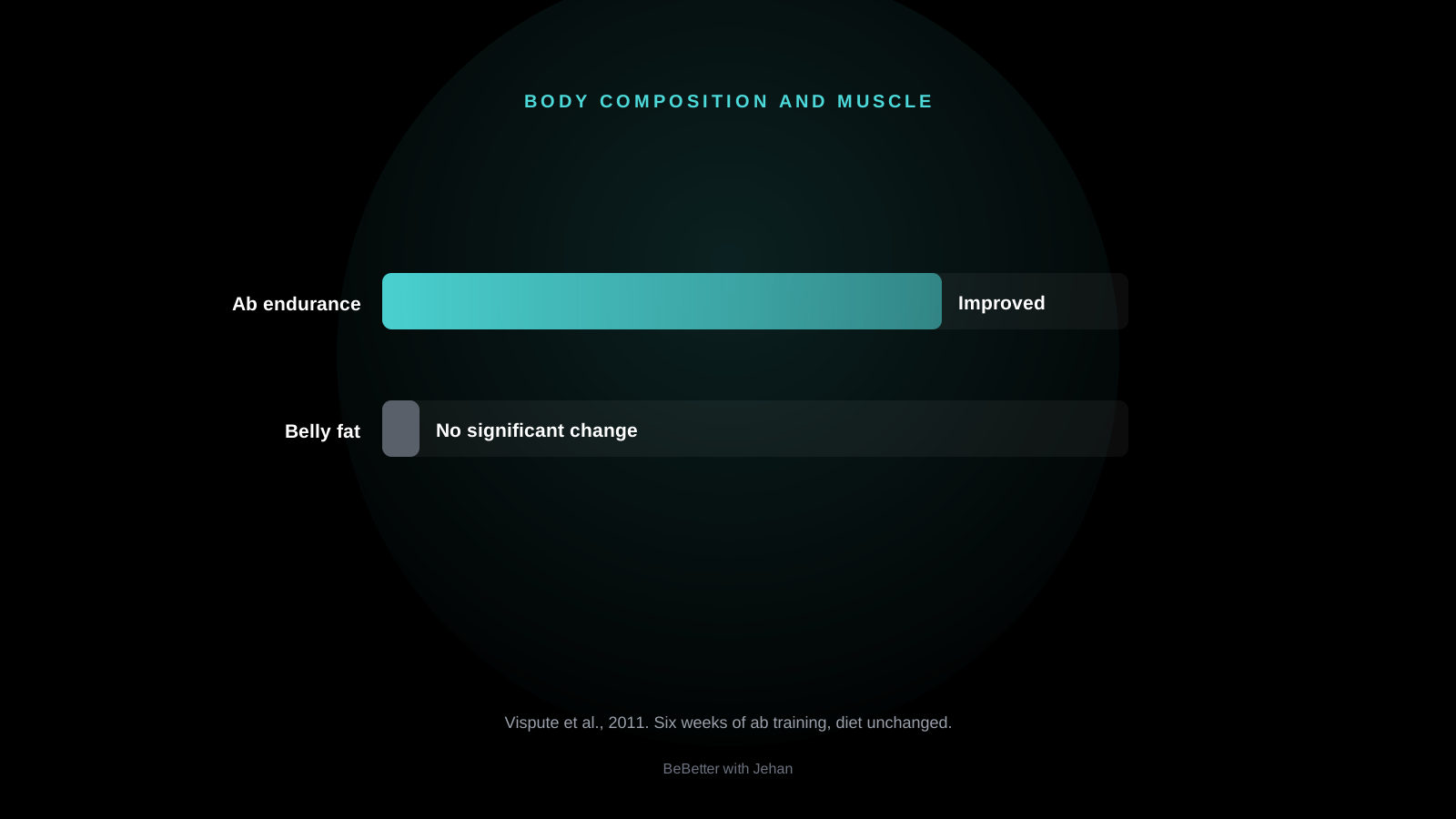
Not with targeted exercises alone. In a randomised trial, six weeks of abdominal exercises improved abdominal endurance but did not significantly reduce abdominal fat, waist size or body fat. Belly fat comes off through overall fat loss.
A calorie deficit, regular training and enough protein reduce your waistline over time.
- Ab exercises strengthen muscles but do not burn the fat over them.
- Belly fat reduces through overall fat loss.
- A calorie deficit drives that fat loss.
- Training protects muscle and adds energy expenditure.
- Track your waist, not just your weight.
What the trial found
Vispute and colleagues randomly assigned 24 sedentary adults to an abdominal exercise group or a control group. The exercise group performed seven abdominal exercises, two sets of ten repetitions, five days a week for six weeks, while everyone kept their diet the same (Vispute et al., 2011).
| Measure | Effect of abdominal exercise |
|---|---|
| Abdominal muscular endurance | Improved significantly |
| Body weight and body fat percentage | No significant change |
| Abdominal fat and waist circumference | No significant change |
Spot reduction is the idea that exercising a body part burns the fat stored over it. Research has not supported it.
Why spot reduction does not work
When your body uses stored fat for energy, it draws on fat stores across the body, not from the area being worked. Where fat comes off first is strongly individual, and for many people the abdomen is one of the last areas to change.
What actually reduces belly fat
Overall fat loss reduces abdominal fat. In an 8-month trial without diet changes, aerobic training reduced fat mass more than resistance training (Willis et al., 2012), but in practice a calorie deficit drives most fat loss. See how to calculate a calorie deficit, cardio or weights for fat loss and how to lose fat without losing muscle.
- A moderate calorie deficit you can sustain.
- Strength training two to three times a week.
- Cardio or daily steps for extra expenditure.
- Enough protein to protect muscle.
- Weekly waist measurements to track progress.
Coach's perspective
Clients often want a list of belly exercises. I give them a plan for overall fat loss instead, and their waist comes down.
Core training still has a place for strength and posture. It just is not a fat loss tool.
- Six weeks of ab exercises did not reduce belly fat in a randomised trial.
- Ab exercises improve abdominal endurance and strength.
- Belly fat reduces through overall fat loss.
- A calorie deficit drives most fat loss.
- Measure your waist to track progress.
Myth versus fact
| Common claim | What the evidence says |
|---|---|
| “Crunches burn belly fat.” | They strengthen the muscles but did not reduce abdominal fat in the trial. |
| “You can target where you lose fat.” | Fat loss happens across the body, in a pattern that varies between people. |
| “Belly fat needs special foods.” | No food targets belly fat. Overall calorie balance does. |
The mistakes I see most
1. Doing hundreds of crunches for fat loss
The time is better spent on full-body training.
2. Judging progress by the scale alone
Waist measurements often show change first.
3. Expecting the abdomen to change first
For many people it is one of the last areas to go.
4. Buying belly-fat supplements
No supplement targets abdominal fat.
Your practical checklist
- Set a moderate calorie deficit.
- Train with weights two to three times a week.
- Add cardio or raise daily steps.
- Keep protein high.
- Measure your waist weekly at the same time of day.
Research summary
Vispute and colleagues (2011) is a small randomised trial of 24 adults over six weeks. Its short duration and small sample are real limitations, but the finding is consistent with the broader understanding of how fat is used.
Willis and colleagues (2012) is a larger randomised trial on exercise type and fat loss, without dietary changes.
A plan for losing fat, not just doing crunches.
Your Blueprint combines a calorie deficit, training and protein targets built around your life, and your Progress Dashboard tracks your waist alongside your weight. Send me a message and I will walk you through the next steps.
Start my BlueprintOpens WhatsApp with a short message ready to send. Prefer to share your details directly? Complete the client intake form.
The Fitness Blueprint is ₹14,999 at present, reduced from a recommended price of ₹24,999. Flexible payment over 3 or 6 months can be arranged. See what is included.
Curious exactly what is included and what it costs? See the full pricing breakdown. Still deciding, or have a specific question first? Get in touch and I will answer honestly.
Frequently asked questions
Can you spot-reduce belly fat?
Not with targeted exercises alone. In a randomised trial, six weeks of abdominal exercises did not significantly reduce abdominal fat.
Do crunches burn belly fat?
Crunches strengthen the abdominal muscles but did not reduce abdominal fat in the trial. Fat loss across the whole body is what reduces belly fat.
What is the best way to lose belly fat?
A sustained calorie deficit, regular training, enough protein and patience. Where fat comes off first varies between people.
Why is belly fat the last to go?
Where you store and lose fat first is strongly individual. For many people, the abdomen is one of the last areas to change.
References
- Vispute SS, Smith JD, LeCheminant JD, Hurley KS. The effect of abdominal exercise on abdominal fat. Journal of Strength and Conditioning Research. 2011;25(9):2559-2564. PubMed
- Willis LH, Slentz CA, Bateman LA, et al. Effects of aerobic and/or resistance training on body mass and fat mass in overweight or obese adults. Journal of Applied Physiology. 2012;113(12):1831-1837. PubMed
A note on medical advice. This article is educational and reflects the research as I read it. It is not medical or dietetic advice and it cannot account for your individual circumstances. If you are managing a medical condition, are pregnant, are taking medication affected by diet or activity, or are recovering from injury, please speak to your doctor or a registered dietitian first. If anything here conflicts with advice from your own clinician, follow theirs.
Questions about applying any of this? Message me directly or find me on Instagram. Back to the Knowledge Hub or the homepage. You can also read more about how I coach, see what the Fitness Blueprint costs, or get in touch.