Cardio or weights for fat loss: which is better?
It is one of the most common fitness questions, and the honest answer is that the two do different jobs. Choosing between them is usually the wrong question.
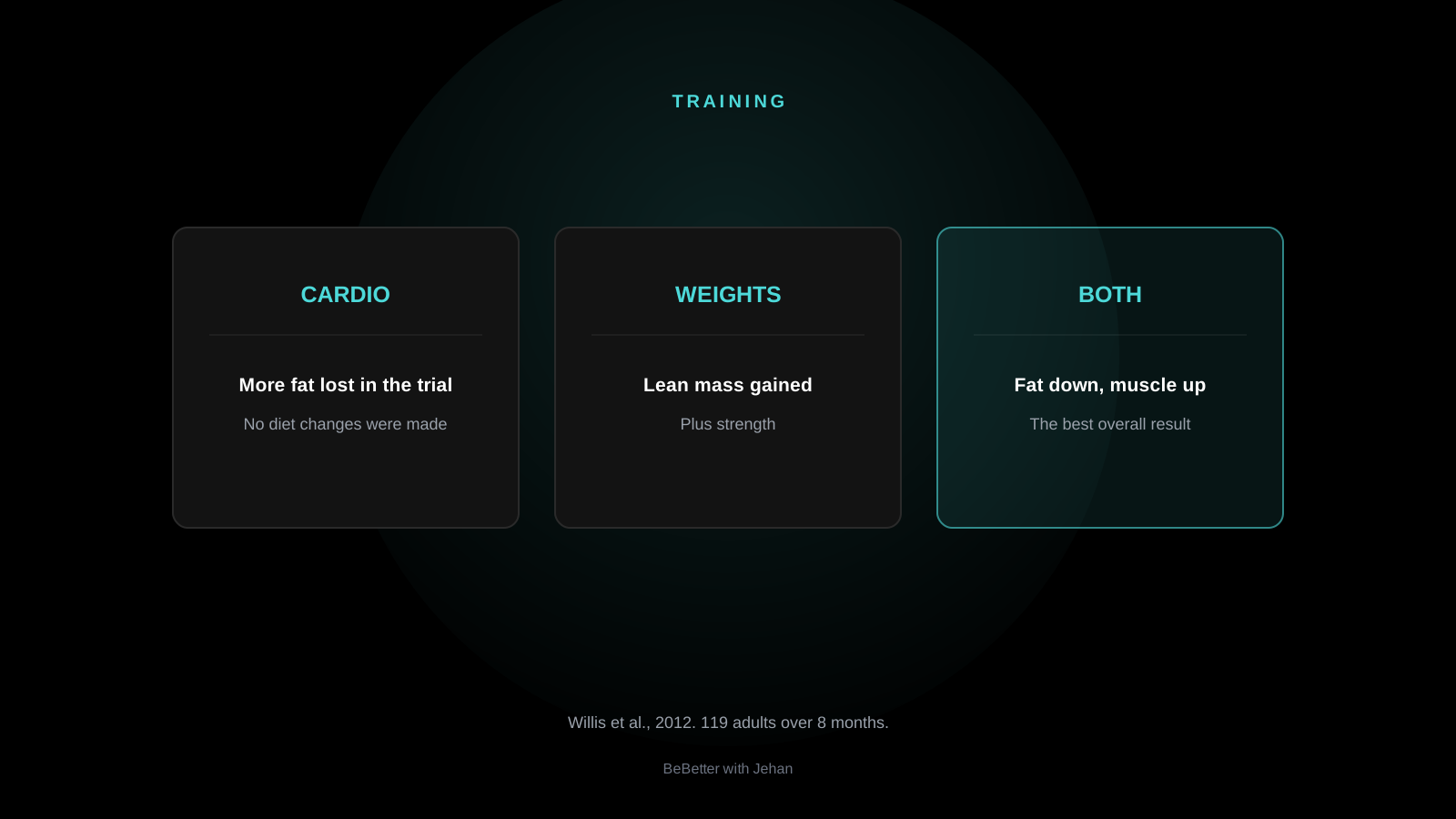
They do different jobs. In an 8-month trial, cardio reduced more fat and body weight than weight training, while weight training increased lean mass. Combining them reduced fat as much as cardio alone and added muscle.
For most people, the best approach is both, with a calorie deficit doing most of the fat loss work.
- Cardio burns more calories per session and reduced more fat in the trial.
- Weights build and protect muscle.
- A calorie deficit drives fat loss more than either.
- Prioritise weights two to three times a week, then add cardio or steps.
- Choose cardio you can sustain.
What the trial found
Willis and colleagues randomised 119 sedentary adults with overweight or obesity to aerobic training, resistance training or both for eight months (Willis et al., 2012).
| Group | Fat mass and body weight | Lean mass |
|---|---|---|
| Aerobic training | Reduced more than resistance training | Not increased as much |
| Resistance training | Did not significantly reduce | Increased |
| Both combined | Reduced similarly to aerobic training | Increased |
The combined programme took twice as long as either alone, yet did not reduce fat significantly more than aerobic training. Importantly, participants did not change their diets.
Lean mass is everything in the body that is not fat, including muscle. Keeping it during fat loss affects how you look and how strong you remain.
Where diet fits
Because the trial did not use a calorie deficit, it shows what exercise does on its own. In practice, diet usually drives fat loss, and weights protect muscle while you lose it. A randomised trial found that higher protein, combined with training during an energy deficit, produced more lean mass gain and more fat loss than lower protein (Longland et al., 2016). More in how to lose fat without losing muscle.
How to combine them in a busy week
| Component | Amount | Role |
|---|---|---|
| Weight training | 2 to 3 sessions | Protects and builds muscle |
| Cardio | 1 to 2 sessions | Adds energy expenditure and fitness |
| Daily steps | Increase from your baseline | Low-cost extra expenditure |
| Calorie deficit | Moderate | Drives fat loss |
If time is short, steps can replace some cardio, as covered in how many steps a day you need, and short weight sessions still work, as covered in whether a 30-minute workout builds muscle.
Coach's perspective
Clients often expect weights alone to melt fat because they have heard muscle boosts metabolism. The trial is a useful reality check: weights alone did not significantly reduce fat without diet changes.
I treat weights as non-negotiable for keeping muscle, cardio as a useful extra, and the calorie deficit as the main driver.
- Cardio reduced more fat and body weight than weights in an 8-month trial.
- Weights increased lean mass; cardio did not to the same extent.
- The trial did not change diet; in practice, a deficit drives fat loss.
- Combine 2 to 3 weight sessions with cardio or steps.
- Keep protein high to protect muscle.
Myth versus fact
| Common claim | What the evidence says |
|---|---|
| “Weights burn more fat than cardio.” | In the trial, resistance training alone did not significantly reduce fat mass. |
| “Cardio burns muscle.” | Moderate cardio alongside weights and enough protein does not meaningfully compromise muscle. |
| “You must choose one.” | Combining them reduced fat and added muscle. |
The mistakes I see most
1. Doing only cardio during fat loss
You risk losing muscle without weights to protect it.
2. Expecting weights alone to drive fat loss
Without a deficit, fat loss is limited.
3. Choosing cardio you hate
Adherence decides results. Pick something sustainable.
4. Ignoring the diet
Exercise supports fat loss; the deficit drives it.
Your practical checklist
- Schedule two to three weight sessions a week.
- Add one or two cardio sessions you enjoy.
- Raise your daily steps from your baseline.
- Set a moderate calorie deficit.
- Keep protein high throughout.
Research summary
Willis and colleagues (2012) is a randomised trial of 119 adults over eight months, with no dietary intervention. It shows the independent effect of exercise type, not the effect of exercise combined with a diet.
Longland and colleagues (2016) is a randomised trial supporting higher protein with training during a deficit. Its deficit was large and its training supervised, so real-world effects may be smaller.
A training week built for your goal.
Your Training Plan combines weights and cardio around the days you can genuinely train, with a demonstration video on every movement. Send me a message and I will walk you through the next steps.
Start my BlueprintOpens WhatsApp with a short message ready to send. Prefer to share your details directly? Complete the client intake form.
The Fitness Blueprint is ₹14,999 at present, reduced from a recommended price of ₹24,999. Flexible payment over 3 or 6 months can be arranged. See what is included.
Curious exactly what is included and what it costs? See the full pricing breakdown. Still deciding, or have a specific question first? Get in touch and I will answer honestly.
Frequently asked questions
Is cardio or weights better for fat loss?
In an 8-month trial without diet changes, aerobic training reduced more fat mass than resistance training. Resistance training increased lean mass. Combining both, alongside a calorie deficit, usually gives the best overall result.
Do weights burn more calories than cardio?
In the trial, resistance training alone did not significantly reduce body weight or fat mass, despite claims about raised metabolism.
Should I do cardio or weights first?
Do whichever matters most to your goal first, while you are freshest. For most people building or keeping muscle, that is the weights.
Can I lose fat with weights alone?
Yes, if you are in a calorie deficit. Weights protect muscle while the deficit drives fat loss.
References
- Willis LH, Slentz CA, Bateman LA, et al. Effects of aerobic and/or resistance training on body mass and fat mass in overweight or obese adults. Journal of Applied Physiology. 2012;113(12):1831-1837. PubMed
- Longland TM, Oikawa SY, Mitchell CJ, Devries MC, Phillips SM. Higher compared with lower dietary protein during an energy deficit combined with intense exercise promotes greater lean mass gain and fat mass loss: a randomized trial. American Journal of Clinical Nutrition. 2016;103(3):738-746. PubMed
A note on medical advice. This article is educational and reflects the research as I read it. It is not medical or dietetic advice and it cannot account for your individual circumstances. If you are managing a medical condition, are pregnant, are taking medication affected by diet or activity, or are recovering from injury, please speak to your doctor or a registered dietitian first. If anything here conflicts with advice from your own clinician, follow theirs.
Questions about applying any of this? Message me directly or find me on Instagram. Back to the Knowledge Hub or the homepage. You can also read more about how I coach, see what the Fitness Blueprint costs, or get in touch.