How many sets per week do you need to build muscle?
Weekly training volume is one of the most studied variables in muscle growth, and one of the most misunderstood. More is not always better, but too little genuinely limits results.
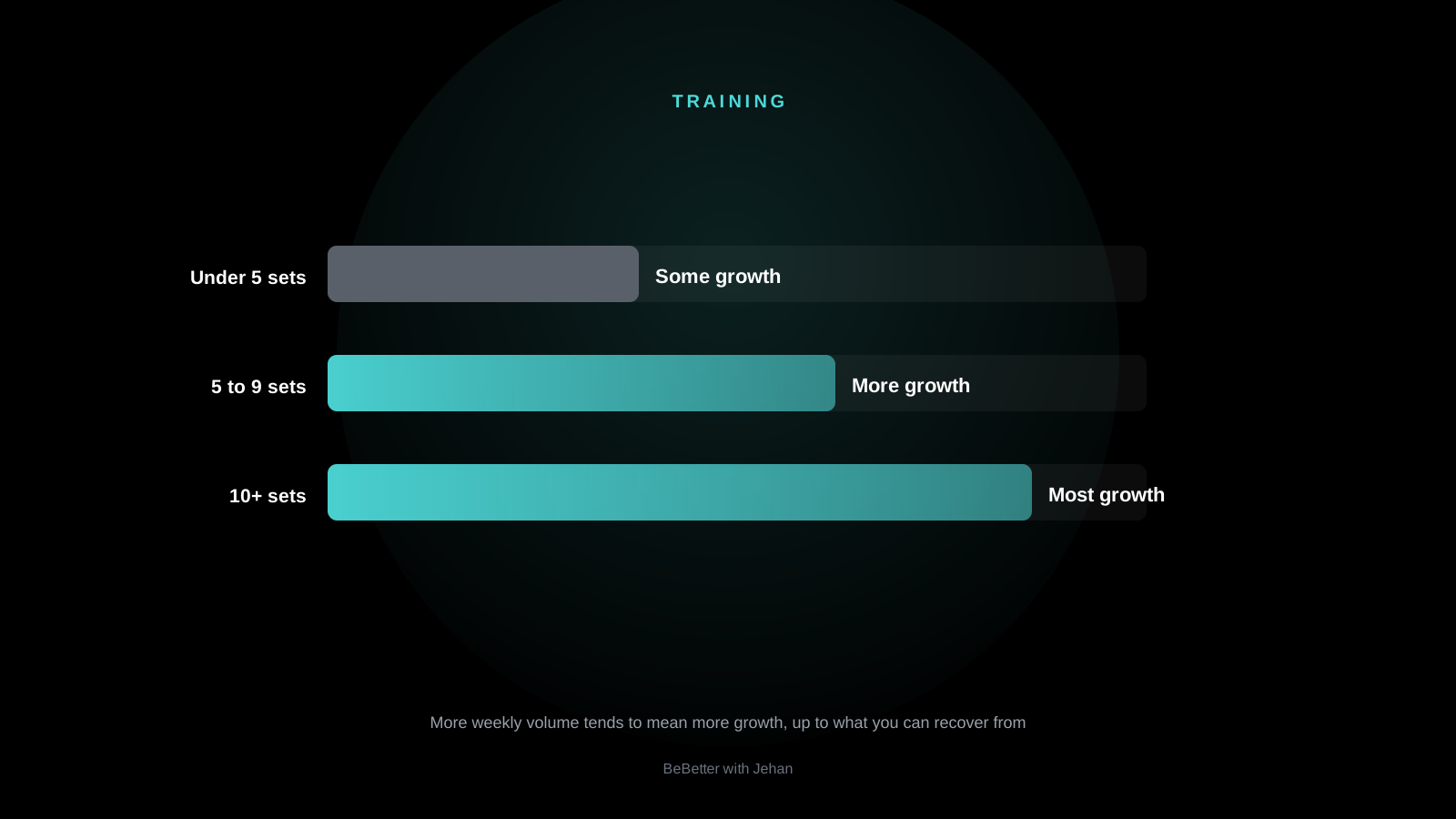
A meta-analysis found a dose-response relationship between weekly sets and muscle growth, with 10 or more sets per muscle per week producing more growth than lower volumes. For most working professionals, a sensible approach is to start lower, around the middle of that range, and add sets only when progress slows.
Volume only helps up to the point you can recover from. Beyond that, more sets just mean more fatigue.
- Count hard working sets per muscle group across the whole week.
- Around 10 sets per muscle is a sound target for many people.
- Beginners can grow well on less. Start lower and build.
- Add sets when progress stalls, not by default.
- If performance drops and soreness lingers, you are doing too much.
What the research found
Schoenfeld and colleagues pooled the available studies on weekly training volume and found a graded relationship: more weekly sets were associated with more muscle growth, and 10 or more sets per muscle per week outperformed lower volumes (Schoenfeld et al., 2017).
A later trial in trained men found the same dose-response for muscle size, but notably not for strength, which improved similarly across volume conditions (Schoenfeld et al., 2019). That distinction matters: if your goal is strength, high volume is less important than heavy, progressive work.
Weekly volume is usually counted as the number of hard working sets a muscle group receives across a week. It is one of the variables most closely associated with muscle growth.
What counts as a set
Only hard sets count. A working set is one taken reasonably close to failure, roughly one to three repetitions short, as covered in do you have to train to failure. Warm-up sets and sets you could repeat comfortably several more times are not contributing much to growth.
| Weekly sets per muscle | How it tends to work | Who it suits |
|---|---|---|
| Under 5 | Some growth, particularly for beginners | Busy weeks, deloads, early beginners |
| 5 to 9 | Solid progress for most people | A sensible starting point for many |
| 10 or more | More growth in the research | Those progressing well and recovering well |
Practical weekly targets
The easiest way to hit sensible volume is to spread it across the week. Training a muscle twice weekly makes 10 sets far more manageable than cramming them into one session, which is part of why twice-weekly frequency is generally favoured. The structure that suits your available days is covered in full body or a split.
| Structure | Session A | Session B | Weekly total |
|---|---|---|---|
| Full body, 3 days | 3 sets | 3 sets, plus a third day of 4 | 10 sets |
| Upper and lower, 4 days | 5 sets | 5 sets | 10 sets |
Coach's perspective
When a client stops progressing, more volume is the obvious answer and it is often the wrong one. The first questions are always whether they are actually progressing the weight, sleeping enough and eating enough protein.
Volume is a dial worth turning, but only after the basics are in place. Adding sets to a plan that is not recovering just adds fatigue.
When more stops helping
The research finding is that more volume tends to produce more growth, but only to the point you can recover from. Beyond that, extra sets add fatigue rather than results. Warning signs include strength dropping across several sessions, soreness that does not clear, and sleep quality falling.
For someone fitting training around a demanding job, recovery capacity is often the real ceiling, which is a strong reason to start in the middle of the range rather than the top.
- More weekly sets tend to produce more muscle growth, up to what you can recover from.
- Around 10 hard sets per muscle per week is a sound target for many people.
- The volume benefit applied to muscle size more clearly than to strength.
- Only hard sets count towards your weekly total.
- Add volume when progress stalls, after checking sleep, food and progression.
Myth versus fact
| Common claim | What the evidence says |
|---|---|
| “More sets always means more muscle.” | Only up to what you can recover from. Beyond that, extra sets add fatigue rather than growth. |
| “You need 20-plus sets per muscle to grow.” | Many people grow well on considerably less, particularly beginners. |
| “High volume is the key to strength.” | In one trial, strength improved similarly across volumes. Heavy, progressive work matters more for strength. |
The mistakes I see most
1. Counting warm-ups as working sets
This inflates your total and hides how little hard work you are actually doing.
2. Jumping straight to high volume
Beginners can grow on modest volume. Starting high just adds fatigue.
3. Adding sets instead of adding load
Progressive overload remains the core mechanism. Volume supports it, not replaces it.
4. Ignoring recovery signals
Falling performance is your body telling you the volume is too high.
Your practical checklist
- Count your hard working sets per muscle group for one normal week.
- If you are under about 5 for a muscle, consider adding a little.
- Aim to train each muscle at least twice a week.
- Add one or two sets only when progress stalls for several weeks.
- Check sleep, protein and progression before adding volume.
Research summary
Schoenfeld and colleagues (2017) is a systematic review and meta-analysis, which carries more weight than individual studies. Its limitation is that the number of studies and the range of volumes tested were modest.
Schoenfeld and colleagues (2019) was a trial in trained men with a small sample, typical of this literature. Its finding that strength did not follow the same volume pattern is useful but should not be over-generalised.
What is not settled: the precise volume at which returns flatten is not well established and almost certainly differs between people. The ranges here are reasonable starting points, not precise prescriptions.
The right volume, already worked out for you.
Your Training Plan sets the weekly sets for each muscle group around your available days and experience, with explicit progression rules. Answer a few quick questions to see the structure your Blueprint would use.
Start my BlueprintEight quick questions, about 2 minutes, and you see a preview of your own Blueprint before you message me. The Fitness Blueprint is ₹14,999 at present, reduced from a recommended price of ₹24,999. Flexible payment over 3 or 6 months can be arranged. See what is included.
Curious exactly what is included and what it costs? See the full pricing breakdown. Still deciding, or have a specific question first? Get in touch and I will answer honestly.
Frequently asked questions
How many sets per week should a beginner do?
Fewer than an experienced lifter. Starting around the lower end and adding sets only when progress slows is more sensible than jumping straight to high volume.
Is 10 sets per muscle per week enough?
For many people it is a sound target. A meta-analysis found 10 or more weekly sets per muscle produced more growth than lower volumes.
What counts as a set?
A hard working set, taken reasonably close to failure. Warm-up sets and very easy sets do not count towards your weekly total.
Can doing too many sets be a problem?
Yes. Volume only helps if you can recover from it. Falling performance, persistent soreness and poor sleep are signs you are doing more than you can use.
References
- Schoenfeld BJ, Ogborn D, Krieger JW. Dose-response relationship between weekly resistance training volume and increases in muscle mass: A systematic review and meta-analysis. Journal of Sports Sciences. 2017;35(11):1073-1082. PubMed
- Schoenfeld BJ, Contreras B, Krieger J, et al. Resistance Training Volume Enhances Muscle Hypertrophy but Not Strength in Trained Men. Medicine and Science in Sports and Exercise. 2019;51(1):94-103. PubMed
A note on medical advice. This article is educational and reflects the research as I read it. It is not medical or dietetic advice and it cannot account for your individual circumstances. If you are managing a medical condition, are pregnant, are taking medication affected by diet or activity, or are recovering from injury, please speak to your doctor or a registered dietitian first. If anything here conflicts with advice from your own clinician, follow theirs.
Questions about applying any of this? Message me directly or find me on Instagram. Back to the Knowledge Hub or the homepage. You can also read more about how I coach, see what the Fitness Blueprint costs, or get in touch.