What can beginners realistically expect from training?
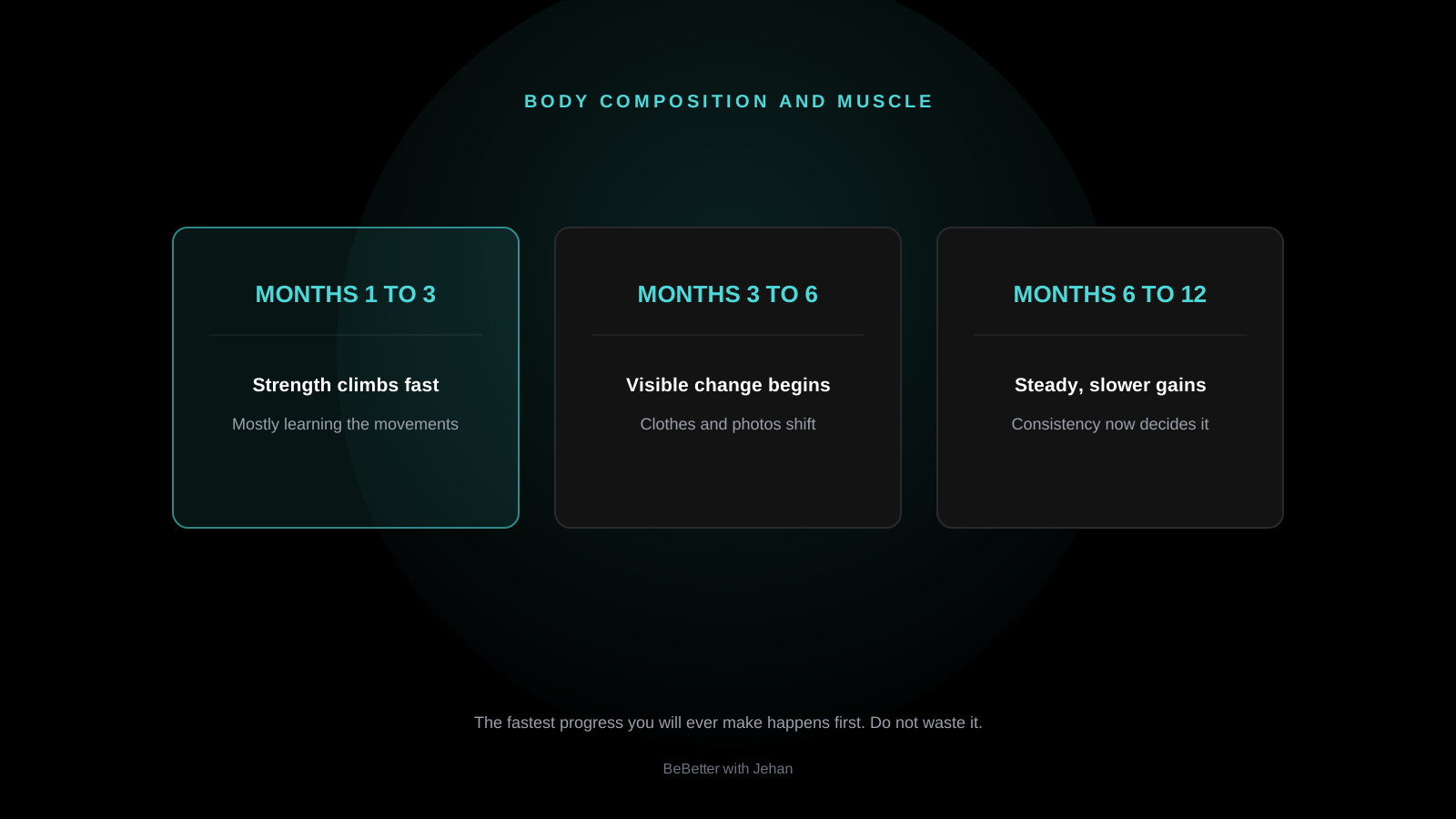
Being a beginner is the best position to be in. You will never progress faster than you do in your first months, which makes it worth knowing what to expect and how not to waste it.
Expect fast early strength gains, much of them from your nervous system learning the movements, followed by slower but steady visible change over the following months. Beginners are also among the people most likely to lose fat and build muscle at the same time.
Your first months are the most productive you will ever have. The main risk is quitting before visible change catches up with the work.
- Expect strength to climb quickly in the first weeks.
- Expect visible change to take longer, often a few months.
- Keep the programme simple and progress it steadily.
- Eat enough protein, since beginners can build muscle while losing fat.
- Do not judge progress in week three.
A realistic first-year timeline
| Period | What usually happens | What to focus on |
|---|---|---|
| Weeks 1 to 4 | Strength rises noticeably as you learn the movements | Technique and turning up |
| Months 1 to 3 | Steady strength gains, energy and sleep often improve | Progressing the weights each week |
| Months 3 to 6 | Visible change in the mirror and in clothes | Consistency and protein |
| Months 6 to 12 | Progress continues, more slowly | Keeping the habit through busy periods |
The physical timeline runs alongside a behavioural one. How long it takes for training to feel automatic is covered in the 21-day habit myth, and what the scale does in the meantime is covered in how long results take.
Why early strength comes so fast
A large share of early strength comes from learning, not from muscle. Your nervous system becomes better at coordinating the movement and recruiting the muscles involved. Research on training and retraining has observed this kind of long-lasting motor learning effect, with strength remaining elevated well after training stopped (Psilander et al., 2019).
This explains a common experience: the numbers in the logbook climb quickly while the mirror barely changes. That is normal. Muscle growth follows, more slowly.
Neural adaptation is the improvement in how efficiently your nervous system coordinates and activates muscle. It drives much of the strength gained in the first weeks of training, before significant muscle growth.
Beginners and recomposition
Beginners are among the groups most likely to lose fat and build muscle at the same time. A review of body recomposition notes that the effect is most achievable for people new to training, those returning after a break and those carrying more body fat (Barakat et al., 2020). It is covered in full in body recomposition.
Coach's perspective
The beginners who do best are rarely the most motivated. They are the ones who keep the programme boring, add a little weight each week, and do not change everything after a fortnight.
The most common failure I see is a beginner abandoning a perfectly good plan in week four because the mirror has not changed yet. The plan was working. The expectation was wrong.
How beginners waste their best months
The beginner phase is the easiest time to make progress, which makes it easy to waste. The most common ways are programme hopping before any plan has had time to work, training with too much variety to progress anything, and under-eating protein while trying to lose fat. Keep it simple: a few multi-joint movements, progressed steadily, as covered in progressive overload explained.
- Beginners progress faster than at any later stage.
- Much of early strength comes from learning the movements, not from muscle.
- Visible change usually takes a few months of consistent training.
- Beginners are among those most likely to lose fat and build muscle together.
- A simple, progressive programme beats a complicated one.
Myth versus fact
| Common claim | What the evidence says |
|---|---|
| “If the mirror has not changed in a month, it is not working.” | Early gains are largely neural. Visible change typically lags strength by several months. |
| “Beginners need advanced techniques to grow.” | Beginners respond well to simple, progressive training. Complexity adds little at this stage. |
| “You must bulk first, then cut.” | Beginners are among the people most likely to build muscle while losing fat. |
The mistakes I see most
1. Changing programmes every few weeks
No plan has time to work, and progress becomes impossible to measure.
2. Judging progress by the mirror too early
Strength moves first. Use the logbook, not week-three photos.
3. Under-eating protein while losing fat
This wastes the beginner's ability to build muscle in a deficit.
4. Adding too much variety
You cannot progress an exercise you only do occasionally.
Your practical checklist
- Choose a simple programme built on a few multi-joint movements.
- Record every session so you can see strength rising.
- Aim to add a little weight or a rep each week.
- Hit your protein target most days.
- Take photos at the start and every four weeks, not every week.
- Commit to the same plan for at least twelve weeks.
Research summary
Barakat and colleagues (2020) is a narrative review of body recomposition. It supports the point that beginners are well placed to build muscle while losing fat, but as a review rather than a trial it does not quantify how much.
Psilander and colleagues (2019) observed a long-lasting motor learning effect, with strength remaining elevated after training stopped. It was a small study and its main focus was muscle memory rather than beginners specifically.
What is deliberately not here: specific figures for how many kilograms of muscle a beginner can gain per month. Popular estimates exist, but they are not well supported by controlled research, and individual variation is large.
Start with a plan built for where you are now.
If you are new to training, your Blueprint starts with technique and a simple, progressive structure, with a demonstration video on every movement so there is nothing to work out on day one. Answer a few quick questions to see what it would look like.
Start my BlueprintEight quick questions, about 2 minutes, and you see a preview of your own Blueprint before you message me. The Fitness Blueprint is ₹14,999 at present, reduced from a recommended price of ₹24,999. Flexible payment over 3 or 6 months can be arranged. See what is included.
Curious exactly what is included and what it costs? See the full pricing breakdown. Still deciding, or have a specific question first? Get in touch and I will answer honestly.
Frequently asked questions
How quickly will a beginner see results?
Strength usually climbs within the first few weeks. Visible change in the mirror and in how clothes fit typically takes longer, often a few months of consistent training.
Why do beginners get stronger so fast?
A large share of early strength gains comes from the nervous system learning to perform the movements efficiently, before much muscle has been added.
Can beginners lose fat and build muscle at the same time?
Beginners are among the people most likely to do both at once, alongside those returning after a break and those carrying more body fat.
Do beginners need a complicated programme?
No. A simple programme built around a few multi-joint movements, progressed steadily, is what works best.
References
- Barakat C, Pearson J, Escalante G, Campbell B, De Souza EO. Body Recomposition: Can Trained Individuals Build Muscle and Lose Fat at the Same Time? Strength and Conditioning Journal. 2020;42(5):7-21. Journal
- Psilander N, Eftestøl E, Cumming KT, et al. Effects of training, detraining, and retraining on strength, hypertrophy, and myonuclear number in human skeletal muscle. Journal of Applied Physiology. 2019;126(6):1636-1645. PubMed
A note on medical advice. This article is educational and reflects the research as I read it. It is not medical or dietetic advice and it cannot account for your individual circumstances. If you are managing a medical condition, are pregnant, are taking medication affected by diet or activity, or are recovering from injury, please speak to your doctor or a registered dietitian first. If anything here conflicts with advice from your own clinician, follow theirs.
Questions about applying any of this? Message me directly or find me on Instagram. Back to the Knowledge Hub or the homepage. You can also read more about how I coach, see what the Fitness Blueprint costs, or get in touch.