Regaining muscle after a long break: what muscle memory really means
If you have trained before and stopped, you are in a better position than a beginner. How much better, and why, is more interesting and more contested than most fitness content admits.

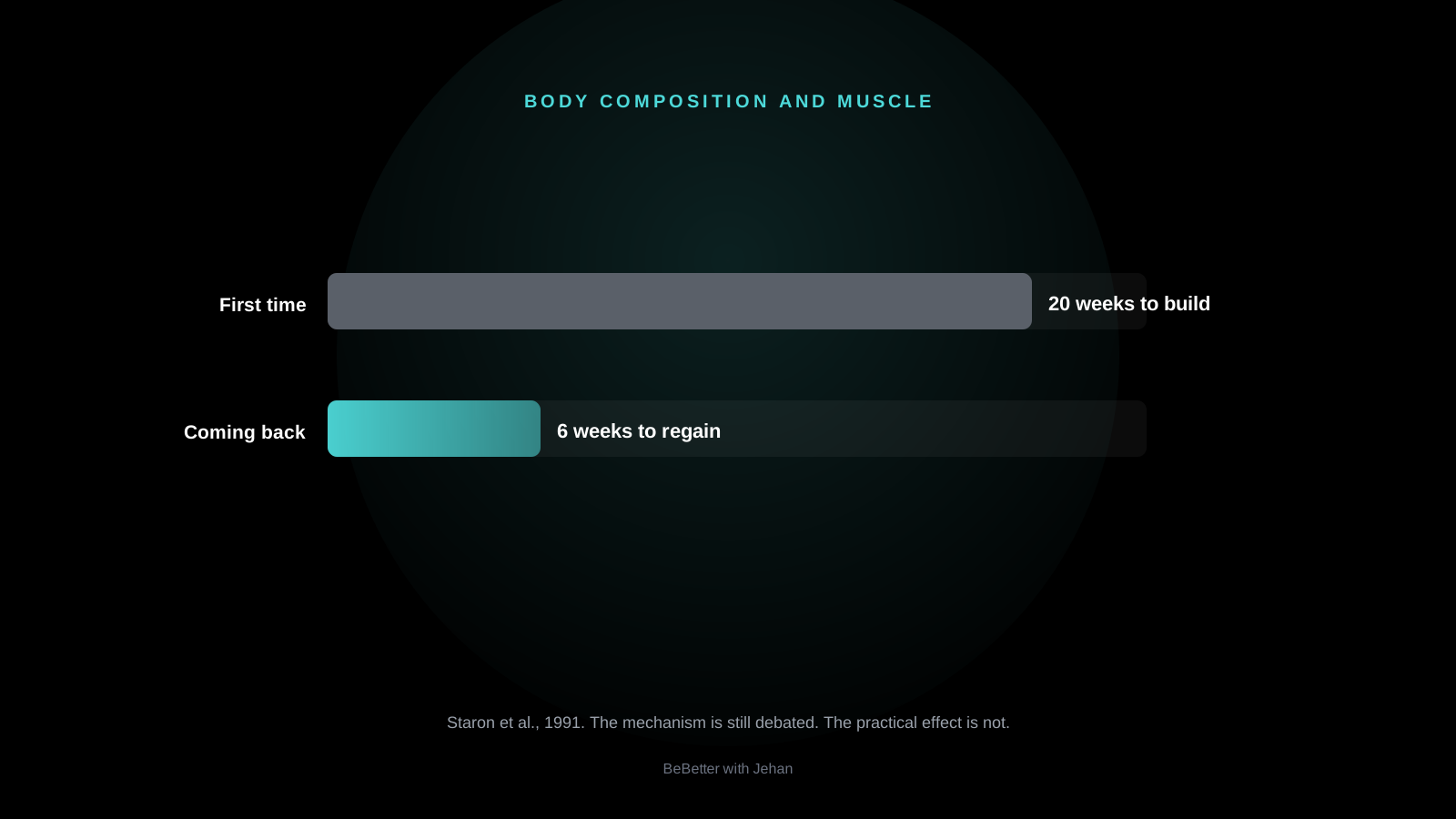
Regaining strength and muscle after a break is usually faster than building it the first time. In one classic study, gains built over 20 weeks were regained within 6 weeks of retraining. The practical effect is well observed. The cellular mechanism is genuinely debated, and human studies have reached conflicting conclusions.
What matters for you: start lighter than you think, rebuild gradually, and expect to progress faster than you did as a beginner.
- Expect to regain faster than you first built.
- Start well below your previous working weights.
- Rebuild load over several weeks rather than in your first session.
- Expect strength to return before size fully does.
- Keep protein high while you rebuild.
What the research shows
Staron and colleagues (1991) trained women for 20 weeks, had them stop for around 30 weeks, then retrained them. The strength and muscle gains originally built over 20 weeks were regained with just 6 weeks of retraining (Staron et al., 1991). That is the clearest practical demonstration of muscle memory in humans.
| Study | Finding |
|---|---|
| Staron et al., 1991 | Gains built over 20 weeks were regained in 6 weeks of retraining |
| Psilander et al., 2019 | Previously trained muscle did not respond faster in a second period; strength stayed elevated |
| Cumming et al., 2024 | Reported evidence for retained myonuclei after strength training in humans |
Myonuclei are the nuclei inside muscle fibres. One theory of muscle memory proposes that nuclei gained during training are retained when you stop, making it faster to rebuild later.
Why the mechanism is debated
The theory that retained myonuclei explain muscle memory comes largely from animal research. Human evidence is mixed. Psilander and colleagues (2019) found that a previously trained leg did not respond differently to a second training period than an untrained leg, and they did not observe an increase in myonuclei during initial training. They noted that this did not rule out muscle memory, since their design could not rigorously test the theory, and they did observe a long-lasting improvement in strength consistent with motor learning (Psilander et al., 2019).
Cumming and colleagues (2024) later reported evidence that myonuclei gained through strength training were maintained during detraining in humans (Cumming et al., 2024). So the honest summary is that the effect is observed, while the explanation is still being worked out. Some popular articles overstate these findings, and it is worth reading the original papers rather than the headlines.
Coach's perspective
Clients returning after a long break almost always make the same mistake in their first week: they load the bar with what they lifted two years ago. The muscle may remember. Their tendons and joints often have not caught up.
I start returners well below their old numbers and build back over several weeks. They nearly always overtake my expectations, which is muscle memory doing its job, without the injury that would have set them back months.
How to restart safely
| Phase | Approach |
|---|---|
| First 1 to 2 weeks | Well below your old working weights, with clean technique and no grinding sets |
| Weeks 3 to 6 | Build load steadily each week as performance returns |
| After that | Normal progressive overload, as you would on any plan |
The structure for that progression is covered in progressive overload explained, and how hard each set should be in training to failure.
Eating while you rebuild
Returners are among the groups best placed to lose fat and rebuild muscle at the same time, as covered in body recomposition. Keep protein high, and avoid an aggressive deficit while you are rebuilding.
- Regaining strength and muscle is usually faster than building them the first time.
- In one classic study, 20 weeks of gains returned within 6 weeks of retraining.
- The cellular mechanism is debated, and human studies conflict.
- Strength often returns before size fully does.
- Start well below your old weights and rebuild over several weeks.
Myth versus fact
| Common claim | What the evidence says |
|---|---|
| “After a long break you have to start from zero.” | Regaining is usually faster than first building, as observed in retraining studies. |
| “Science has proven exactly how muscle memory works.” | The mechanism is still debated. Human studies have reached different conclusions. |
| “Start back at your old weights since the muscle remembers.” | Connective tissue readapts more slowly. Starting too heavy is a common route to injury. |
The mistakes I see most
1. Starting at your old working weights
The fastest way to turn a comeback into an injury.
2. Expecting no soreness
The first sessions back are often very sore. Keep volume modest early on.
3. Crash dieting while rebuilding
An aggressive deficit makes it harder to regain muscle. Keep protein high.
4. Waiting for the perfect time to restart
The memory is on your side. The longer you wait, the more you have to rebuild.
Your practical checklist
- Choose a simple full-body plan for your return.
- Start your working weights well below where you left off.
- Add load steadily each week as sessions feel controlled.
- Keep protein high throughout.
- Expect strength to return first and size to follow.
- Return to normal progression after around six weeks.
Research summary
Staron and colleagues (1991) is the classic human retraining study. Its participants were women undergoing heavy resistance training, and the sample was small, so the specific timings should be read as illustrative rather than universal.
Psilander and colleagues (2019) was a carefully designed study, but the authors themselves note it could not rigorously test the myonuclear theory, since myonuclei did not increase during the first training period.
Cumming and colleagues (2024) reported retained myonuclei in humans. Together these papers show a genuinely open scientific question about mechanism, alongside a fairly consistent practical observation that returning is easier than starting.
A comeback plan that does not start you at zero.
If you have trained before, your Blueprint ramps you back up gradually and builds on what you already have, with a reset system for exactly this situation. Answer a few quick questions to see what your return could look like.
Start my BlueprintEight quick questions, about 2 minutes, and you see a preview of your own Blueprint before you message me. The Fitness Blueprint is ₹14,999 at present, reduced from a recommended price of ₹24,999. Flexible payment over 3 or 6 months can be arranged. See what is included.
Curious exactly what is included and what it costs? See the full pricing breakdown. Still deciding, or have a specific question first? Get in touch and I will answer honestly.
Frequently asked questions
Is muscle memory real?
The practical effect, regaining strength and size faster than they were first built, has been observed in humans. The cellular mechanism behind it is still debated, with human studies reaching different conclusions.
How quickly does muscle come back after a break?
In one classic study, strength and size built over 20 weeks were regained with only 6 weeks of retraining after a long break. Individual results vary.
Should I start where I left off?
No. Start well below your previous working weights and build back up over several weeks. Your joints and tendons need time to readapt.
Does strength come back faster than size?
Often, yes. Much of the skill of performing a movement appears to persist, so strength can return quickly before muscle size fully catches up.
References
- Staron RS, Leonardi MJ, Karapondo DL, et al. Strength and skeletal muscle adaptations in heavy-resistance-trained women after detraining and retraining. Journal of Applied Physiology. 1991;70(2):631-640. Journal
- Psilander N, Eftestøl E, Cumming KT, et al. Effects of training, detraining, and retraining on strength, hypertrophy, and myonuclear number in human skeletal muscle. Journal of Applied Physiology. 2019;126(6):1636-1645. PubMed
- Cumming KT, et al. Muscle memory in humans: evidence for myonuclear permanence and long-term transcriptional regulation after strength training. The Journal of Physiology. 2024. Journal
A note on medical advice. This article is educational and reflects the research as I read it. It is not medical or dietetic advice and it cannot account for your individual circumstances. If you are managing a medical condition, are pregnant, are taking medication affected by diet or activity, or are recovering from injury, please speak to your doctor or a registered dietitian first. If anything here conflicts with advice from your own clinician, follow theirs.
Questions about applying any of this? Message me directly or find me on Instagram. Back to the Knowledge Hub or the homepage. You can also read more about how I coach, see what the Fitness Blueprint costs, or get in touch.