Does the type of diet matter for fat loss?
Low-carb, low-fat, keto, intermittent fasting. The arguments are endless. The research has been surprisingly consistent about what actually decides the result.
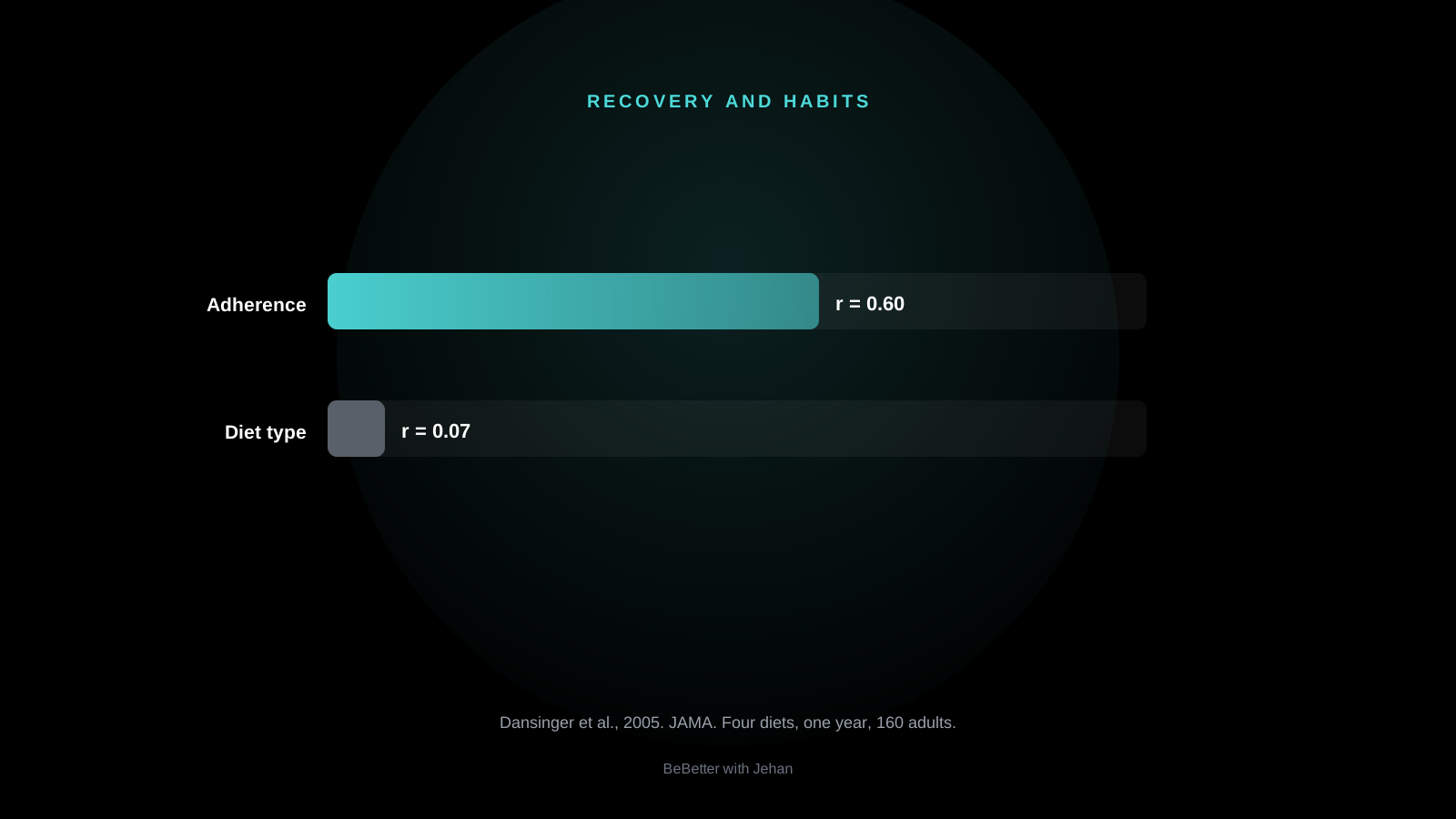
Much less than the arguments suggest. In a year-long trial of four popular diets, weight loss was strongly associated with adherence (r = 0.60) but barely with diet type (r = 0.07). A larger 12-month trial comparing low-fat and low-carbohydrate diets in 609 adults reached a similar conclusion.
The best diet for fat loss is the one you can keep following.
- Pick the approach you can follow for months, not weeks.
- Calories decide fat loss. Diet labels mostly decide how you get there.
- Keep protein high whichever approach you use.
- Judge a diet by whether you are still on it in month three.
- Ignore claims that one approach burns fat faster.
What the research found
Dansinger and colleagues (2005) randomised 160 adults to one of four popular diets, Atkins, Ornish, Weight Watchers and Zone, for a year. Weight loss was modest and similar across them. The decisive finding was that weight loss was associated with how well people adhered to their diet, and not with which diet they were on (Dansinger et al., 2005). Roughly half of those on the most restrictive diets dropped out before the year ended.
| Measure | Result |
|---|---|
| Weight loss and adherence | Strongly associated, r = 0.60 |
| Weight loss and diet type | Barely associated, r = 0.07 |
| Weight loss across the four diets | Modest and similar |
| Dropout on the most restrictive diets | Around half |
The DIETFITS trial compared healthy low-fat and healthy low-carbohydrate diets in 609 adults over 12 months, and did not find a meaningful difference in weight loss between them (Gardner et al., 2018).
Adherence is how consistently you follow a plan over time. In weight loss research it is repeatedly a stronger predictor of results than the specific diet chosen.
Why adherence wins
Every diet that works does so through the same mechanism: an energy deficit, as covered in how to calculate a calorie deficit. Different diets are simply different routes to eating less. The route you can stay on is the one that works for you.
Coach's perspective
Clients often arrive asking which diet I recommend, expecting a name. My answer is the one that fits your life. If you love rice, I am not going to build your plan around removing it.
The plans that fail are almost never failing on the science. They fail because they demanded something the person could not sustain past week six.
How to choose your approach
| Question | Why it matters |
|---|---|
| Can I eat this way at work and with family? | A plan that only works in isolation rarely lasts |
| Does it include foods I genuinely enjoy? | Restriction you resent tends to end in rebound |
| Can I keep it up during travel and busy weeks? | Real life is where diets are tested |
| Does it keep my protein high? | Protein protects muscle whichever approach you choose |
What still matters
Diet type matters little for weight loss, but some things still matter a great deal: enough protein to protect muscle, as covered in the protein guide, overall food quality, and a deficit moderate enough to sustain. Some medical conditions also make specific approaches more or less suitable, which is a conversation for your doctor.
- Weight loss tracked adherence, not diet type, in a year-long four-diet trial.
- A 12-month trial of 609 adults found no meaningful difference between low-fat and low-carb.
- Every effective diet works through an energy deficit.
- Choose the approach you can sustain for months.
- Protein and food quality still matter whichever approach you choose.
Myth versus fact
| Common claim | What the evidence says |
|---|---|
| “Low-carb burns more fat.” | Large trials have not found a meaningful difference in weight loss when both diets are followed. |
| “There is one best diet for everyone.” | Weight loss tracked adherence rather than diet type. |
| “If a diet did not work, you chose the wrong one.” | More often, it was not sustainable for you. The mechanism is the same. |
The mistakes I see most
1. Switching diets every few weeks
Each switch resets your habits. Pick one sustainable approach and keep it.
2. Choosing the most restrictive option
The most restrictive diets in the trial had the highest dropout.
3. Ignoring protein while following a trend
Whichever approach you choose, protein still protects muscle.
4. Blaming yourself when a diet fails
If a plan was unsustainable, the plan was the problem.
Your practical checklist
- List the foods you genuinely enjoy and want to keep.
- Choose an approach that includes most of them.
- Set your protein target and plan meals around it.
- Ask whether you could still follow it on a travel week.
- Review at month three: are you still following it?
Research summary
Dansinger and colleagues (2005) is a randomised trial published in JAMA. Its main limitations are a modest sample of 160 adults, all with known cardiovascular risk factors, and low overall adherence, which limited the weight loss observed.
The DIETFITS trial (Gardner et al., 2018) is a larger 12-month randomised trial of 609 adults comparing healthy versions of low-fat and low-carbohydrate diets. Both studies examined weight loss; neither suggests diet composition is irrelevant for health in every context.
Interpretation: the conclusion that adherence matters more than diet type for weight loss is well supported. The practical advice on choosing an approach is coaching judgement built on it.
A nutrition plan built around foods you will actually eat.
Your Nutrition Plan is built from your own preferences, cuisine and routine, with swap options, so it is designed to be sustainable from the start. Answer a few quick questions to see what your plan could look like.
Start my BlueprintEight quick questions, about 2 minutes, and you see a preview of your own Blueprint before you message me. The Fitness Blueprint is ₹14,999 at present, reduced from a recommended price of ₹24,999. Flexible payment over 3 or 6 months can be arranged. See what is included.
Curious exactly what is included and what it costs? See the full pricing breakdown. Still deciding, or have a specific question first? Get in touch and I will answer honestly.
Frequently asked questions
Is low-carb better than low-fat for weight loss?
Large trials have not found a meaningful difference in weight loss when both are followed. The DIETFITS trial of 609 adults compared the two over 12 months.
What is the best diet for fat loss?
The one you can sustain. In a year-long comparison of four popular diets, weight loss was associated with adherence rather than with the diet followed.
Does intermittent fasting work?
It can work if it helps you eat less overall and you can sustain it. It is a way of arranging calories, not a separate mechanism.
Why do some people lose more on one diet?
Mostly because they found it easier to stick to. Individual preference and lifestyle matter more than the label.
References
- Dansinger ML, Gleason JA, Griffith JL, Selker HP, Schaefer EJ. Comparison of the Atkins, Ornish, Weight Watchers, and Zone diets for weight loss and heart disease risk reduction: a randomized trial. JAMA. 2005;293(1):43-53. PubMed
- Gardner CD, Trepanowski JF, Del Gobbo LC, et al. Effect of Low-Fat vs Low-Carbohydrate Diet on 12-Month Weight Loss in Overweight Adults and the Association With Genotype Pattern or Insulin Secretion: The DIETFITS Randomized Clinical Trial. JAMA. 2018;319(7):667-679. PubMed
A note on medical advice. This article is educational and reflects the research as I read it. It is not medical or dietetic advice and it cannot account for your individual circumstances. If you are managing a medical condition, are pregnant, are taking medication affected by diet or activity, or are recovering from injury, please speak to your doctor or a registered dietitian first. If anything here conflicts with advice from your own clinician, follow theirs.
Questions about applying any of this? Message me directly or find me on Instagram. Back to the Knowledge Hub or the homepage. You can also read more about how I coach, see what the Fitness Blueprint costs, or get in touch.