Do you need to warm up and stretch before lifting?
Many people spend more time warming up than training, or skip it entirely. The research points to a quicker, more targeted middle ground.
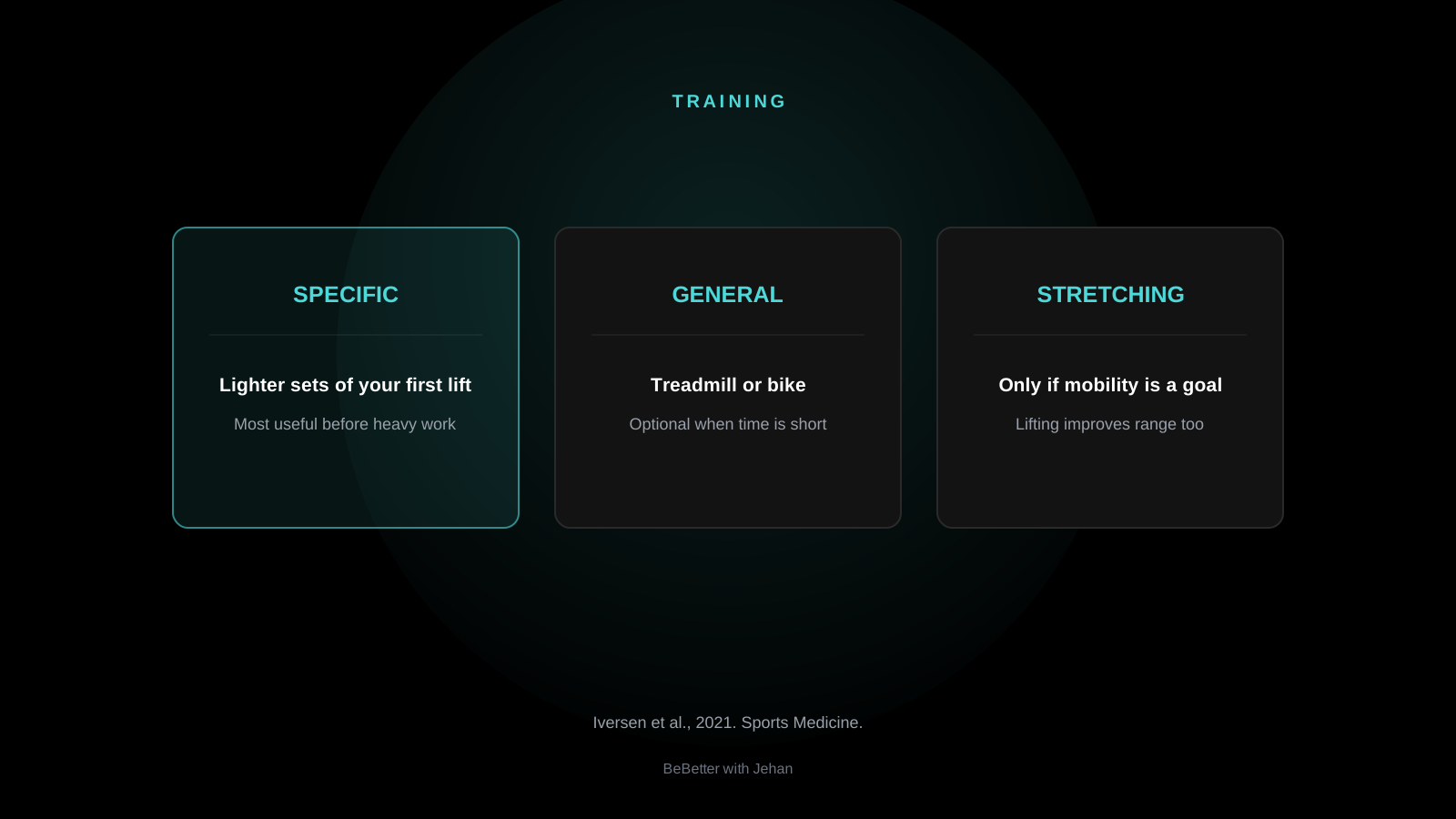
A short, specific warm-up is worthwhile, such as lighter sets of your first exercise, particularly before heavy loads. A review of time-efficient training suggests a general warm-up is optional when time is short, and stretching is only worth prioritising if improving mobility is a goal, since resistance training itself improves range of motion.
Spend your warm-up time on the movement you are about to do.
- Do one or two lighter sets of your first exercise.
- Add more warm-up sets before very heavy work.
- A general warm-up, such as a bike or treadmill, is optional.
- Stretch if mobility is a goal; lifting improves range of motion too.
- Use the time you save for working sets.
What the research says
Iversen and colleagues reviewed how to make strength training more time-efficient, including whether warm-ups and stretching are needed. They recommend restricting the warm-up to exercise-specific warm-ups, note that a specific warm-up can be useful when training with heavy loads above about 80 percent of your maximum, and suggest prioritising stretching only when increasing mobility is an important goal, because resistance training itself promotes improvements in range of motion (Iversen et al., 2021).
A specific warm-up means performing the exercise you are about to train with lighter loads first, rather than doing unrelated general activity.
How to warm up efficiently
| Situation | Warm-up |
|---|---|
| First exercise for a muscle group | One or two lighter sets of that exercise |
| Heavy loads, above about 80 percent of your maximum | A few progressively heavier warm-up sets |
| Later exercises for the same muscles | Usually no separate warm-up needed |
| Cold environment or stiff joints | Optional few minutes of general activity |
This approach fits the structure in can a 30-minute workout build muscle, where every minute matters.
When stretching is worth it
A paper in Frontiers in Physiology argued that the useful question is not whether you can stretch, but whether you have to, and concluded that for most people, stretching is optional rather than mandatory, since other activities, including resistance training, also improve range of motion (Frontiers in Physiology, 2021). Stretch if you enjoy it or have a mobility goal. Do not feel obliged to.
Coach's perspective
Clients short on time often skip the session entirely because they think they need 20 minutes to warm up first. They do not.
Two lighter sets of the first lift, then straight into work. That is the warm-up I programme for most busy clients.
- Exercise-specific warm-up sets matter most.
- More warm-up sets help before very heavy work.
- A general warm-up is optional when time is short.
- Stretching is optional unless mobility is a goal.
- Use saved time for working sets.
Myth versus fact
| Common claim | What the evidence says |
|---|---|
| “You must stretch before lifting.” | Resistance training itself improves range of motion; stretching is optional for most people. |
| “A long cardio warm-up is essential.” | A review suggests a general warm-up is not a priority when time is short. |
| “Warm-ups are a waste of time.” | Specific warm-up sets are useful, particularly before heavy loads. |
The mistakes I see most
1. Skipping the session because there is no time to warm up
A short specific warm-up is enough.
2. Long static stretches before heavy lifting
Not necessary for most people.
3. Jumping straight to heavy loads
Build up with lighter sets first.
4. Warming up every exercise separately
Later exercises for the same muscles rarely need it.
Your practical checklist
- Do one or two lighter sets of your first exercise.
- Add more warm-up sets before very heavy loads.
- Skip a general warm-up when short of time, unless you feel stiff.
- Stretch only if mobility is a goal or you enjoy it.
- Move straight into your working sets.
Research summary
Iversen and colleagues (2021) is a narrative review aimed at the general public with limited time, not athletes. Its recommendations are practical judgements based on the research it reviews.
The Frontiers in Physiology (2021) paper is an opinion and review piece, useful for framing but not new trial evidence.
Limitation: people with injuries, joint conditions or specific mobility needs may benefit from more warm-up or stretching, ideally guided by a physiotherapist.
Warm-ups built into every session.
Your Training Plan includes a warm-up and cool-down for every training day, kept short and specific, with a demonstration video on every movement. Send me a message and I will walk you through the next steps.
Start my BlueprintOpens WhatsApp with a short message ready to send. Prefer to share your details directly? Complete the client intake form.
The Fitness Blueprint is ₹14,999 at present, reduced from a recommended price of ₹24,999. Flexible payment over 3 or 6 months can be arranged. See what is included.
Curious exactly what is included and what it costs? See the full pricing breakdown. Still deciding, or have a specific question first? Get in touch and I will answer honestly.
Frequently asked questions
Do you need to warm up before lifting?
A specific warm-up, such as lighter sets of your first exercise, is worthwhile, particularly before heavy loads. A long general warm-up is optional when time is short.
Should I stretch before lifting weights?
Not necessarily. Resistance training itself improves range of motion, so stretching is mainly worth prioritising if improving mobility is a goal.
How many warm-up sets should I do?
One or two lighter sets of your first exercise for each muscle group is usually enough, with more before very heavy work.
Do warm-ups prevent injury?
Warm-ups are sensible, but the evidence that stretching specifically prevents injury in lifting is not strong.
References
- Iversen VM, Norum M, Schoenfeld BJ, Fimland MS. No Time to Lift? Designing Time-Efficient Training Programs for Strength and Hypertrophy: A Narrative Review. Sports Medicine. 2021;51(10):2079-2095. PubMed
- Time to Move From Mandatory Stretching? We Need to Differentiate “Can I?” From “Do I Have To?”. Frontiers in Physiology. 2021;12:714166. Journal
A note on medical advice. This article is educational and reflects the research as I read it. It is not medical or dietetic advice and it cannot account for your individual circumstances. If you are managing a medical condition, are pregnant, are taking medication affected by diet or activity, or are recovering from injury, please speak to your doctor or a registered dietitian first. If anything here conflicts with advice from your own clinician, follow theirs.
Questions about applying any of this? Message me directly or find me on Instagram. Back to the Knowledge Hub or the homepage. You can also read more about how I coach, see what the Fitness Blueprint costs, or get in touch.