How much protein can your body use in one meal?
The idea that your body can only use about 30 g of protein at a time is one of the most repeated rules in fitness. The research behind it is narrower than the rule suggests.
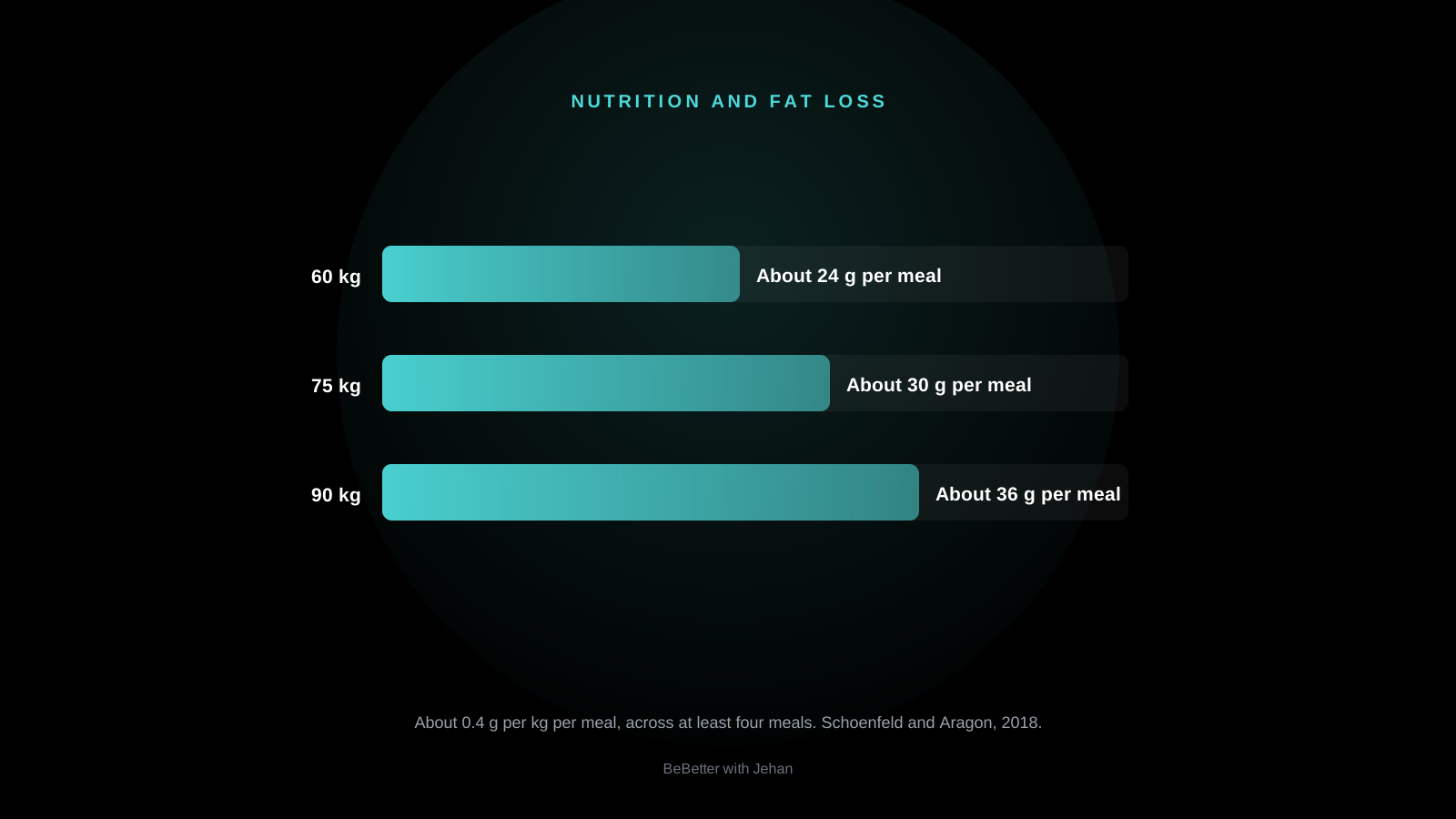
There is no fixed 30 g limit. A review recommends about 0.4 g of protein per kg of bodyweight per meal, across at least four meals, to reach at least 1.6 g per kg a day. A 2023 study found that 100 g of protein after training produced a larger and longer muscle-building response than 25 g.
Your daily total matters most. Spreading it across meals is a sensible refinement.
- Get your daily protein total right first.
- Aim for about 0.4 g per kg per meal across four meals.
- A larger protein meal is not wasted.
- Make breakfast count, since it is often the lowest-protein meal.
- Do not force extra meals just to hit a per-meal number.
Where the 30 g idea came from
Early studies gave people fast-digesting protein, often whey, and measured muscle protein synthesis over a few hours. Responses appeared to level off at around 20 to 25 g. That finding was then repeated as a general rule that anything above about 30 g is wasted.
The problem is that most real meals digest more slowly, and short measurement windows can miss what happens later.
Muscle protein synthesis is the process of building new muscle protein. It rises after eating protein and after training, and is one of the main ways muscle adapts.
What the research shows
Schoenfeld and Aragon reviewed the evidence and concluded that, to maximise muscle building, people should eat about 0.4 g of protein per kg of bodyweight per meal across at least four meals, reaching a minimum of 1.6 g per kg a day. At the upper daily intake of 2.2 g per kg, that becomes up to about 0.55 g per kg per meal (Schoenfeld and Aragon, 2018). They also noted that short-term responses do not necessarily predict long-term muscle gain.
A 2023 study then tested much larger doses directly. After resistance training, 100 g of protein produced a larger and longer-lasting muscle-building response than 25 g, and the authors found no upper limit in the size or duration of that response (Trommelen et al., 2023).
How to split your protein
| Bodyweight | Per meal | Four meals |
|---|---|---|
| 60 kg | About 24 g | About 96 g |
| 70 kg | About 28 g | About 112 g |
| 80 kg | About 32 g | About 128 g |
| 90 kg | About 36 g | About 144 g |
These totals sit at the lower end of the daily range explained in the main protein guide. Breakfast is usually the weakest meal for protein in India, which is why high-protein Indian breakfasts is often the easiest win.
Coach's perspective
I rarely see clients eating too much protein in one meal. I see the opposite: a small breakfast, a light lunch and most of the day's protein at dinner.
Fixing the distribution usually means fixing breakfast. Once that meal carries 20 to 30 g, the daily total stops being a struggle.
- There is no fixed 30 g limit on protein per meal.
- About 0.4 g per kg per meal across four meals is a well-supported target.
- A 2023 study found 100 g after training produced a larger, longer response than 25 g.
- Daily total comes first; distribution is a refinement.
- Breakfast is often the meal to improve.
Myth versus fact
| Common claim | What the evidence says |
|---|---|
| “You can only absorb 30 g of protein at once.” | Your body absorbs the protein you eat. The limit came from short studies of fast-digesting protein. |
| “Extra protein in one meal is wasted.” | A 2023 study found a larger and longer response with 100 g than with 25 g. |
| “You must eat protein every three hours.” | Around four protein-containing meals a day is a practical target. Total intake matters most. |
The mistakes I see most
1. Loading all protein into dinner
Spreading it across meals is easier and supports muscle building.
2. Ignoring the daily total
Per-meal targets only help once the total is right.
3. Adding meals you do not want
Four meals is a guideline, not a rule. Fit it to your day.
4. A tea-and-biscuit breakfast
This leaves a large gap that is hard to make up later.
Your practical checklist
- Calculate your daily protein target.
- Divide it across three or four meals.
- Check which meal is lowest in protein.
- Raise that meal first, usually breakfast.
- Keep the daily total consistent across the week.
Research summary
Schoenfeld and Aragon (2018) is a review, which interprets the existing literature rather than reporting a new trial. Trommelen and colleagues (2023) is a controlled study measuring the response to different protein doses after resistance training in young men, using milk protein.
Limitations: responses vary with age, protein source and training status, and short-term measurements do not always predict long-term muscle gain.
Protein targets for every meal, worked out for you.
Your Nutrition Plan sets your daily protein from your own body and spreads it across meals you actually eat, with quantities. Send me a message and I will walk you through the next steps.
Start my BlueprintOpens WhatsApp with a short message ready to send. Prefer to share your details directly? Complete the client intake form.
The Fitness Blueprint is ₹14,999 at present, reduced from a recommended price of ₹24,999. Flexible payment over 3 or 6 months can be arranged. See what is included.
Curious exactly what is included and what it costs? See the full pricing breakdown. Still deciding, or have a specific question first? Get in touch and I will answer honestly.
Frequently asked questions
Can your body only absorb 30 g of protein at once?
No. Your body absorbs the protein you eat. The 30 g idea comes from short studies of fast-digesting protein and was then applied far more broadly than the evidence supports.
How much protein should I eat per meal?
A review suggests about 0.4 g per kg of bodyweight per meal, across at least four meals, to reach at least 1.6 g per kg a day.
Is a large protein meal wasted?
A 2023 study found that 100 g of protein after training produced a larger and longer muscle-building response than 25 g, so larger meals are not simply wasted.
Does total daily protein matter more than per-meal protein?
Yes. Total daily intake is the priority. Spreading it across meals is a useful refinement once the total is right.
References
- Schoenfeld BJ, Aragon AA. How much protein can the body use in a single meal for muscle-building? Implications for daily protein distribution. Journal of the International Society of Sports Nutrition. 2018;15:10. Journal
- Trommelen J, van Lieshout GAA, Nyakayiru J, et al. The anabolic response to protein ingestion during recovery from exercise has no upper limit in magnitude and duration in vivo in humans. Cell Reports Medicine. 2023;4(12):101324. PubMed
A note on medical advice. This article is educational and reflects the research as I read it. It is not medical or dietetic advice and it cannot account for your individual circumstances. If you are managing a medical condition, are pregnant, are taking medication affected by diet or activity, or are recovering from injury, please speak to your doctor or a registered dietitian first. If anything here conflicts with advice from your own clinician, follow theirs.
Questions about applying any of this? Message me directly or find me on Instagram. Back to the Knowledge Hub or the homepage. You can also read more about how I coach, see what the Fitness Blueprint costs, or get in touch.